

Wall Street will tell you S&P 500 profits grew 50.4% last quarter.
That number is real. It’s also not what it looks like.
Two companies are doing most of the lifting — Alphabet Inc. (GOOGL) and Amazon.com Inc. (AMZN). Both booked massive paper gains on their investments.
Those gains count. But they aren’t the business. FactSet says the index beat its earnings estimates by 29.2% last quarter. Strip out those two names, and the beat drops to 10.9%.
So skip the profit line.
Look at the top line instead…
Revenue for the S&P 500 grew 15.0% last quarter.
That’s the fastest pace since the fourth quarter of 2021. 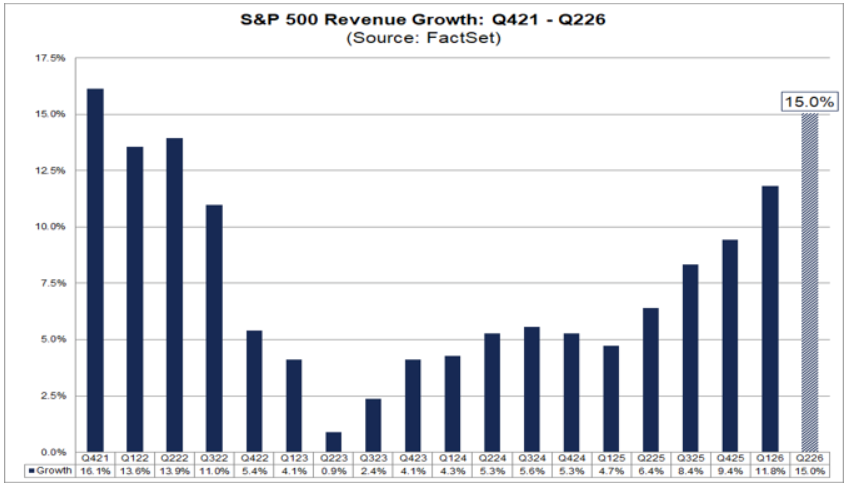
Revenue is the number I trust. A company can dress up its profits. It can buy back stock, take a one-time charge, or book a gain on something it owns. It can’t fake a sale.
Now look at where we came from.
In the spring of 2023, revenue growth for the whole index was 0.9%. Not a typo. Corporate America had stopped growing. From that low, the top line has climbed in 10 of the last 12 quarters. In the last five quarters alone, growth more than tripled — from 4.7% to 15.0%.
That’s a boom. And it’s a broad one. Three out of four companies beat their revenue estimate.
Here’s the part almost nobody says out loud.
When the whole market grows this fast, beating an estimate stops being special. Everybody beats. Last quarter, 86% of the index topped its EPS number. If nearly nine in 10 companies clear the bar, clearing the bar tells you nothing.
So the question next week isn’t who beats. Almost all of them will.
It’s which ones are worth owning.
That’s what Adam’s Green Zone Power Ratings system was built to answer. It scores every stock from 0 to 100 on six factors — momentum, size, volatility, value, quality and growth. It doesn’t care what a company earned last Tuesday. It cares whether the stock has the traits that beat the market over time.
And this week, the system disagrees with the calendar in a big way.
“Bullish” Earnings to Watch
These stocks are expected to beat their earnings per share (EPS) from the previous quarter. And if those expectations are met or exceeded, they could potentially trade higher.
For this screen, stocks must meet four criteria:
- 10 or more analysts cover the stock.
- The average analyst recommendation is a “Buy.”
- It BEAT analysts’ EPS estimates for the previous quarter.
- The average analyst estimate for the current quarter’s EPS is greater than the previous one.
Here are 10 companies that made this week’s list:
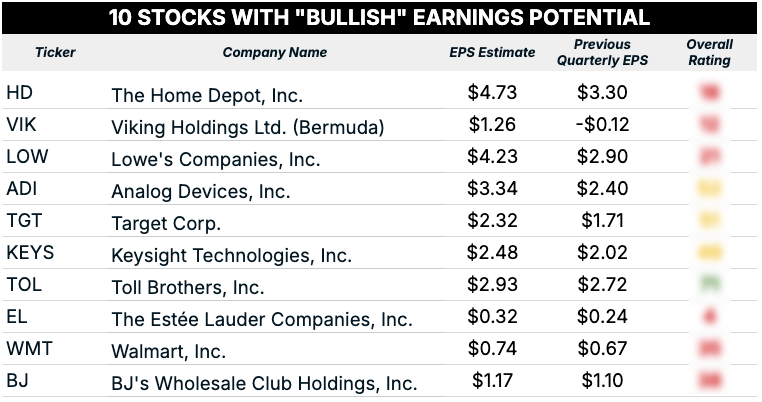
Ten stories Wall Street will call a turnaround.
My system rates exactly one of them bullish.
Six rate bearish. Three sit in neutral. That gap is the whole point of a rating system. A rising estimate is a forecast. A rating is a scorecard.
Analog Devices (ADI) reports on Wednesday morning, and it’s one of the neutral names. That may not last.
Last quarter was a monster. Revenue hit $3.62 billion, up 37% from a year ago. Adjusted earnings jumped 67%. The industrial business grew 56%. The communications business — the piece tied to AI data centers — grew 79%. Management called out record bookings across all three of its business markets.
Then it guided for $3.30 in adjusted earnings this quarter. Wall Street sits at $3.33.
I think that bar is too low. ADI has beaten its number in each of the last two quarters by 6% and 7%, respectively. Bookings are at record levels. And chip companies with full order books tend to guide soft and deliver hot.
What would a beat mean for the rating? It strengthens the two factors that matter most here — growth and momentum. But there’s a catch. ADI is already up more than 40% this year. Every dollar the stock climbs makes its value score worse. So a beat can push this toward bullish, but only if the stock doesn’t run so hot that price undoes the progress.
That’s the system working. It won’t let a great story bully it into a great rating.
Toll Brothers (TOL) is the one bullish name on the list. It reports on Tuesday after the close.
I like this setup better, and it’s not close.
Last quarter, Toll delivered 2,491 homes at an average price of $1,008,600 and earned $2.72 a share.
Orders rose 7%. Management raised full-year guidance. And here’s the detail most people miss: the backlog carries an average price of $1,171,800. That’s well above what Toll delivered last quarter. The pricier homes are already sold. They just haven’t closed yet.
Meanwhile, the stock trades near 12 times earnings and 1.7 times book value. It earns a 15.7% return on equity and buys back stock at roughly a 5% yield.
Cheap, profitable, shrinking share count, higher prices already locked in — that’s exactly what the six factors are built to find. A beat and another guidance raise would lift growth and quality without touching what makes it cheap. This is the rare name where the earnings math and the rating agree.
Now flip it over.
“Bearish” Earnings to Watch
For our “bearish” earnings screen, we’re only looking for two things:
- 10 or more analysts must cover the stock.
- The average analyst estimate for the current quarter’s EPS is less than the previous quarter’s.
We want companies that are covered by a sufficiently large group of Wall Street analysts who collectively expect the company to report a QOQ decline in earnings.
Here are five companies that passed this screen:
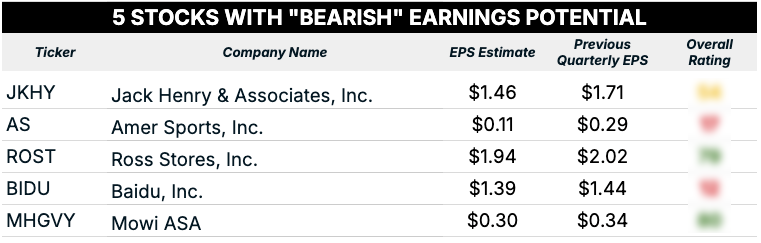
Five companies report next week, with estimates below last quarter’s earnings. Two of those are rated bullish in the system, and one is rated neutral. I’ll come back to that.
That leaves two. And those two I’d avoid.
Baidu Inc. (BIDU) reports Tuesday morning, and the math here is brutal.
Last quarter, Baidu’s advertising revenue fell 22% from a year ago and 17% from the quarter before. Its legacy business dropped 29%. Meanwhile, its AI cloud infrastructure business grew 79%, and GPU cloud grew 184%.
Sounds like a fair trade. It isn’t.
The shrinking business is the profitable one. The growing business eats cash — Baidu spent RMB 5.9 billion on capital projects in a single quarter. Adjusted profits fell 17%. Earnings per share fell 35%. Wall Street expects roughly another 20% drop this quarter.
That’s a company paying full price today for revenue it might collect in 2029. Maybe it works. But you don’t have to fund the experiment. The system rates Baidu as bearish because momentum, growth and quality all point in the wrong direction. A low price doesn’t fix any of that.
Amer Sports Inc. (AS) reports on Tuesday, and this one has a specific trap.
The business is genuinely good. Revenue grew 32% last quarter. Arc’teryx grew 33%, Salomon grew 42%, and Greater China grew 44.5%. Gross margin hit 60%. Management raised guidance.
So why does the system rate it bearish?
Because the system rates the stock, not the company.
Amer guided for adjusted earnings of $0.08 to $0.10 this quarter. Wall Street is modeling $0.11 — above the top of the company’s own range. On a number that small, a $0.02 shortfall is a 20% miss. That’s a setup where a fine quarter can still print as a disappointment.
Add a rich valuation and heavy exposure to one country, and you get a bearish rating on a business doing everything right. That’s not a contradiction. It’s the difference between admiring a company and owning its stock.
Use next week as a filter instead.
If Toll beats and raises, the rating and the earnings finally agree — that’s the setup I want.
If Analog Devices beats, watch what the stock does. A gap higher makes it more expensive, not more attractive.
And if Baidu or Amer Sports sells off, resist the urge to call it a bargain. A bearish-rated stock getting cheaper is usually just a bearish-rated stock getting cheaper.
One last thing. Two of the five names with falling earnings estimates next week rate bullish in the system. That’s not a glitch. It’s the most useful lesson on the whole calendar.
Have a great weekend.
Until next time…

Matt Clark, CMSA®
Chief Research Analyst, What My System Says Today