

It’s easy for us as investors to get distracted by “shiny objects” — those headline-grabbing stories of explosive revenue growth, massive market caps or the latest AI-driven hype cycle.
We often find ourselves caught up in the sheer scale of a company, but at the end of the day, a business is essentially a machine designed to produce a profit.
That’s why net income remains the ultimate truth-teller in financial analysis.
It tells us exactly what is left for shareholders after the taxman, landlords, suppliers and utility companies have each taken their share.
While revenue shows us the size of the operation, net income shows us its quality.
However, if you really want to see how “lean and mean” a company is, you have to look past the total profit and examine its operational leverage through the lens of net income per employee.
This metric is the ultimate litmus test for organizational efficiency. It shows how much actual profit each person on the payroll generates for the firm.
High revenue is a great starting point, but if it takes an army of 100,000 people to squeeze out a modest profit, that machine might be clunky and prone to friction.
A high net income per employee suggests a business model that is highly scalable, often requiring less capital expenditure and fewer layers of management to grow.
New Screen: Net Income Per Employee
To get to the heart of net income per employee, I created a new screener that calculates it.
This screener can analyze any stock universe and calculate a company’s net revenue per employee.
For this exercise, I started simple… with the S&P 500 Index. I included the number of employees, total net income, net income per employee and each company’s Green Zone Power Rating.
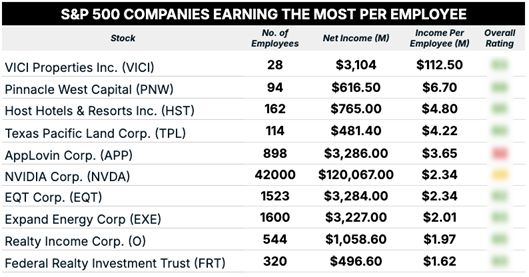
When you screen for the heavy hitters in efficiency, you see a fascinating mix of capital-light businesses and tech giants that are absolutely crushing the game by doing more with less.
The other trend worth noting is that all but two of the top 10 rate “Bullish” or better on Adam’s Green Zone Power Ratings system.
Leading the pack by a staggering margin is VICI Properties, Inc. (VICI).
According to the data in this new screen, VICI generated a trailing 12-month net income of approximately $3.10 billion.
What makes this figure truly mind-blowing is that it achieved this with a reported staff of only 28 employees.
This results in a net income per employee of over $112 million. While VICI operates in the real estate sector — owning massive, iconic properties like Caesars Palace — this level of efficiency highlights a unique business model.
The company is essentially a massive landlord for high-trophy assets, meaning it doesn’t need a massive payroll to collect rent on some of the world’s most valuable real estate. It is the definition of a capital-light, high-margin enterprise.
We see a similar, though less extreme, story with Texas Pacific Land Corp. (TPL).
The new screen shows TPL pulling in over $481 million in net income with just 114 employees. That translates to more than $4.22 million in profit per head.
TPL is one of the largest landowners in Texas. And like VICI, its business revolves around managing land and collecting royalties rather than intensive daily labor.
These companies demonstrate that you don’t need a skyscraper full of people to generate half a billion dollars in profit; you just need the right assets and a disciplined structure.
Let’s Not Forget About Tech
Moving into the tech sector, AppLovin Corp. (APP) serves as a masterclass in software scalability.
The data reveals they generated roughly $3.28 billion in net income with 898 employees. This brings its efficiency to about $3.65 million per employee.
Software is inherently scalable; once the core code for an advertising or gaming platform is written and deployed, you don’t necessarily need a new hire for every new dollar of revenue.
AppLovin’s ability to maintain such high profit-per-head figures while operating at a multi-billion dollar scale shows just how much leverage a well-oiled technology platform can provide to investors.
Perhaps the most impressive outlier in the screen data is NVIDIA Corp. (NVDA).
We all know NVIDIA is the heavyweight champion of the current market, but seeing its efficiency numbers still shocks the system.
Despite having a massive workforce of 42,000 people, the company is still managing to pull in nearly $2.86 million in profit per employee on the payroll.
Usually, when a company reaches that size, the law of diminishing returns kicks in, and efficiency starts to dip as the organization becomes more complex.
However, NVIDIA is currently defying the laws of corporate gravity by maintaining the lean profile of a startup while operating as one of the largest companies on the planet.
The takeaway for us as investors is clear: when you’re looking for your next position, don’t just ask how much the company is making. Ask how hard they have to work to make it.
A company that can generate millions in profit with a small, elite team is often a much more resilient and scalable bet than a bloated giant struggling with massive overhead and administrative friction.
As you review your own holdings, it might be worth running the math on your favorite stocks.
How much leverage does your portfolio actually have? If your companies aren’t moving the needle per employee, they are working harder, not smarter.
Until next time…
Safe trading,

Matt Clark, CMSA®
Chief Research Analyst, Money & Markets