

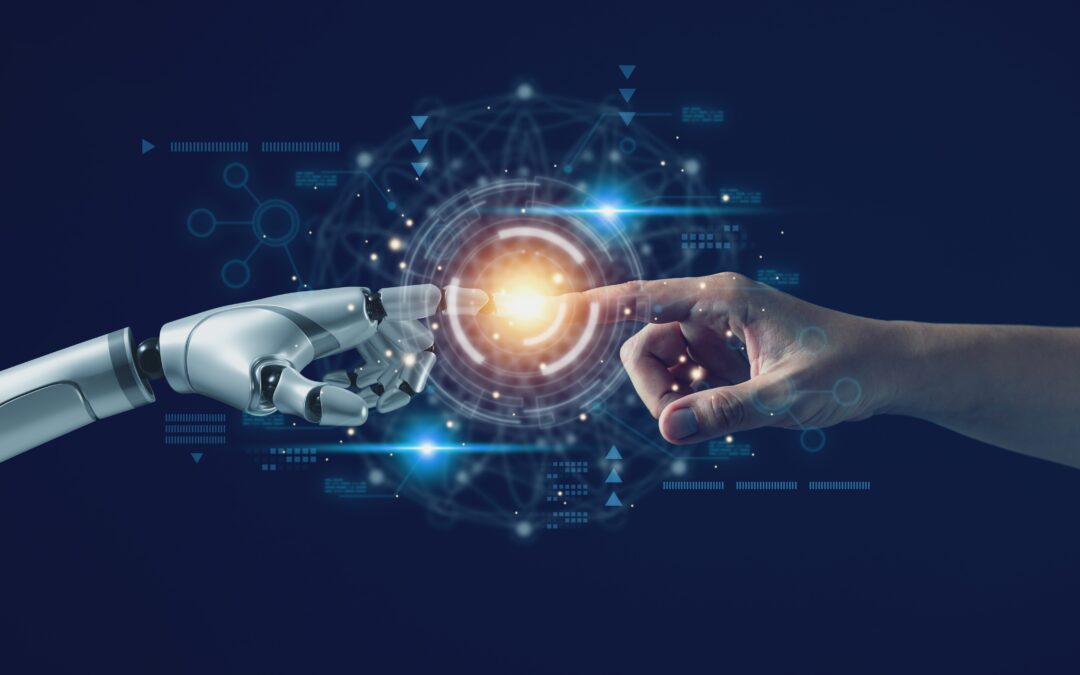
With AI, it seems like the sky’s the limit…
We’ve got Wall Street making massive projections about the future value AI will add to the economy.
We’ve got top tech companies embarking on major new projects — even embracing nuclear power to fuel their lofty ambitions.
And we’ve got a government that’s rapidly adapting to a new reality ruled by AI security companies like Palantir (PLTR).
To put it bluntly; AI is big.
But it’s also important to remember that AI is going to be small too. It’s going to work its way into everything from manufacturing the device you’re reading this update on, to washing your dishes and maybe even making your bed at night.
That’s what we’re going to talk about in this episode of Moneyball Economics.
Click below to start the video:
Video transcript:
This is Moneyball Economics, I’m Andrew Zatlin.
I am frequently being asked where I believe artificial intelligence is going to take us, where the biggest impact is going to be on the economy.
And right now we see it showing up as a big disruptor in the knowledge-based economy and it’s going to continue to do that.
However, I think the most profound impact on the economy and on our ways of life is going to be the merger of robotics and artificial intelligence. I’d like to share with you my thoughts on that…
Now, right off the bat, artificial intelligence to me is a wonderful enabling technology. What we’re doing is we’re harnessing raw computing power and the ability for these computers to kind of mimic human thought and we also have a better interface to these computers. And so what we’re finding is that, well, basically this big moat that the knowledge-based economy thought it had, it doesn’t really have. That just like in the analog world, the world where you had manual labor, you always were trying to reduce that manual labor by using some form of automation.
That was the advent of the industrial era.
No longer picking cotton by hand, Eli Whitney’s cotton gin.
We’ve always tried to take the manual labor out of things because people can’t work 24 hours a day. They get sick, they get injured. All these things that are basically not faced by a machine. If a machine breaks, you fix it, it’s back to working. We’ve seen this kind of action again in the day laborer type of work. In the old days, the gas lamp lighter, he’d go around or she would go around and light the lamps. Electricity comes out, you flip a switch, those jobs are gone.
Again, in the knowledge-based economy, we did not think that those jobs could be eradicated.
You didn’t imagine that a lawyer reviewing a contract could be replaced by AI who could review that contract immediately and propose solutions and do it at a fraction of the cost, but that’s where we are.
I believe artificial intelligence, again, it’s an enabling technology.
It’s not like, “boom! we’re done.” For some sectors, we’re going to continue to see this knocking on the door. It’s not just a job type. We’re going to see actual industries affected.
For example, like I said, the legal industry is going to be affected, financial industry is going to be affected, but you’re also going to see things like, say, Hollywood or music recording or advertising. Let’s use advertising. To make a commercial, you’ve got to hire actors, they get residuals, you’ve got a crew.
You got all these things in the physical space that need to be brought together so that you can film or take a picture of something.
And yet today you can do that within the world of AI. So you don’t need all these people in this higher cost.
This is a very disruptive technology.
But that’s where we are right now in the knowledge-based economy because it’s happened so fast that we’ve realized a lot of these repetitive tasks, it’s just the same thing as in the analog world. We’ve brought the digital disruption to the corporate world, essentially. Where I think the next step though is when we take this artificial intelligence and we marry it with robotics. We haven’t done that yet and it’s here.
And I believe that the form it’s going to take is kind of like the computer. You buy the hardware and then you subscribe to certain software functionality.
Let me use an example…
So I have a cousin who used to be a pretty prominent person within the world of manufacturing, contract manufacturing. So he was involved in things like making the Apple iPhone in China. And what was remarkable, he said, is everything that is done today in China in the form of assembling and basically manufacturing the iPhones.
Well, you could do that with robots right now. There are some challenges, but the reason we don’t, the starting point is just cheaper not to. Robots have a certain cost and there’s a certain limitation.
For example, you’ve got a robot hand, grabs a screw and it’s going to put it in the iPod or the iPhone. Well, the problem is if it’s holding something, how does it know it’s a screw? It could be at a certain angle. So you’ve got to train it. This is what a screw looks like, 360 degrees. And then when you hold it this way, that’s not the right way to hold it. You got to hold it this way.
So there’s some intelligence that goes on here to teach that robot what it needs to do. It’s very task specific and task limited. Fast forward though, and what we’re finding is that we can use artificial intelligence at a certain level cheaply to train appliances.
Maybe you’ve seen a Roomba.
That’s that device that goes throughout the house, it vacuums, it bumps into a wall, it moves. Same thing. There’s some pool cleaners out there. You turn them on and they just go back and forth around the pool and figures out what it needs to do. I was in Costco recently, that same technology is now available in lawnmowers. All battery operated lawn mowing type of functionality. Super cheap.
Hey, I’m sorry. A lot of the high school and college kids who come home and on the weekends pick up money to cut yards. Not going to need that anymore. A couple hundred bucks, it can be automated.
And this is where the artificial intelligence comes into play…
Each of these devices can be taught to learn the specific layout of your home, of your pool, of your yard. That’s barely scratching the surface of AI, but it’s there.
Where we’re seeing right now is most of the robotic capability is still in the factory floor, still in an industrial place. I believe it’s going to rapidly migrate into these commercial products in a whole new way.
Let me explain. Right now, if you’re on the factory floor, say at GM, you have, I’ll call them robots, but they’re not like the C3PO type of Star Wars robot, a humanoid shape that can do a lot of tasks.
Robots are very good for repetitive automated tasks like welding, spot welding, or moving this part, and they’re strong so they can lift up chassis and things like that. They now have something called cobots, collaborative robots. This is the next level. This is kind of bringing AI in the sense that you’ve got basically a mechanical arm. And like a human arm, it can move in many different ways. You just have to tell it what to do.
And that’s what a cobot (collaborative robot) is set up to do.
It’s a $50,000 ish price and you can basically have it mimic a human motion and it can learn new human motions. So one day you might need it to screw something in. The next day you might need it to hammer something. Whatever it is, you can train it very quickly. $50,000 device, it’s cheaper than a union worker.
It can perform all the tasks you need 24 hours a day, seven days a week. It rarely breaks down and it can learn more and more tasks as you go along. This is why recently GM announced that in their new electric vehicle factory, they’re putting in 50 cobots and not people. Labor unions are not happy with that. They’re demonstrating because they say this is taking away our jobs.
And the fact is, yes, it is. That’s the next step in the evolution of robotics on the factory floor.
However, I think it’s going to have an impact on households.
In my house, over the course of a month, I spend a lot of hours, as does everybody else in my family, doing repetitive mundane tasks, whether that’s getting laundry done and folding the clothes, cleaning the house, washing, putting dishes away, changing light bulbs, you name it. Over the course of the month, we’re spending hours doing drudge tasks, which over the past hundred years we’ve tried to automate away. For example, laundry you used to do by hand, now it’s a washing machine and a dryer, but it still has to be done.
There’s a sweet spot where I would pay an appliance, a humanoid robotic appliance to do these tasks for me and maybe learn new tasks. Maybe it can be taught to wash and put the dishes away. Maybe it can be taught to vacuum.
Maybe it can be taught a lot of things, make the bed. And in fact, it’s actually pretty simple to do that with AI. Right now, if I want to learn how to do something, I might go onto YouTube and watch a video. Well, the equivalent would be we can take the process of how to make a bed, remove the sheets, put on sheets, remove pillow cases. This is simple instructions that could be taught through an AI type of interface where you record the motion. The robot then is programmed to download and learn and do. The issue is cost.
If a cobot at GM is 50 grand one time fee and some kind of ongoing software maintenance and you want to upgrade to another task, there’s some kind of subscription dollars. I’m not going to pay 50 grand for a robot. I believe Kim Kardashian, those types would, but would I pay $10,000 for something that saves me cumulatively over five years a lot of time and cost?
For example, if you have a household and you have people who come in and clean it and you pay 100, 150 bucks a week, 500 bucks a month, six grand or more up to 10 grand a year to vacuum dust and do a couple of other things, those are some things that could be taught to a robot. And so I see some disruption coming down the pipeline in the form of, again, manual labor tasks that are easily done and yet, well, they do cost the economy in certain ways.
I believe that personal robots are going to be here within the next five years because we already have humanoid robots out there. They’re not perfect, but they’re getting really, really, really close to mimicking the human body’s range of motion and that’s what you need. Add in the AI. Now you’ve got the knowledge. You have a device that can move around and basically as a human can, now you teach it to go through this range of motions to accomplish a task.
The reason that these cobots at GM are 50 grand a piece is volume. Now think of it as what Elon Musk did at Tesla. You make 10,000 cars a year, it’s 100, $120,000. You start making 100,000 cars, that price comes down to a hundred. You start making half a million to a million cars. Hey, that price falls rapidly. Right now you can get an EV car from BYD in China for 20 grand.
Once we start scaling up personal robots, the price is going to come down to 10 grand and it’s going to happen quickly. We see what’s going on with drone technology. It just takes a little bit of incentive and all of a sudden these drones are doing this, that, and the other. Massive technological leaps forward, but it really hinges on AI and that ability to reduce human tasks into some kind of computing language that is understood by a robot.
Frankly, that’s exactly what AI is designed to do.
I don’t know as an investor where I would go to take advantage of this. I don’t know the companies out there that, for example, play a lead role in robotics, but trust me when I say I’m now embarking on finding out. We’re in it to win it, folks.
Zatlin out.

Andrew Zatlin
Editor, Moneyball Economics