

Open the technology fund in your retirement account…
Find the holdings tab…
Now add up the top three lines.
Nvidia Corp. (NVDA). Apple Inc. (AAPL). Microsoft Corp (MSFT).
Thirty-six cents of every dollar.
You did not decide that. Nobody asked you. You bought a technology fund, and a rule inside the fund handed a third of your money to three companies, because the rule buys the biggest companies first.
For seven years, that rule did you a favor. The three biggest were also three of the best. Nobody complains about a rule that pays.
This year, the same rule is costing you 12.5 points…
How Three Names Ate a Sector
It happened slowly enough that nobody objected. Money poured into index funds. Index funds buy the biggest companies first.
The biggest companies got bigger, which pulled in more money, which made them bigger still. The loop fed itself for seven straight years.
So the smartest thing you could do in tech was be lazy. Buy the sector fund. Let the loop work. Ranking the other 70 companies changed nothing.
This year, the loop broke.
Every week, I run a screen to find the top-rated stocks in every sector. The system ranks more than 5,000 stocks, and I would sort for tech.
I would see the same handful of names at the top and move on to a sector where the list shifted a little.
Recently, something has changed in the market, so I opened a file, and here’s what was in it.
Through August 17, an equal slice of every tech stock in the S&P 500 returned 45.0%. The cap-weighted version of the exact same sector returned 32.5%.
That is a 12.5-point gap, in eight months, from the same list of stocks. The only difference is how much of each one you own.
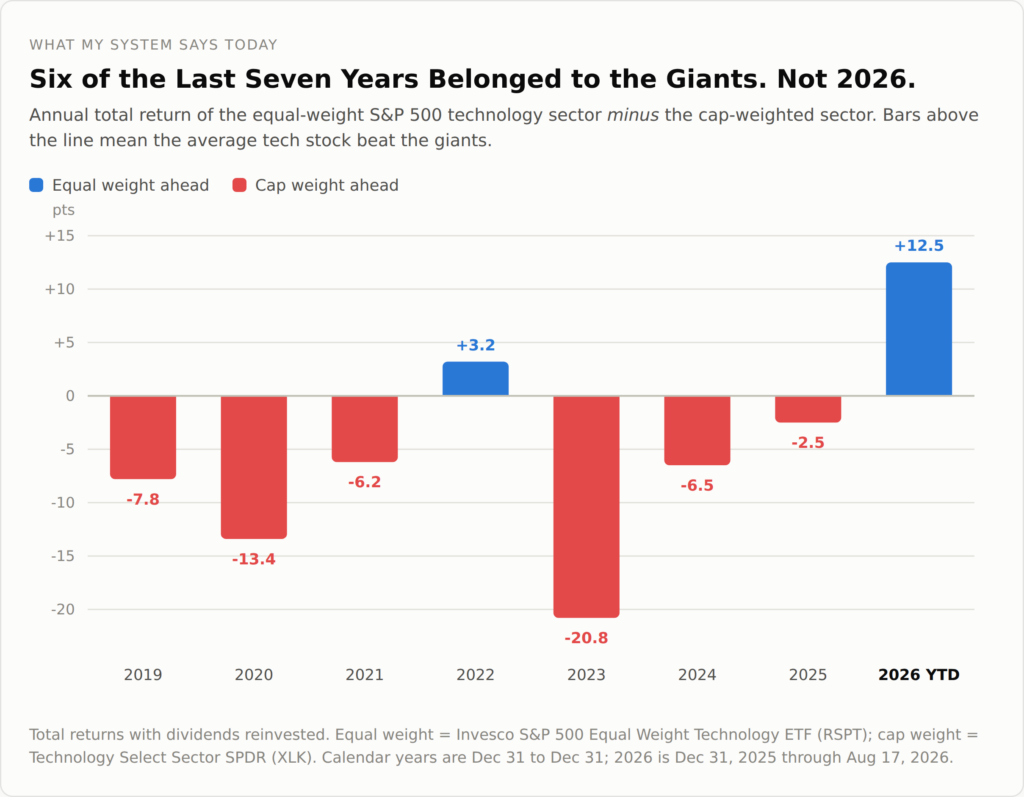
Look at the bars before 2026. In 2019, spreading your money evenly cost you 7.8 points. In 2020, it cost you 13.4. In 2023, it cost you 20.8 points, the worst year in the run. Six of the seven years from 2019 through 2025 punished you for owning the average tech stock instead of the giant one.
Now look at the last bar.
That might lead to the question: Why did it happen?
The mechanic is simple, and it is not about earnings.
In the cap-weighted index, Nvidia accounts for 14.4% of your money, Apple for 11.8%, and Microsoft for 9.4%. In the equal-weighted version, each one is about 1.4%.
Nvidia is up 20.8% this year. Apple is up 12.7%. Neither is a bad stock. Both are simply average-to-slow in a year when the sector ran 45%.
When your three biggest holdings are 36% of the portfolio and all three lag, you lag. That is arithmetic, not opinion.
Meanwhile, the money went somewhere. It went into memory, into test equipment, into the storage and networking names nobody puts on a magazine cover.
Micron’s 52-week low was $113. It closed at $1,012 on August 17. For most of that run, it was a rounding error inside a cap-weighted index. It was a full position inside an equal-weighted one.
The Part Everyone Will Get Wrong
You are about to read a hundred articles saying “equal weight is back.” Be careful. That is not what the data says.
Across the whole S&P 500, equal weight beat cap weight by only 2.3 points this year. That is noise.
The breadth story is not a market story. It is a technology story, and it is happening in the one sector where concentration has become most extreme. The rest of the index never had this problem, so it never got this trade.
That distinction matters because it tells you where to point the work.
What Adam’s System Says
Adam’s Green Zone Power Ratings system scores every stock on six things: Momentum, Size, Volatility, Value, Quality and Growth. Two of those six explain everything above.
- Size rewards smaller enterprise values. For seven years, that factor was a tax. The market paid you to own the largest company in the room, and any system that leaned against size looked broken.
- Momentum rewards stocks already moving. Momentum did fine those seven years, but it kept pointing at the same six tickers, so it told you nothing you did not already know.
Put those together, and you get the honest verdict on 2019 through 2025: a six-factor rating system added almost nothing to technology. When six stocks are the sector, ranking 493 others is a hobby.
That is exactly what changed. Size stopped being a tax. Momentum stopped pointing at the same six names. The ranked list below the giants has finally spread between the top and the bottom, and spread is the only thing a rating system can ever monetize.
A rating system earns its keep when 493 names matter. This year, they matter.
And I can show you that in one strange result.
I ran a second screen this week. It hunts for standouts: any stock rated at least 25 points above its own sector’s median. That is my usual way of finding the one name in a group that does not belong with the rest.
It came back with 621 stocks across eight sectors. Not one technology stock among them.
That looks like the system is failing until you see why.
To clear a bar like that in technology, a stock now needs a rating in the high 90s, because the median technology stock already rates above 70.
Nothing else on the board is close. Financials sit at 58. Industrials at 52. Health care at 32.
Nobody in tech can stand 25 points clear of the middle anymore, because the middle got that good.
That is what breadth looks like from inside a rating system. Not one hero stock. A sector where the ordinary name is strong.
What You Can Do About It
Three specific steps:
- Stop measuring your tech exposure by ticker. Measure it by weight. Add up what Nvidia, Apple and Microsoft are inside every fund you own. If that number is near 36%, you do not own technology. You own three companies with a technology label.
- Move your sector exposure to equal weight. The Invesco S&P 500 Equal Weight Technology ETF (RSPT) holds the same 73 stocks as the cap-weighted fund. It just refuses to let three of them run the portfolio. Same sector, same companies, different arithmetic.
- Work the list below the top three. That is where the ratings finally pay. Dig into the ratings and find those stocks with strong, across-the-board ratings that aren’t the biggest three of the bunch.
One warning, because I promised you these when they come.
This trade reverses on the day the giants report a blowout quarter.
Nvidia reports on August 26. If mega-cap earnings reaccelerate and the rest of the sector does not, that last blue bar shrinks fast.
I am not telling you to sell the giants.
I am telling you to stop letting them account for 36% of your technology spending.
Until next time…
Safe trading,

Matt Clark, CMSA®
Chief Research Analyst, What My System Says Today