

Every quarter, the same question lands in my inbox: Is this finally the one where the “Magnificent Seven” hand the baton to everyone else?
One chart keeps the debate alive…
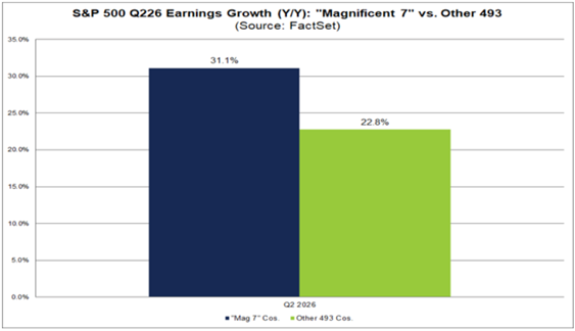
Look at those two bars.
The Mag 7 are still setting the pace — with earnings expected to grow 31.1% year over year (YOY) in second-quarter 2026, according to FactSet.
That’s no surprise. They’ve been the engine driving this market for years.
But now, look at the rest of the market.
The other 493 companies in the S&P 500 Index are expected to grow earnings by 22.8%. That is not a rounding error. And it’s a far cry from the lopsided earnings seasons we’ve grown accustomed to, when the Mag 7 generated nearly all of the market’s growth while everyone else merely kept pace.
That’s what makes this chart so important. A market powered by only a handful of companies is inherently fragile.
If one or two mega-cap names stumble, the entire index feels it. But when hundreds of companies are reporting earnings growth north of 20%, leadership broadens, making the rally far more resilient.
We’re not there yet.
The Mag 7 are still leading. But the gap is narrowing, and that’s exactly what healthier bull markets tend to look like.
Which brings us to next week’s earnings slate.
My system flagged two lists that caught my eye: companies with setups that suggest they could outperform expectations, and others that appear vulnerable heading into their reports.
Neither is guaranteed — earnings season has a way of humbling everyone — but these are the setups that stand out the most.
“Bullish” Earnings to Watch
These stocks are expected to beat their earnings per share (EPS) from the previous quarter. And if those expectations are met or exceeded, they could potentially trade higher.
For this screen, stocks must meet four criteria:
- 10 or more analysts cover the stock.
- The average analyst recommendation is a “Buy.”
- It BEAT analysts’ EPS estimates for the previous quarter.
- The average analyst estimate for the current quarter’s EPS is greater than the previous one.
Here are 10 companies that made this week’s list:
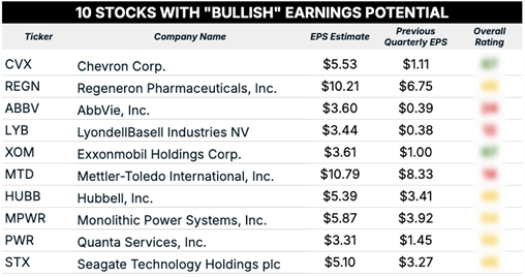
Energy sits at the top of this list, and the two names I keep coming back to are Chevron Corp. (CVX) and Exxonmobil Holdings (XOM).
Both are expected to post strong quarter-over-quarter (QOQ) improvements, and — just as importantly — my system rates both stocks bullish.
When the fundamentals and the ratings point in the same direction, that’s the kind of alignment I like to see.
The thesis isn’t complicated.
Crude prices have remained supportive, refining margins have improved and both companies are lapping relatively soft results from the previous quarter.
That’s the cleanest kind of setup — a favorable backdrop meeting a low bar.
The more interesting story on this list is where the signals diverge.
A handful of names — AbbVie Inc. (ABBV), LyondellBasell Industries (LYB) and Mettler-Toledo International (MTD) — screen with genuine beat potential. Each is expected to rebound from a depressed prior quarter, but my system rates all three bearish.
Why? Because a strong quarter isn’t always enough.
As I wrote in last week’s earnings report card, the real challenge during earnings season is separating the companies riding the wave from the ones building businesses that can keep compounding after the tide goes out.
AbbVie may beat expectations, but investors are increasingly focused on its patent cliff and what comes after Humira.
LyondellBasell can benefit from a cyclical recovery in chemicals, but a single good quarter doesn’t erase longer-term industry headwinds.
That’s exactly the kind of disconnect my system is designed to identify.
It’s an important distinction. A company can report excellent earnings and still be an unattractive investment if the market is looking beyond the current quarter.
The middle of the list — Regeneron Pharmaceuticals (REGN), Hubbell Inc. (HUBB), Monolithic Power Systems (MPWR), Quanta Services (PWR), Seagate Technology (STX) — reads neutral.
Solid setups, but nothing my system wants to lean into hard in either direction. Worth a watch, not a table-pound.
Now, let’s look at the potentially “bearish” earnings calls for next week…
“Bearish” Earnings to Watch
For our “bearish” earnings screen, we’re only looking for two things:
- 10 or more analysts must cover the stock.
- The average analyst estimate for the current quarter’s EPS is less than the previous quarter’s.
We want companies that are covered by a sufficiently large group of Wall Street analysts who collectively expect the company to report a QOQ decline in earnings.
Here are 10 companies that passed this screen:
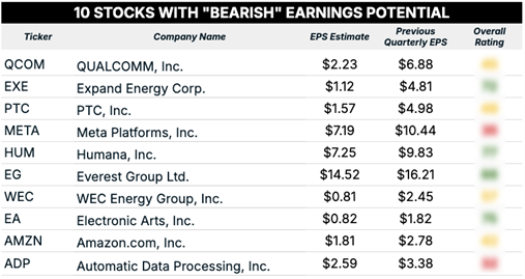
Now we’re seeing the other side of the ledger — companies whose estimates sit well below the prior quarter, where the risk of a soft print runs higher.
Qualcomm Inc. (QCOM) headlines it: the estimate steps down sharply from last quarter, and the setup is the usual smartphone-chip worry — a maturing handset cycle and lumpy licensing revenue that can swing a single quarter.
My system rates the stock neutral, so this is more of a caution flag than a red alert.
Meta Platforms Inc. (META) is the one where the setup and the rating agree to the downside: estimates come in below last quarter, and my system rates the stock bearish.
The question hanging over Meta is the same one it’s carried all year — the ad engine is strong, but the AI and infrastructure spending is enormous, and when a company pours that much into capex, margins are where the strain shows up first.
Amazon.com Inc. (AMZN) tells a similar story: a lower sequential estimate, a neutral rating and the market is watching whether cloud growth and retail margins can carry the weight of its own investment cycle.
But here’s the wrinkle that makes this list worth reading closely. Not every “bearish setup” is a stock my system dislikes.
Everest Group (EG), Humana Inc. (HUM) and Electronic Arts (EA) all screen with softer sequential estimates — the earnings-potential math points down — yet my system rates all three bullish.
That’s a real divergence, and it’s often where the interesting opportunities hide: a name the crowd is bracing to be let down by, that my system thinks is stronger than the quarter alone suggests.
With EA, seasonality and release timing can make one quarter look weak in isolation while the franchise underneath keeps compounding.
When the setup screens are ugly, but the rating stays green, I pay attention.
None of these lists is a buy or sell order — they’re a map.
They tell me where the surprises are most likely to land next week, and, just as useful, where Adam’s system’s conviction lines up with the setup and where it disagrees.
The names I like best are those that agree: a bullish setup on a stock my system already likes (Chevron, Exxon), or a bearish setup on a stock it already distrusts (Meta).
The divergences — a great-looking quarter on a stock my system doesn’t trust, or an ugly setup on a stock it does — are where I slow down and do the extra homework.
Until next time…
Safe trading,

Matt Clark, CMSA®
Chief Research Analyst, What My System Says Today