Seven out of 10 companies are beating earnings right now.
But the strange part is the market barely cares.
That’s the big takeaway from my Earnings Week Dashboard this week. Take a look:
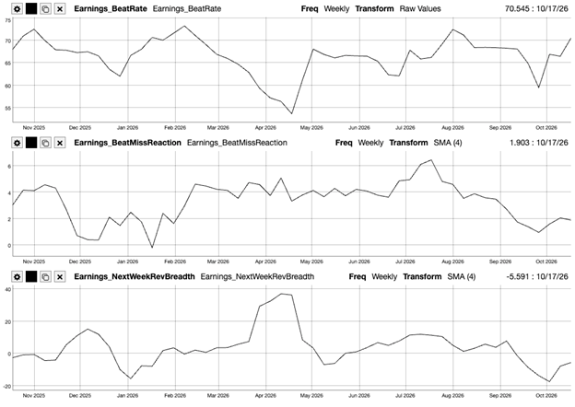
Start with the top chart. The beat rate hit 70.5% for the week ending October 17. That’s a sharp rebound from the dip below 60% at the start of October.
We’re right back near the highs we saw in August.
Good news, right?
Not so fast. Look at the middle chart.
This one tracks how differently stocks trade after a beat versus a miss. In other words, it monitors how much the market pays you for good news. Back in mid-July, that gap topped 6 on a four-week average. Today, it’s 1.9.
That’s roughly a 70% drop in the reward for beating.
Now the bottom chart. It measures whether analysts are raising or cutting estimates for companies that report next week. It’s been negative since mid-September. It bottomed near -17 in early October and has climbed back to -5.6.
That’s an improvement… but analysts are still cutting more than they’re raising.
Put it all together, and here’s my read: Companies are clearing a bar that’s been lowered. And investors aren’t handing out prizes for it.
That means next week, what’s inside the number matters more than whether it beats.
And that’s exactly why I want to walk you through two very different setups you must be aware of.
“Bullish” Earnings to Watch
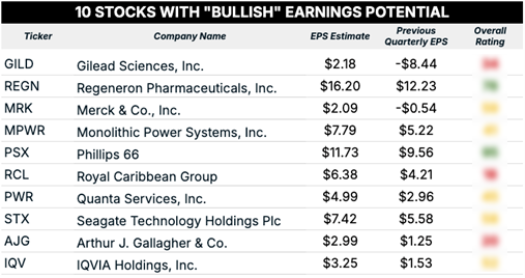
These stocks are expected to beat their earnings per share (EPS) from the previous quarter. And if those expectations are met or exceeded, they could potentially trade higher.
For this screen, stocks must meet four criteria:
- 10 or more analysts cover the stock.
- The average analyst recommendation is a “Buy.”
- It BEAT analysts’ EPS estimates for the previous quarter.
- The average analyst estimate for the current quarter’s EPS is greater than the previous one.
Here are the eight companies that made this week’s list:
Last week, I told you Valero Energy Corp. (VLO) was set up for a monster quarter. Wall Street was looking for $20.90 a share.
Yesterday, the company posted $23.90.
Its refineries ran at near-record utilization. Net income hit $6.8 billion, up from $1.1 billion a year ago.
That’s the backdrop for Phillips 66 (PSX), which reports Wednesday, October 28, before the opening bell.
Analysts expect $11.73 per share, up from $9.56 last quarter.
After seeing Valero’s numbers, that seems very doable.
Here’s why.
In the second quarter, Phillips 66 ran its refineries at 96% utilization and booked a realized refining margin of $24.08 a barrel. Management planned to maintain mid-90% capacity through the third quarter.
And diesel inventories are expected to stay tight through the end of the year.
On top of that, the company enlarged its share buyback program. Fewer shares means every dollar of profit goes further on a per-share basis.
Same market. Same fuel margins. Valero just showed us what this quarter looks like for a refiner running flat out.
The risk? This is a margin story. If global supply disruptions ease, refining spreads can unwind fast. But for the quarter that ended September 30, the setup is about as clean as it gets.
“Bearish” Earnings to Watch
For our “bearish” earnings screen, we’re only looking for two things:
- 10 or more analysts must cover the stock.
- The average analyst estimate for the current quarter’s EPS is less than the previous quarter’s.
We want companies that are covered by a sufficiently large group of Wall Street analysts who collectively expect the company to report a quarter-over-quarter (QOQ) decline in earnings.
Here are 10 companies that passed this screen:
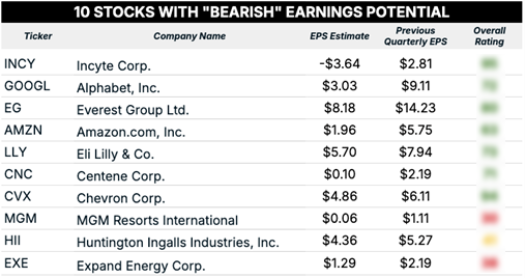
This one’s going to surprise some folks.
Alphabet Inc. (GOOGL) earned $9.11 per share last quarter. Next week, analysts expect $3.03.
That’s a two-thirds drop in earnings.
Did the company’s business fall apart? Not even close. Second-quarter revenue jumped 24% to $119.8 billion. Google Cloud revenue soared 82%. Operating income climbed 30%.
So where did $9.11 come from?
Other income.
Alphabet booked a $98 billion net gain last quarter, mostly from unrealized gains on its stakes in other companies. That’s paper profit. It came from marking up investments… not from selling more ads or more cloud computing.
Take that out, and Alphabet’s operating business looks a lot closer to the $3 a share Wall Street is expecting.
So why am I bearish heading into the report? Two reasons.
- First, the headline. A 67% plunge in earnings per share is the number that hits the screens. And remember that middle chart: This market isn’t rewarding good news right now. It’s certainly not going to throw a parade for a big drop.
- Second, paper gains cut both ways. Unrealized gains move with the value of those stakes. If those values slip, that “other income” line can swing the other direction.
Alphabet hasn’t confirmed its report date yet, but calendars point to Wednesday, October 28, after the close.
Is it a great company? Absolutely. But its earnings are coming back to Earth, and I wouldn’t want to be on the wrong side of that headline.
The Bottom Line
A 70% beat rate. A shrinking reward for beating. Analysts still trimming estimates.
This is a market where you have to know what’s inside the number.
Phillips 66 has real operating momentum behind its estimate. Alphabet’s last quarter was inflated by paper gains that aren’t in this quarter’s forecast.
Check out both tables above for the full list of stocks with bullish and bearish earnings setups heading into next week.
Until next time…
Safe trading,

Matt Clark, CMSA®
Chief Research Analyst, What My System Says Today
P.S. The November 3 midterms could create major opportunities — or unexpected turbulence — for investors.
My colleague Grey Swan founder Addison Wiggin has put together a blueprint outlining five moves to consider before Election Day, including what to avoid and how to prepare for a potential market shock.