
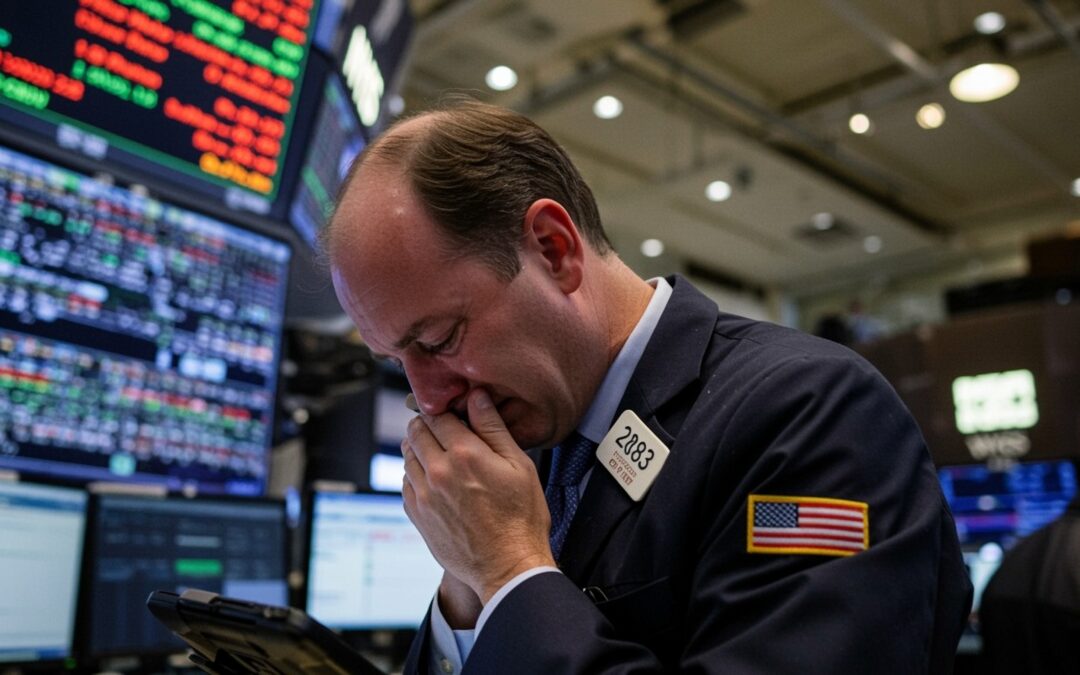
It’s rough out there, folks.
Following President Trump’s nomination of Kevin Warsh to be the next Fed Chair, we’re seeing a widespread pullback across, stocks, crypto, gold and silver.
And I want to emphasize — this is not just a “knee-jerk” reaction or a one-off pullback…
What we’re seeing right now is the beginning of a marketwide transformation, where investors from all over the world are starting to adapt to the “New Normal” and position their assets to thrive in a radically different economic environment.
Click the video below for full story:
Video transcript:
Welcome to Moneyball Economics, I’m Andrew Zatlin, and I’m looking around seeing a bloodbath out there.
Gold: down. Silver: down.
All the cryptos like Bitcoin, down, down, down.
Even the stock market, down.
The trigger for today’s selloff, president Trump nominated as the next Federal Reserve chairman, a guy named Warsh, and he’s a little bit hawkish, so the markets are trying to digest what the implications are for interest rate cuts going forward.
This is not a standalone event.
This is not profit taking in the silver, gold markets, crypto markets, whatever.
Today’s actually fitting a much bigger pattern and the implications going forward are advising a little bit of caution in the markets as the markets adjust to the new economic realities. See, everything that’s happening today started back in October. Let’s talk about what I mean…
If you look at Bitcoin, Bitcoin’s supposed to be the new gold. Turns out gold is the new gold.
Gold rocketed up starting in October, November timeframe while Bitcoin went from $120,000 down to $80,000. Now, a lot of people say, oh, gold, we need it for all this AI, CapEx and silver, we need it for computing and stuff. No, that’s absolutely wrong.
What’s going on is risk has entered the world stage risk and uncertainty is driving up silver and gold. There are other things that are adding to that squeeze, but it’s primarily kicking off with what happened in October. The same reason why Bitcoin collapsed back in October.
Until October for years and years and years, you could go to Japan and you could get engaged in what was called the carry trade. Essentially, you could borrow money really cheap in Japan, 1%, and then you could come over to the US or European markets and you could invest it.
1%? That’s noise. I can just easily arbitrage that with US Treasury rates. What you had was hot money and hot money was involved in things like pumping up crypto.
Well, that hot money stopped in November.
The music stopped suddenly, Japanese yields rocketed up to two and a quarter percent from November until January. This rattled global markets. You could no longer get easy money. So anyone out there who’s a fan of crypto recognize, please recognize it is easily manipulated. It is a pump-and-dump scenario.
Once that easy money moved away, you saw crypto collapse and don’t be surprised going forward. What happens next? There’s more downside than upside here because it’s a very, very speculative asset. And the same reason gold went up when that easy money went away is because everyone in the market’s realized we’ve got problems ahead and so gold reentered as the risk asset of preference.
Why though?
The question is why did Japanese yields go up and it’s because their economy is firming up, up. In fact, the global economy is firming up.
We see that in the latest data coming out of Europe and Germany and the US economy is also firming up, and that is another concern for the markets going forward. We just had a meeting this week with the Federal Reserve saying, yeah, we kind of see some firming up and so we’re not going to do a rate cut.
The markets did not like that.
The stock market has been flat since October, again because the easy money coming out of Japan stopped. And so going forward, what’s going to get that market going up? Again, interest rate cuts would help, but are they on the table? Because a lot of the more recent data coming out points to a firming up in the US economy.
Now, I’ve been saying this for a couple of months and this is not what consensus thought, but I’ve been saying that everything’s firming up. We’re seeing a firming up of the labor market, which is reflecting of affirming economy, and sure enough, we’re getting some more December related data. We’ve got factory orders moved up in December, and then we also now see that producer inflation, PPI, moved up sharply in December, but it moved up for very important reason off on the side.
If inflation’s going up, that’s another kiss of death for interest rate cuts, but when you drill into this particular data point, it becomes a little bit more muddy because what happened to drive up the PPI is that we had a huge surge in the price for equipment and machinery, 5% almost.
Now that’s material. One month 5% is huge. I think it shot up for a couple reasons, and it shot up primarily because a lot of companies had been delaying equipment and machinery purchases because the demand didn’t seem to be there.
Well, guess what? Demand is back on the table again. Factory order demand went up. The latest ISM P<I data shows that manufacturing is starting to come back to life, and if so, you’ve got to start building up inventories and you need machinery equipment to do that, and it’s December end of year you’ve got some user or lose it budget.
So to a certain degree, this PPI is probably exaggerated by that end of the year user or lose it budget and by ongoing demand starting to perk up and that’s the focus, is that demand going to sustain? Well, I’m of the belief that yeah, it is going to go up.
We’re seeing nothing but a steady stream of economic data that’s saying, Hey, as we come into January, things are looking good and they’re improving. Fourth quarter, GDP could be another five and a half percent. That’s massive growth.
We look at earnings. Earnings are pretty solid so far.
In any case, now you’ve got a new situation. I call it the beginning of the “Trump Cycle.” We’re past all the COVID madness where we overhired and then we had to overreact and fire off. These people this year kicks off what I call the Trump cycle. We’re now one year past when he kicked in these tariffs and we are seeing some interesting developments where there is more onshoring, there is more activity going on.
We have cut interest rates. It’s starting to flow into the markets. Housing demand is perking up because mortgages are down and so on and so on and so on. We get affirming up of the US economy just like Japan did. Guess what? Interest rate cuts aren’t going to be on the table. This is a situation where good news is bad news.
Hot money drove the markets for the longest time.
If we don’t have that hot money, the markets are going to recalibrate, valuations are going to readjust, and so as a result, you can expect a little choppiness as markets look for a consistent signal and that consistent signal is not going to be out there for a couple of months.
Unfortunately, the labor data is going to look choppy as are a lot of other macroeconomic data points. Now, that’s classic. When you’ve got different data points sending out different signals, that is the hallmark of a transition to a different stage in the economy, we’re not going to be going down, so that means we are transitioning up more and more. Data is coming out more and more positive.
What you want to do is continue to focus on gold. I mean $5,500, whatever it is, huge, but you want to start thinking that rate cuts are not going to be coming down in the near term, and so there’s going to be some readjusting. Gold still might be a safe haven for us. I don’t know what else might be worth considering, except for some select stocks where we are seeing definite growth.
We’re in it to win it.
Zatlin out.
Andrew Zatlin
Editor, Moneyball Economics