

The wait is finally over.
In his first meeting as Federal Reserve chair, Kevin Warsh asserted his anti-inflation bona fides. The Fed kept rates unchanged, and Warsh’s words came across as decidedly hawkish.
When forced to choose between higher-than-ideal inflation or higher-than-ideal unemployment, the Fed will err on the side of higher inflation every time.
You know that as well as I do, and it’s no indictment of Warsh. It’s just the nature of the job, and we’ve seen every Fed chair since Alan Greenspan do it.
But the fear was that Warsh was going to be excessively dovish, immediately slash interest rates and massively reignite inflation. In his press conference, Warsh put those fears to rest.
So, this gives us good news… and bad news.
The good news is that Warsh won’t be a rubber stamp for the White House… or at least no more than any previous Fed chair.
It looks like he’s serious about maintaining Fed independence.
That’s good.
Even though the Fed has been in disarray over the past 30 years, it’s safe to assume they handled things better than any of fearless leaders in the White House or Congress would have.
The bad news, of course, is that a hawkish Fed setting interest rates that are “higher for longer” is a headwind for stocks.
All else equal, stocks tend to perform better when the Fed is spiking the proverbial punchbowl.
So, how am I trading the Fed news?
That was a trick question.
I’m not.
As you know, I don’t trade the news cycle. I follow my system, identifying stocks that are objectively “Bullish” on my proprietary fundamental and technical factors.
So, what is my system saying today?
Let’s take a look. This is Thursday, so I’ll be covering stocks that have recently crossed the “Bullish” threshold of rating a 60 or better out of 100.
So, let’s jump into it, starting with the newly “Bullish” stocks of the S&P 500 Index.
S&P 500 New Bulls
I ran my usual screen for S&P 500 companies that popped up as “Bullish” this week, and this is what I came up with:
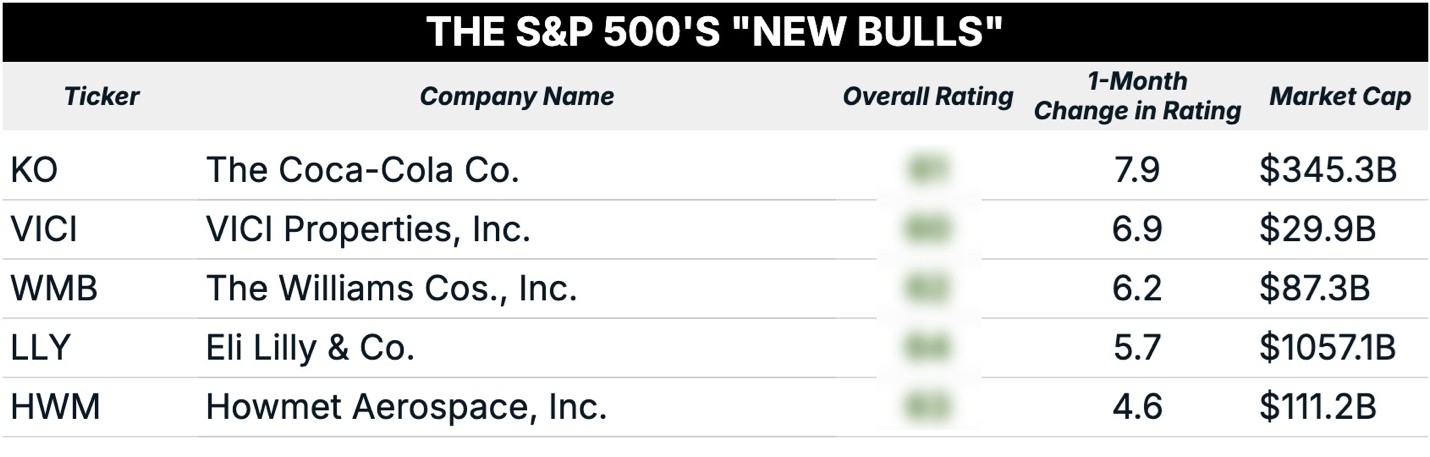
At the top of the list is an American classic: The Coca-Cola Company (KO). Tech and energy have dominated the markets this year, but good ol’ Coca-Cola has been quietly trending higher for the past two years.
We can lump sugary sweets in with tobacco and other “vice” investments.
When times are hard and people are struggling to pay their bills, they often cut back on major expenses like home upgrades or pricey vacations.
But they often spend more on small, frivolous luxuries like a pack of cigarettes or a case of Coke.
In that same vein, casino REIT VICI Properties (VICI) also made the cut this week. VICI owns the Caesar’s Palace, MGM Grand and the Venetian in Las Vegas, as well as dozens of other gaming and “experiential” properties, including properties operated by Great Wolf Resorts, Club Med and Kalahari Resorts.
Importantly, VICI doesn’t operate casinos or theme parks. It simply owns the properties, collecting rent as a landlord. This insulates the REIT from some of the swings in the economic cycle.
REITs are interest-rate sensitive, of course, and a more hawkish Fed isn’t generally good news for the sector.
But VICI rates exceptionally well on its value and growth factors and boasts a 6.4% dividend yield, so a patient investor can weather any Fed-related volatility.
New Bulls Outside the S&P 500
Let’s cast the net a little wider and look at the newly “Bullish” stocks outside of the S&P 500. I ran a screen for the top 20 stocks with the largest score increases over the past month, and this is what popped up:
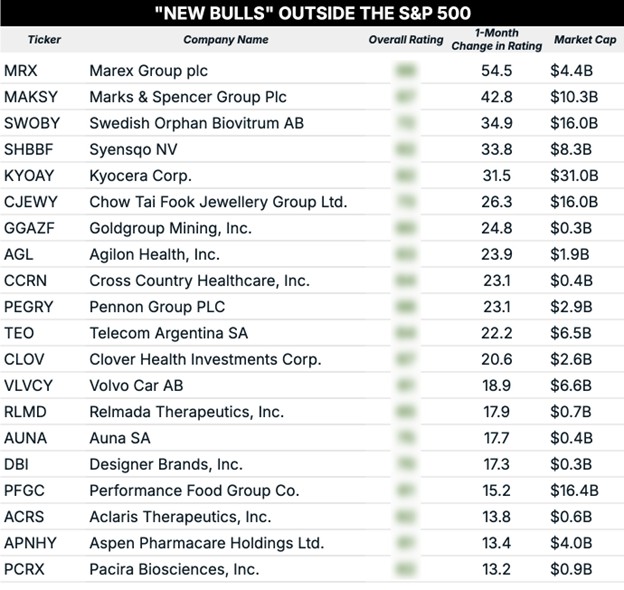
It’s a diverse group this week, including everything from British department store Marks & Spencer (MAKSY) and Swedish automaker Volvo (VLVCY) to Hong Kong-based Chow Tai Fook Jewellery Group (CJEWY).
But one company in particular caught my eye: Telecom Argentina (TEO).
Argentina has been a gold mine for my subscribers in Green Zone Fortunes. Just last week, we sold half of our position in Argentine oil and gas producer YPF SA (YPF) at a return of over 1,000%, making more than 10 times our original investment.
And the second half is still in play!
We’re also up more than 300% in a leading Argentine pipeline operator and 120% in an Argentine bank.
The transformation of Argentina from a mismanaged economic basket case to a first-rate developing market is real and still in the early innings.
We’re only now starting to see Argentine assets revalued to something that looks normal, closing the “Argentina discount” that has haunted them for decades.
Telecom Argentina rates a “Bullish” 64 on its momentum factor and an even stronger 77 on its growth factor. This suggests that the Argentina trade still has a lot longer to run.
To good profits,

Adam O’Dell
Editor, What My System Says Today