
Well, he did it!
Federal Reserve Chairman Kevin Warsh just presided over his first rate hike, raising the benchmark rate to a range of 3.75% to 4%.
And the Fed committee forecast at least one more hike before the end of the year… with futures markets pricing in a 50/50 chance it comes before the midterm elections.
Interestingly, Mr. Market didn’t seem to mind.
Both stock and bond prices were higher this morning.
So… what’s the story?
Aren’t higher interest rates “bad” for the markets?
The short answer is yes, higher rates are bad. But the market is betting that mildly higher rates are less bad than persistently high inflation.
Of course, it remains to be seen if Warsh’s rate hikes end up being only “mildly” higher… or if they’re successful at all in crimping inflation.
After all, the biggest drivers of inflation today are the energy supply shock due to the Iran war and unrelenting demand for power and resources from AI data centers.
The Fed can’t open the Strait of Hormuz… and it’s hard to see interest rates moving a quarter percent higher or lower having any impact at all on the AI boom.
The futures market is giving us a 78% probability that rates are at least half a percent higher than today’s levels by March.
We’ll see about that…
My colleague Moneyball Economics Editor Andrew Zatlin has another take. He’s actually forecasting that rates come down by March. That’s why in yesterday’s daily issue, he stressed the economic data that prompted the Fed to hike could start reversing sooner than the market expects.
At any rate, today is Thursday, and you know what that means.
We’ll be covering stocks that have been newly rated as “Bullish” on my Green Zone Power Ratings system, meaning their ratings just crossed the 60 out of 100 threshold.
Historically, stocks with a “Bullish” rating have outperformed the market by double on average.
So, let’s get to it, starting with the newest additions from the S&P 500 Index.
S&P 500 New Bulls
I ran my usual screen for S&P 500 companies that popped up as “Bullish” this week, and this is what I came up with:
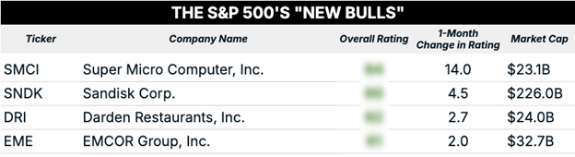
At the top of the list is Super Micro Computer (SMCI), a stock that needs little introduction. It’s one of the biggest names in AI infrastructure.
Super Micro doesn’t design AI datacenter chips. It builds the servers around them.
The company buys processors and accelerators from Nvidia (NVDA), Advanced Micro Devices (AMD) and the rest, then packages them into complete server and rack systems with cooling, networking and power infrastructure.
These are the guys who actually get the data center up and running.
It should go without saying that business is good. Super Micro rates a perfect 100 on its growth factor and a solid 79 on its quality rating.
After a rough two-year stretch that saw its stock price fall by more than 75%, the shares are finally priced attractively, rating “Strong Bullish” 88 on its value factor.
Just don’t expect this one to be a smooth ride. The shares rate a 12 on their volatility factor, meaning they’re subject to pretty extreme price swings.
Moving on, Sandisk (SNDK), a leader in memory flash drives, also made the cut this week.
The data center boom has been a windfall for Sandisk, turning a normally cyclical hardware play into a growth machine. The stock rates a “Strong Bullish” 90 on growth and an even stronger 99 on quality.
But like Super Micro, the shares are volatile.
Expect some wild swings in this one.
One distinctly non-tech company making the list is Darden Restaurants (DRI), owner of the Olive Garden, LongHorn Steakhouse, and Ruth’s Chris chains, among others.
Full-service “sit-down” restaurants have been struggling for years due to nagging inflation and a generational changing of the guard. At least, that’s the Wall Street narrative.
Clearly bucking those trends, Darden has posted strong growth. It rates an 85 on its growth factor and a very respectable 75 on quality.
This is why we invest the way we do.
If we listened to the “smart money,” we’d never consider a stock like Darden. Its brands are too old, too stale… in a dying format.
Except none of that is actually true.
In fact, my system objectively proves that the opposite is true. Darden is a healthy and growing company generating solid profits.
And it’s just one of several attractive stocks my system identified…
New Bulls Outside the S&P 500
Now, let’s look at the newly “Bullish” stocks outside of the S&P 500. I ran a screen for the top 20 stocks with the largest score increases over the past month, and this is what popped up:
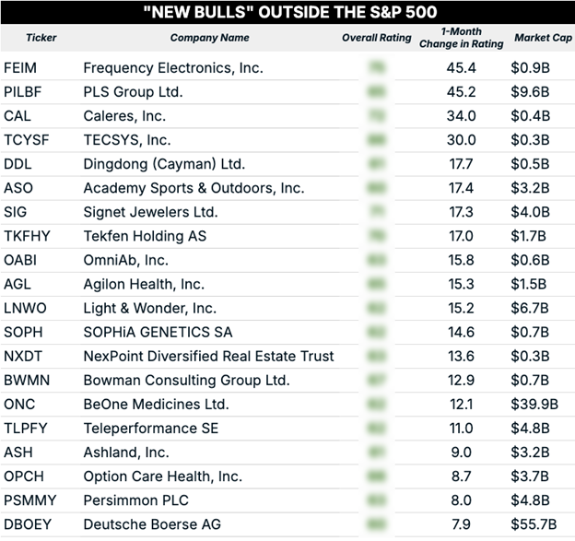
There are a few names that I’d like to highlight.
At the very top of the list sits Frequency Electronics (FEIM), a maker of precision timing and control products used mostly in satellites and military systems.
The SpaceX (SPCX) IPO ignited a surge in interest in the space economy. But Frequency Electronics is no Johnny-come-lately.
The company has been in business since the 1960s… and its shares have risen eightfold since 2024.
We’ve watched Amazon.com (AMZN) and Walmart (WMT) build massive grocery empires by focusing on convenience.
So, it’s worth noting that Dingdong Ltd (DDL), a leading fresh grocery e-commerce company in China, recently popped up as “Bullish.”
Taking a page right out of Amazon and Walmart’s playbook, Dingdong launched a line-up of private-label food products, many made in its own production plants, which helps it control quality and margins rather than just reselling other brands’ groceries.
But unlike Amazon and Walmart, Dingdong is still a small company that most investors have never heard of. It’s a small-cap stock with a size factor rating of 99.
To good profits,

Adam O’Dell
Editor, What My System Says Today
P.S. Wall Street may be looking at a golf-course company, but Moneyball Economist Editor Andrew Zatlin is looking at something very different…
Behind one seemingly ordinary business is a proposed merger involving a national defense company, military drones and a Trump family connection — and Zatlin believes investors should know about it.
On Tuesday, he will host a presentation to pull back the curtain on the proposed backdoor IPO and reveal the company involved. Plus, he’ll explain why September 30 could be the date that brings this obscure story into the spotlight — and what investors should know before then.