
Everybody agreed in the spring of 2021.
Small caps had just run better than 50% in five months. Vaccines were rolling out. Factories were reopening. Little companies were supposed to eat the recovery first.
And every strategist with a microphone said so.
It was the most crowded, most obvious, most unanimous call on Wall Street.
The Russell 2000 ETF eventually touched $244.46 that November.
Then it stopped.
Not a crash. Something slower – and more expensive – than a crash.
It simply went nowhere.
It took until October 2025 to see that price again. Nearly four years of sitting still.
The S&P 500 Index climbed more than 40% while small-cap investors waited.
I bring that up because the same call is back.
Same words. Same certainty. Same headlines.
And it has already stopped working.
Most people have not noticed, because they’re staring at the wrong number.
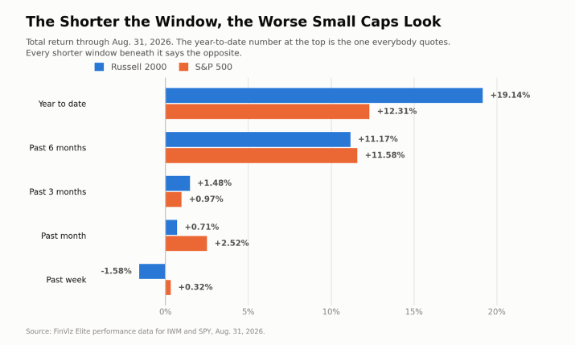
Here is the number everyone quotes… The Russell 2000 is up 19.14% this year. The S&P 500 is up 12.31%. Small caps are winning by nearly seven points.
Case closed, right?
Shorten the window, and the story changes:
- Past six months: the S&P 500 is up 11.58%. The Russell 2000 is up 11.17%. Large caps win.
- Past month: the S&P 500 is up 2.52%. The Russell 2000 is up 0.71%.
- Past week: the S&P 500 is up 0.32%. The Russell 2000 is down 1.58%.
Small caps banked every point of their 2026 outperformance before mid-February.
Everything since has been a coin flip that keeps landing the wrong way.
The chart below measures the Russell 2000 against the S&P 500. The line rises when small caps win and falls when they lose.
It climbed through January.
It flattened in February.
It spiked for one week in late June when large caps hit an air pocket.
Then it rolled straight back over.
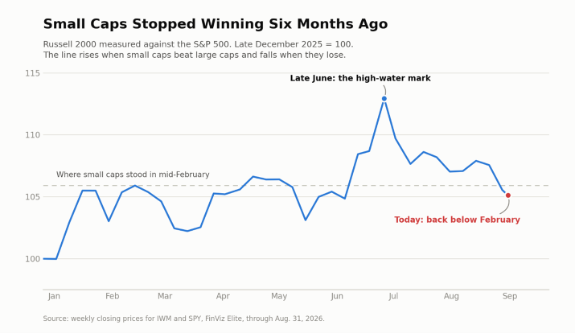
Today, that line sits below where it stood in mid-February. Six and a half months of running in place.
But the bigger problem isn’t the Russell 2000’s recent performance.
It’s what has been driving it.
Apollo Global Management chief economist Torsten Slok put his finger on it in June.
Something is broken in price discovery, he argued, when companies with negative earnings keep beating companies with positive earnings.
And that’s exactly what has been happening.
Roughly 2,000 companies sit in the Russell 2000.
About 806 of them earn no money at all.
Not less money. No money.
Apollo puts the S&P 500’s figure at around 6%.
And the money losers have been leading.
Since the April 2025 low, unprofitable Russell 2000 stocks gained about 60%. The ones that actually turn a profit gained 38%.
That is not a rotation. That’s a bar tab.
So, What Broke?
Nothing broke.
Investors are buying one factor and calling it a strategy.
Adam’s Green Zone Power Ratings system scores more than 6,000 stocks every day across six factors: momentum, size, volatility, value, quality and growth.
About 100 individual metrics feed into those six, and the six roll up into a single score between 0 and 100.
A small-cap index fund screens for exactly one of them. Size.
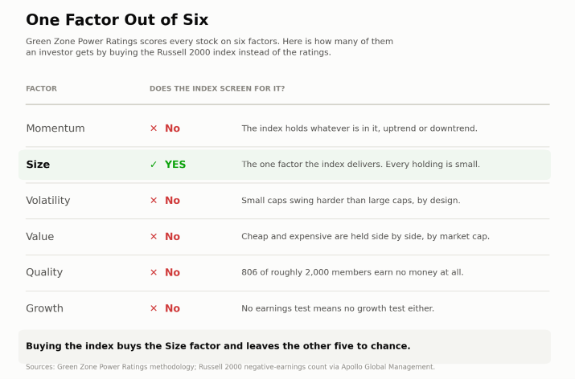
That’s it.
It doesn’t ask whether a company is in an uptrend.
It doesn’t ask what you’re paying for it.
It doesn’t ask whether the business makes money.
If the market cap is small enough, it is in the index.
And that’s the problem.
Size has never been the edge by itself.
Size combined with the other five factors is where the edge comes from. And as you are about to see, the index does not even deliver Size cleanly.
That’s the whole reason Adam’s system beats a broad index over time. It does not just hunt small companies. It refuses to buy the 806 companies that don’t make money just to get exposure to the ones that do.
What the System Says About the Top Holdings
Look at what sits at the top of the fund right now.
The three largest holdings in the Russell 2000 are Moog Inc. (MOG.A), UMB Financial Corp. (UMBF) and Glaukos Corp (GKOS). Their market values run about $11.9 billion, $11 billion and $10.6 billion, respectively.
Those are not small companies.
But that’s the trick with an index.
Its members grow between reconstitutions, and nobody kicks them out for winning.
So, I ran all three through Adam’s six-factor system this morning.
Look at the Size column first.
Moog scores 34. UMB scores 36. Glaukos scores 31.
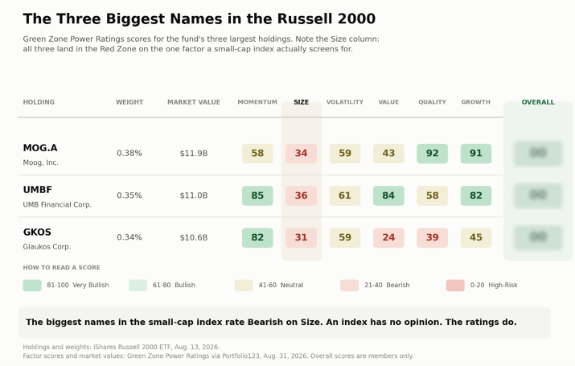
Every one of them lands in the Red Zone. Bearish.
Think about that.
The three biggest positions in America’s best-known small-cap index fail the only factor the index screens for.
And the rest of the scorecard falls apart in different directions.
Moog earns a 92 on Quality and a 91 on Growth, then turns in a 43 on Value. UMB flips it, with an 85 on Momentum and an 84 on Value against a 58 on Quality. Glaukos posts an 82 on Momentum, a 24 on Value and a 39 on Quality.
Three businesses with almost nothing in common.
And the fund owns all three at roughly the same weight, because an index has no opinion.
The overall score is what settles the argument. That number is the one thing I am not going to print here.
Let me be clear about what this is not.
This is not a call to sell small caps. The Size factor still works. Smaller companies still grow faster off a smaller base, and the ratings still reward them for it.
This is a call to sell the index.
Stop renting 2,000 companies to get to one factor.
Run your small-cap holdings through all six instead, and keep only those that earn a Bullish rating or better.
In the Green Zone system, 61 to 80 is Bullish, and those stocks are built to double the market’s return over the next 12 months. Anything from 81 to 100 is Very Bullish, with a target of tripling the market.
Anything under 40 is Bearish, and a broad small-cap fund is full of it.
One more thing, because the timing matters.
Money is already moving. The S&P 500 has beaten the Russell 2000 over the past six months, one month and the past week.
That is not noise. That is a trend the headlines have not caught up to yet, and trends in the Momentum factor tend to run longer than anyone expects.
The crowd will get here eventually. You do not have to wait for them.
Pull up your small-cap positions tonight. Check the rating on everyone. Sell what comes back Bearish and put the money into what comes back Bullish.
The last time everybody agreed on small caps, it took four years.
The factor underneath the call still works. You just have to buy it on purpose.
Until next time…
Safe trading,

Matt Clark, CMSA®
Chief Research Analyst, What My System Says Today
P.S. With volatility picking up and traditional buy-and-hold strategies facing a much tougher environment, What My System Says Today Editor Adam O’Dell has been looking for a different way to approach the market.
The market may look unpredictable right now, but he believes there are patterns hiding beneath the volatility that can help investors identify where the biggest opportunities may emerge.
That’s why he’s going LIVE tomorrow at 1 p.m. for a special HyperCycle Blueprint event to walk you through his latest market outlook and the approach he’s using to uncover explosive trades in a market that could look very different over the months ahead.