


You’ve heard me say this all year: “As goes tech, so goes the S&P 500.”
And that’s not just because technology is the largest sector in the market.
Given the sheer size of the tech sector – and the gargantuan market caps of the biggest technology stocks – the S&P 500 Index needs strong participation from tech for any move higher to be sustainable.
Tech and tech-adjacent stocks account for about half of the S&P 500’s total market cap.
But today, we’re going to talk about that “other” tech sector, communications.
That might sound strange. After all, communications doesn’t exactly scream “technology.”
But two of the biggest “tech stocks” in the world – and proud members of the “Magnificent Seven” – aren’t actually classified as technology stocks.
I’m talking, of course, about Google parent company Alphabet (GOOGL) and Facebook and Instagram owner Meta Platforms (META).
Call them tech… call them communications… call them whatever you want.
The label doesn’t really matter.
What matters is that these are two of the most important companies in the AI revolution – and two of the biggest hyperscalers on the planet.
Whatever happens next in the AI revolution, these two companies will be major players.
But what about the rest of their sector? Alphabet and Meta are so enormous that they can make the communications sector look a lot healthier than it really is.
So, let’s do a sector X-ray of the communications sector to see where the opportunities – and the traps – are hiding.
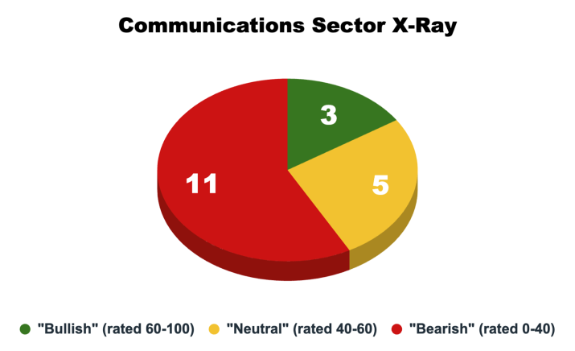
At first glance, the picture isn’t particularly encouraging.
If you’re looking for opportunities in communications, you’re going to have to be selective. Very selective.
Overall, the sector rates poorly on my Green Zone Power Ratings system.
Of the 19 communications stocks, only three rate as “Bullish,” meaning a score of 60 or higher out of 100. (For those new to my system, “Bullish” rated stocks outperform the S&P 500 by double on average over the following year.)
Another five rate as “Neutral,” meaning my system would expect them to perform more or less in line with the broader market. And 11 communications stocks – a solid majority – rate as “Bearish,” meaning my system would expect them to significantly underperform the market.
The AI revolution is the biggest economic event of our lifetimes, and the communications sector is unquestionably a big part of that story.
But clearly, not all stocks in this space are benefitting equally.
Alphabet and Meta may be leading the charge.
That doesn’t mean the rest of the sector gets a free ride.
So let’s keep digging.
Where Do Communications Pick Up Points?
The Green Zone Power Rating system is a composite score based on six primary factors: momentum, size, volatility, value, quality and growth, each of which comprises several sub-factors. (As we are looking at large-cap constituents of the S&P 500, I don’t consider size when doing the sector X-ray.)
So, where do communications stocks pick up the most points?
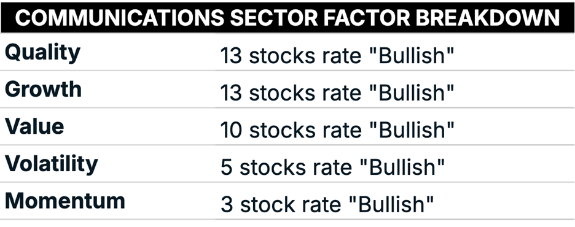
The sector rates well overall on its quality and growth factors. Thirteen stocks rate as “Bullish” on each factor, and another 10 rate as “Bullish” on value.
After that, it really drops off.
Only five rate as “Bullish” on their volatility factor, and another three rate as “Bullish” on momentum.
In my Green Zone system, a high volatility rating means that the stock exhibits low volatility. In other words, a stock that rates well on volatility doesn’t “bounce around” all that much relative to other stocks.
So, how are we to interpret all of this?
Overall, the sector is growing and profitable. These are “good companies.”
But in the current environment, they’re choppy and not trending higher relative to their peers in other sectors.
So, these “good companies” are not necessarily “good stocks” right now.
A Deeper Look at Communications
Let’s keep digging.
I ranked the 19 stocks in the communications sector by their Green Zone Power Ratings. Let’s take a look at the list to see if we can glean any insights… or find any hidden gems.
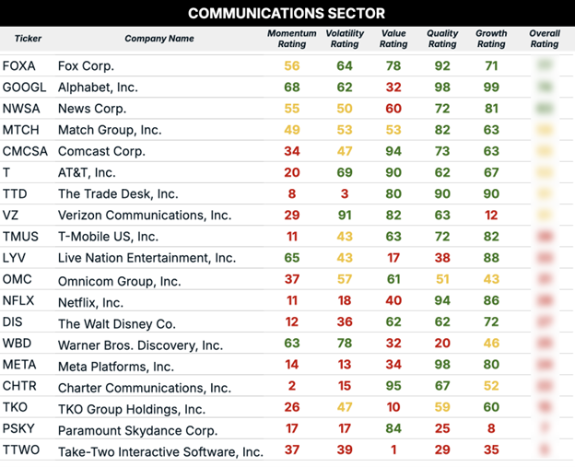
Interestingly, the top-rated communications stock is one of the most “old school.”
Fox Corp (FOXA), the owner of Fox News, Fox Sports and other traditional media assets, rates as “Bullish” across all factors but momentum and even momentum rates as respectably “Neutral.”
We’re entering the last few months of what promises to be a cantankerous midterm election cycle.
All else equal, that should bode well for Fox.
The more people are glued to their TV screens, the more valuable advertisements become on Fox’s assorted channels.
Alphabet also rates particularly well. The stock rates as “Bullish” on all factors except value, and it rates impressively at 98 and 99 on its quality and growth factors, respectively.
This is a company with a $4 trillion market cap that is still growing like a weed. That would have sounded absurd just a few years ago. But that’s the reality.
Moving on, Alphabet occupies a unique space in the AI economy.
Its generative AI assistant Gemini is duking it out with Anthropic’s Claude and OpenAI’s ChatGPT for supremacy. But unlike the competition, Alphabet is also a leading hyperscaler, competing with Microsoft (MSFT) and Amazon (AMZN) in AI cloud infrastructure. The company also builds its own AI server chips.
It seems that in the AI economy, all roads lead to Alphabet.
Interestingly, Meta doesn’t stack up nearly as well on my Green Zone Power Ratings system. It boasts similar factor ratings on quality and a “Strong Bullish” rating of 80 on growth. But it rates poorly across all other factors.
And as I discussed yesterday, Meta faces greater regulatory risks to its business than Alphabet.
While the company’s settlement with the state attorneys general removes the risk of a catastrophic legal judgment, it sets a precedent for greater government meddling in their businesses, particularly regarding how they are marketed to children.
To good profits,

Adam O’Dell
Editor, What My System Says Today