

Let’s talk about health care.
It was last week’s best-performing sector by a country mile.
Some of that strength reflected genuine buying interest. Some of it was simply investors rotating out of crowded mega-cap tech trades.
So, does this move have staying power?
Or was it a short-term sector rotation destined to fizzle out as quickly as it appeared?
Let’s see what my system has to say…
My Green Zone Power Ratings suggest investors should be careful about painting the entire sector with a broad brush.
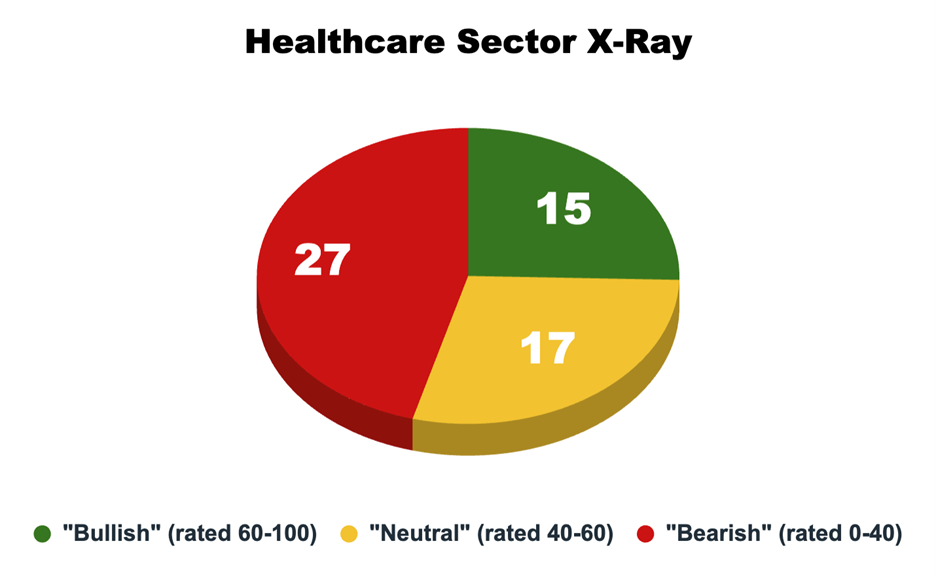
Of the 59 health care stocks in my coverage universe, only 15 rate “Bullish,” meaning a score of 60 or higher out of 100. (For those new to my system, “Bullish” rated stocks outperform the S&P 500 Index by double on average over the following year.)
Another 17 rate as “Neutral,” meaning my system would expect them to perform more or less in line with the broader market. Nearly half, at 27, rate as “Bearish.”
So, we’ll want to be selective. I wouldn’t just buy a health care sector ETF and hope for the best. If I’m going to put my money on the line, I’m going to buy the select stocks that my system indicates are most likely to outperform.
So, where might those opportunities lie? Let’s keep digging to find out.
Where Does Health Care Pick Up Points?
The Green Zone Power Rating system is a composite score based on six primary factors: momentum, size, volatility, value, quality and growth, each of which comprises several sub-factors. (As we are looking at large-cap constituents of the S&P 500, I don’t consider size when doing the sector X-ray.)
Let’s take a look to see where health care stocks pick up points.
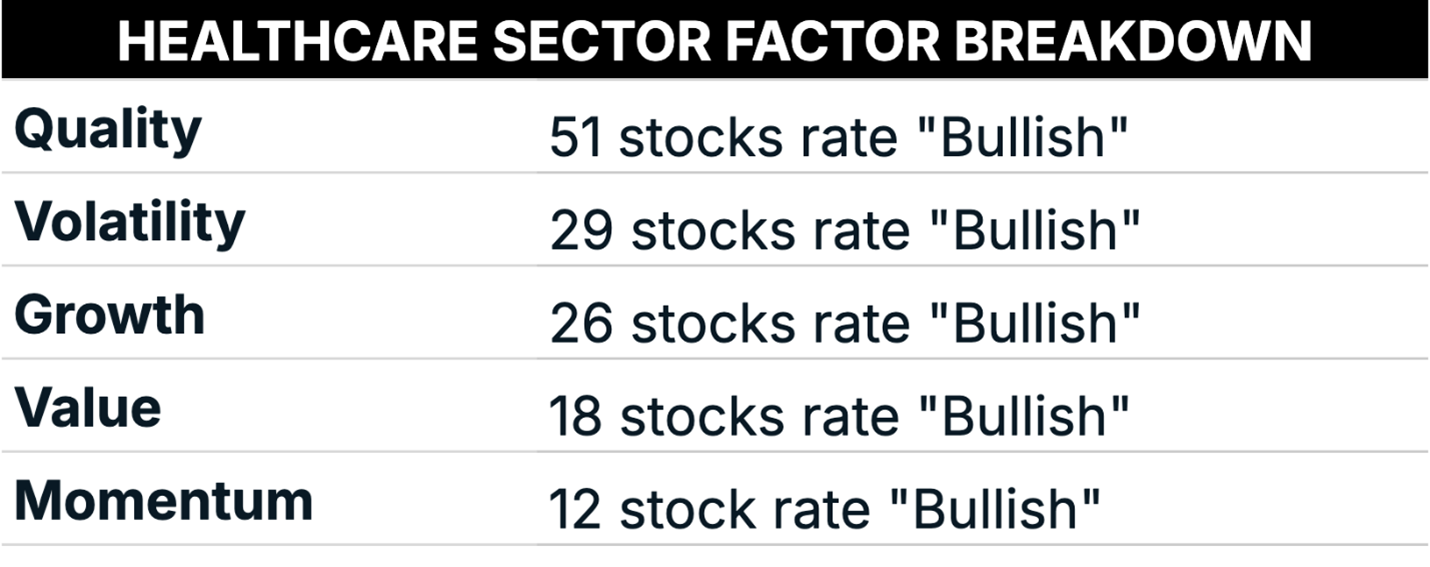
The single most “Bullish” factor is quality. And if you understand this sector, that makes a lot of sense.
My quality factor tends to reward “capital light” businesses that throw off a lot of cash with minimal investment in physical property, plant and equipment.
With health care dominated by pharmaceutical companies and health insurance companies, both fit that bill perfectly.
Pharmaceutical companies are essentially “intellectual property portfolios” that enjoy patent protection on their branded drugs. This gives them a juicy, legally-protected monopoly on the treatment for the duration of the patent… and a virtual license to print money.
Insurance companies also have a fantastic gig. The vast sums they collect in premiums provide them with a steady stream of cash to invest. Most people don’t realize this, but that was the secret to Warren Buffett’s success.
Early on, he converted Berkshire Hathaway (BRK-B) into an insurance company and then built it into one of the world’s largest financial powerhouses by profitably investing the insurance float.
It’s worth noting that nearly half the health care stocks in our universe rate as “Bullish” on their volatility factor. That’s also highly intuitive, as demand for health care doesn’t change all that much based on the economic cycle. Boom or bust, you need medical attention when you’re sick.
I can’t tell you for certain that we’ll have a recession this year or next. But if we do eventually see real economic fallout from the Iran war or from any slowdown in AI infrastructure spending, health care stocks are poised to hold up better than most.
Overall, health care stocks rate poorly on momentum. With investors laser-focused on AI and, to a lesser extent, energy, they simply haven’t had any interest in “boring” pockets of the market like pharmaceuticals or insurance.
Still, 12 stocks in the sector did indeed rate as “Bullish” on momentum. These stocks are going against the current, trending higher in a sector that is mostly flat.
Let’s take a look at those elite 12.
Highest-Momentum Health Care
I put together a list of health care stocks that rate as “Bullish” on their momentum factor. Here’s what made the cut:
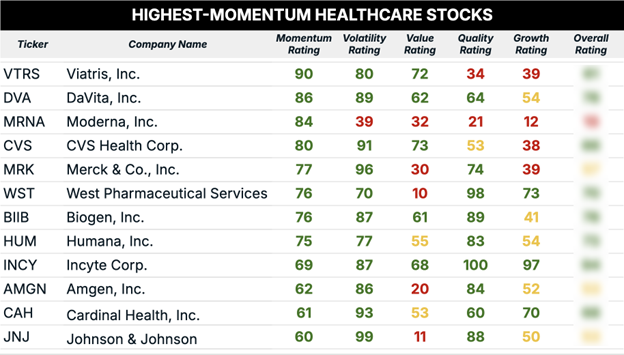
Viatris (VTRS) came out on top with a “Strong Bullish” momentum rating of 90. It also rates as “Bullish” on its volatility and value factors, as well as its overall Green Zone rating.
Viatris is a global pharmaceutical company formed through the merger of Mylan and Upjohn. It holds a broad portfolio of branded, generic and biosimilar drugs, including cholesterol drug Lipitor, blood pressure medication Norvasc, erectile dysfunction treatment Viagra and the autoimmune biosimilar Ogivri.
The company also manufactures injectable medicines, ophthalmology products and complex generics, generating steady cash flow from a diversified portfolio rather than relying on a concentrated handful of blockbuster drugs.
The stock is by no means a growth dynamo. But it has exactly the kind of recession-resistant portfolio that should hold up well during an economic rough patch.
Incyte (INCY) stands out as the only stock on the list that rates “Bullish” or “Strong Bullish” across all its individual factors… and earns a perfect 100 on quality.
The biotechnology company is focused on developing innovative medicines for cancer, blood disorders and autoimmune diseases. Its flagship product, Jakafi, is the standard of care for several rare blood cancers and remains the company’s largest revenue driver.
Incyte is also expanding rapidly with Opzelura, a topical treatment for eczema and vitiligo, along with newer oncology drugs such as Pemazyre and Zynyz.
Unlike many biotech firms, Incyte combines a profitable commercial business with a deep pipeline of next-generation therapies, giving it multiple avenues for long-term growth.
To good profits,

Adam O’Dell
Editor, What My System Says Today
P.S. Every so often, markets experience a rare convergence where multiple powerful trends collide at once. That’s exactly what we’re seeing today as the AI boom accelerates.
Wall Street is still treating AI as a software story. Washington increasingly sees it as an energy story.
But I believe the companies that can help solve America’s looming power shortage could find themselves at the center of both trends — benefiting from private-sector AI spending and growing government support.
That’s why we’re focusing on this opportunity before the crowd catches on. Learn more here…