

For most of this century, “investing in space” meant buying Boeing (BA) and squinting.
You owned a defense contractor, pretended it was a rocket company and hoped nobody asked questions.
The pure-play options were a mix of SPAC wreckage, money-losing launch startups and one exchange-traded fund (ETF).that nobody could figure out how to pronounce.
That era is ending.
Reports are circulating — again, but louder this time — that SpaceX is preparing an IPO that could land somewhere north of $400 billion.
Whether it happens this year, next year or remains perpetually “imminent” in the Elon tradition, the drumbeat matters.
Capital is already pricing in the possibility that the largest private company on Earth is about to become a ticker. That changes the conversation for the entire sector.
And it brings us to this one ETF…
Space… In One Chart
The Procure Space ETF (UFO) has been quietly — and then not so quietly — pricing in the space economy’s graduation from venture capital to public markets.
Since its 2019 launch, it traded like a meme waiting for a thesis. Since last summer, it has traded like a thesis waiting for nothing.
Pull up the five-year chart, and three levels do the talking.
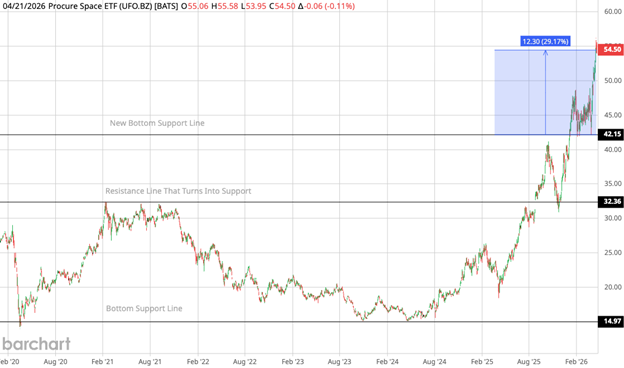
The first is $14.97 — the old floor. For roughly three years, from late 2021 through mid-2024, UFO kicked around the high teens and low 20s, bouncing off that $14.97 line like a pinball without a plunger.
This was the “space is hard” era: high rates, SPAC deals spacing out and a market that had lost interest in any narrative about space.
The second is $32.36 — first a ceiling, now a floor. UFO tested the low $30s repeatedly on the way up in late 2024, only to be swatted down each time.
But once it finally broke through in early 2025, that resistance flipped to support. Textbook. Tested, held and launched.
The third — and the one that matters right now — is $42.15. This is the new bottom support line, and the most recent pullback in February 2026 barely kissed it before ripping higher.
The ETF closed Monday at $54.50, and the box traders on their screens are looking at roughly 29% of upside from that new floor to current levels.
In English: something structural has changed:
- Rates: Long-duration, capital-intensive growth stories do better when the discount rate cooperates, and UFO is stuffed with exactly those — satellite operators, launch providers, comms networks, space-adjacent defense names. When the market was hostile to anything that burned cash before 2030, UFO stayed in the teens. When the market warmed up, UFO doubled.
- Substance: The holdings themselves — the Iridiums, Rocket Labs and Viasats of the world — have shipped. Reusable launch is routine. Satellite constellations are profitable. The backlog of government and commercial contracts is real and, importantly, book-and-billable. UFO is no longer a bet on whether the industry works. It’s a bet on which players capture the most margin as it scales.
- The SpaceX Overhang: Here’s the awkward truth: SpaceX isn’t in UFO because SpaceX isn’t public. An IPO changes that overnight. Whether Procure adds SpaceX at index reconstitution or tracks it separately, the rising tide of a SpaceX listing would re-rate every public space name — suppliers, competitors and adjacent plays — because investors who couldn’t touch SpaceX’s $400 billion valuation yesterday will suddenly be allocating to “space” as a line item. UFO is the easiest line item on the menu.
The final part of this analysis includes running an X-ray through Adam’s Green Zone Power Ratings system on stocks held in UFO…
UFO: Strong Momentum And Growth
An ETF X-ray is a breakdown of the individual ratings of all stocks listed in the fund.
There are 32 ratable stocks held in the ETF — the rest are either below our market cap threshold or not American-traded.
UFO Close To “Neutral” Rating
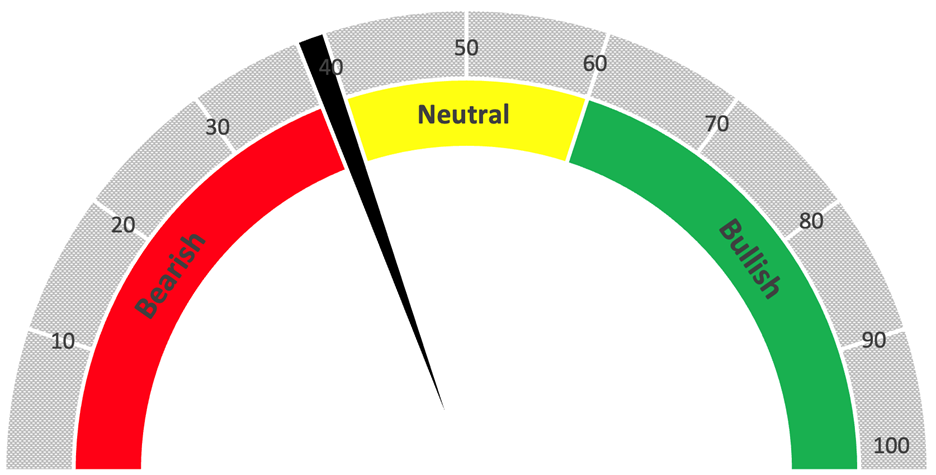
Overall, UFO earns a 38 out of 100 on Adam’s Green Zone Power Ratings system (taking the average of all ratable stocks).
However, that doesn’t tell the whole story.
Of the 32 stocks rated, nine of them rate “Bullish” or higher, while 15 rate “Bearish” or lower.
However, 19 of the holdings rated “Bullish” or higher on Momentum, and 11 were “Bullish” or higher on Growth.
The chart shows UFO has done the hard work — breakout, retest, higher low and continuation. The thesis says the space economy is real and increasingly investable. The catalyst says a SpaceX listing would re-rate the sector in a way few single events could.
The space trade used to be a moonshot. It’s starting to materialize as a trade.
Until next time…
Safe trading,

Matt Clark, CMSA®
Chief Research Analyst, Money & Markets