


I remember exactly where I was when I first saw a photo of Earth from space.
I was maybe eight years old, flipping through a library book on NASA missions, and there it was — that famous “Blue Marble” shot taken by the Apollo 17 crew in 1972.
Something clicked.
The idea that human beings had gone out there, looked back and taken a picture of the whole world hanging in the dark felt like the most important thing our species had ever done.
We haven’t been back since. Until now.
Teams are targeting to roll NASA’s Artemis II rocket to the launch pad, with an April launch window on the books — four astronauts, the Orion spacecraft and a loop around the far side of the Moon.
If the first crewed lunar mission since 1972 doesn’t give you a little chill, I don’t know what will.
Now, let’s talk about what it means for your portfolio.
Most People Are Looking at This All Wrong
When the topic of space exploration comes up and someone finds out I write about stocks, they immediately ask about rocket companies.
Who’s building the best booster? Which company do you think will land humans on Mars first? Which rocket designs do you think are the coolest?
And look… I get it.
Rockets are dramatic. But fixating on rockets is like investing in the California Gold Rush by buying shovels from one company.
The real money wasn’t in the shovels. It was in the jeans, the banks, the railroads — the whole ecosystem that grew up around the rush.
The space economy works the same way.
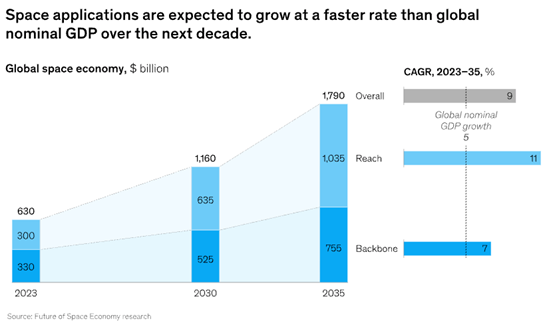
McKinsey pegged it at roughly $630 billion in 2023, with potential to reach $1.8 trillion by 2035.
And the overwhelming majority of that growth isn’t coming from launch vehicles. It’s coming from services — broadband connectivity, defense communications, satellite telemetry and direct-to-device signals.
Space is quietly becoming the backbone of global communications infrastructure. The companies that figured the real business wasn’t the rocket, but everything the rocket makes possible are the names worth owning today.
And one of them trades under a four-letter ticker that would draw blank stares at a cocktail party…
Meet the Company Flying Under Everyone’s Radar
Viasat Inc. (VSAT) isn’t glamorous.
It won’t trend on Reddit. But if you’ve streamed a movie at 35,000 feet or relied on satellite communications in a military context, there’s a decent chance Viasat provided the infrastructure for it.
The company offers broadband and narrowband satellite communications on the commercial side. Plus, it designs space system solutions for geostationary, medium and low earth orbit on the defense side.
That’s not a niche play — it’s the whole stack.
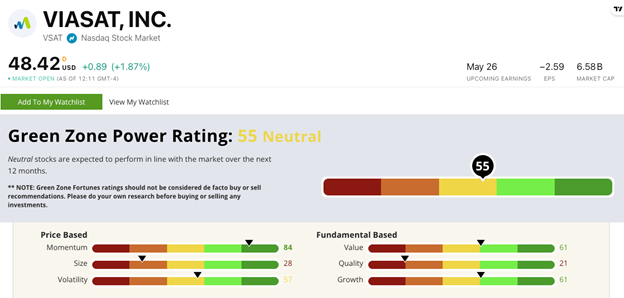
The numbers back it up.
Using Adam’s Green Zone Power Ratings system, the stock earns a “Neutral” 55 out of 100.
That is strong considering that VSAT had an overall rating of 29 just a year ago – meaning the stock’s overall rating has nearly doubled in a year.
A crucial part of that jump is the stock’s momentum (where it scores an 84).
VSAT Is Up More Than 400% in the Last 12 Months
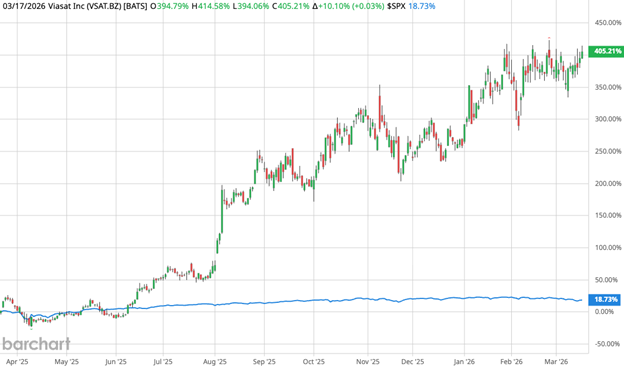
In the last 12 months, VSAT has risen 405% compared with the S&P 500 Index’s paltry 18.7% increase over the same period.
That means VSAT has outperformed the benchmark index by more than 21-to-1.
Now, its “Neutral” rating suggests that now may not be the best time to invest, but a significant catalyst is on the horizon that could change all that.
The SpaceX IPO Changes Everything
The SpaceX initial public offering (IPO)– expected before midyear 2026 – will likely send a wave of fresh capital into space stocks broadly.
The company is targeting a $1.5 trillion valuation and raising up to $50 billion, which would mark the largest IPO in history.
Think about what that moment does to investor awareness.
Millions of people who have never considered this sector will suddenly be seeking exposure.
Some will buy SpaceX on day one. But many others — especially those who want something with more established fundamentals — will go looking for names already embedded in the ecosystem like VSAT.
Four weeks from now, astronauts may be circling the Moon.
A few months after that, the biggest IPO in history could pull an entirely new class of investors into the space trade.
That’s all from me today.
Until next time…
Safe trading,

Matt Clark, CMSA®
Chief Research Analyst, Money & Markets