
Every now and then, the market hands you a gut check.
A pullback, a stretch of bad headlines, a little macro turbulence — and suddenly people start wondering whether the trade they believed in three months ago still makes sense.
The nuclear renaissance has hit one of those moments. And I’d argue the answer written in the charts is more reassuring than anything you’ll read on the wire.
Take the Range Nuclear Renaissance ETF (NUKZ) as a rough proxy for where institutional money is positioning across the sector…
NUKZ Pulls Back, But Runs Back Up
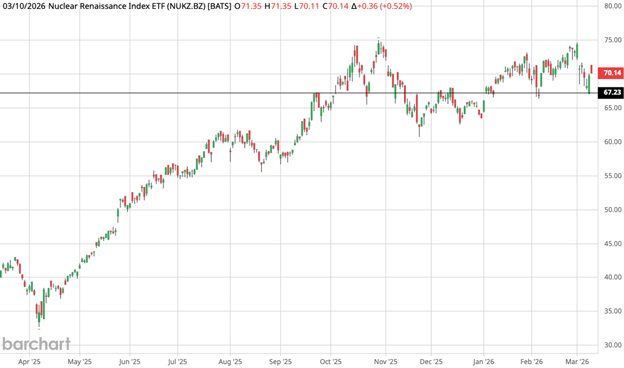
After a remarkable run-up from a 52-week low of around $32.70 to $75, it has pulled back to the $70 range – about 10% off the highs
And critically, it’s holding. Support at roughly $67 has been tested and respected. That’s not a stock tip.
That’s a signal that the buyers are still there.
When a sector pulls back 10% during a stretch of volatility and holds its footing, it tells you the underlying conviction hasn’t broken. The thesis is intact.
What the Noise Is Drowning Out
The recent softness has nothing to do with nuclear.
Tariff headlines, rate uncertainty and the usual macro static serve as the tape rattling the cage. These conditions result in the kind of volatility that shakes out the tourists while the real money holds its position.
Zoom out 30 seconds, and the structural picture looks exactly the same as it did six months ago – maybe better.
The power grid serving 65 million Americans across 13 swing states is still projected to run short of capacity by 2027.
A single AI query still uses 10 times as much electricity as a regular Google search.
Data centers are still on track to consume 300% more energy over the next decade. None of that changed because tariffs got noisy.
And the capital commitments from the biggest players in the world is still on the books. Remember, Alphabet (GOOGL) signed the world’s first corporate SMR power agreement.
Amazon (AMZN) followed with a half-billion-dollar investment… Microsoft (MSFT) restarted Three Mile Island… and Meta Platforms (META) submitted a request for up to 4 gigawatts of nuclear capacity.
In just 18 months, the SMR space attracted over $50 billion worldwide — more than it took Big Tech a full decade to commit to solar and wind power combined. Those aren’t bets you unwind over a bad week in the market.
Still Early, Even After the Run
Here’s what gets lost when people focus on the short-term chart: even after a 72% run over the past year, the nuclear renaissance is arguably earlier in its development cycle than AI was when most investors finally got serious about it.
Natural gas took 20 years to penetrate the grid after the ’70s energy crisis.
Early commercial nuclear took 15 years from the first plant to meaningful capacity.
SMRs are compressing that entire timeline — and the International Energy Agency (IEA) projects capital flowing into the nuclear value chain growing from roughly $5 billion today to $670 billion cumulatively by 2050.
NUKZ Earns “Neutral” Rating
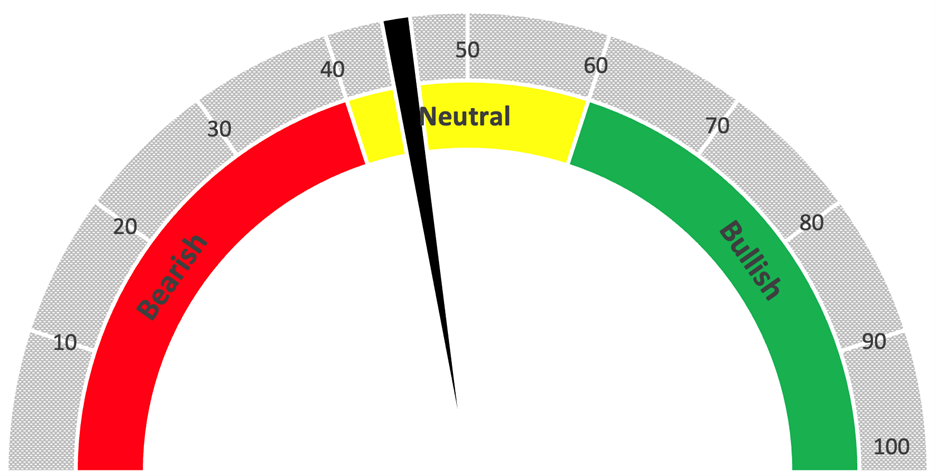
An X-ray of NUKZ shows the ETF averages a “Neutral” rating on Adam’s Green Zone Power Ratings system.
The most interesting thing about this is that the ETF earns its highest mark (a “Bullish” 60 out of 100) on Momentum.
Sixteen of the 38 rated stocks in the ETF rate 70 or higher on the factor… that’s nearly half of the ETF’s stocks showing “maximum momentum.”
That tells me that this Nuclear Renaissance has room to run.
Top investment houses agree…
Morgan Stanley named the nuclear renaissance one of its top investment themes for 2026.
Goldman Sachs is calling it “a largely greenfield growth opportunity.”
Business mogul Bill Gates is building his own SMR plant in Wyoming. When that crowd is reading from the same script, the story isn’t over — it’s just getting started.
So, no — the Renaissance hasn’t peaked.
It’s consolidating.
And there’s a meaningful difference between the two. One signals exhaustion, a story that’s run its course and is looking for the exit.
The other signals that the next leg is being built on a sturdier foundation than the one before it.
That’s all from me today.
Until next time…
Safe trading,

Matt Clark, CMSA®
Chief Research Analyst, Money & Markets