


Three weeks in a row?
Not this time.
Health care relinquished the top spot after leading the market for the previous two weeks, as the State Street Health Care Select Sector ETF (XLV) fell a modest 1.8% last week.
Energy wasted no time reclaiming the lead. As the ceasefire with Iran unraveled, crude oil prices climbed once again… lifting energy stocks along with them. The State Street Energy Select Sector ETF (XLE) was up a commanding 3.5% last week.
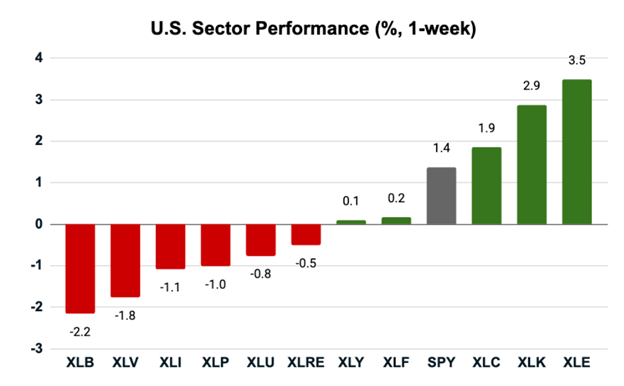
After a rocky start to the month, technology also found its footing. The State Street Technology Select Sector ETF (XLK) gained 2.9%, propelling the S&P 500 Index up with it.
As I’ve said all year, given the size of the tech and tech-adjacent sectors, like communications, it’s extraordinarily difficult for the S&P 500 to sustain a rally without these stocks contributing. Collectively, they make up close to half the index.
This market needs tech. And for now, tech is playing its part.
The laggard this past week was the materials sector, with the State Street Materials Select Sector ETF (XLB) down 2.2%.
Is this just garden-variety profit-taking?
Or is the market sending us a signal?
Let’s see what my system has to say.
Key Insights:
- With hostilities resuming in Iran, energy stocks enjoyed a good week.
- Technology stocks also enjoyed a solid recovery.
- Materials and health care were the laggards, likely due to profit-taking.
Is Energy Back?
It’s not hard to see the connection here…
Tensions rise in the Persian Gulf, and energy stocks rise.
Tensions fall in the Persian Gulf, and energy stocks fall.
That’s certainly been the case since hostilities broke out in Iran. And now, with the ceasefire in tatters and the conflict heating up again, we’re seeing energy stocks rise.
I would not advise trading energy stocks based on war headlines.
Unless you somehow have access to a ring of spies or top-secret CIA intelligence briefings, you’re just reacting to noise. I’ve never seen that work out… for any investor… ever.
Does that mean we should ignore last week’s bump in energy stocks?
Absolutely not.
Energy stocks were rising long before the Iran war broke out, and the sector has consistently had a high percentage of “Bullish” rated stocks on my Green Zone Power Ratings system.
I see a lot of opportunity in the sector. But the key is to keep your eye on the ball and ignore the constant stream of war-related noise.
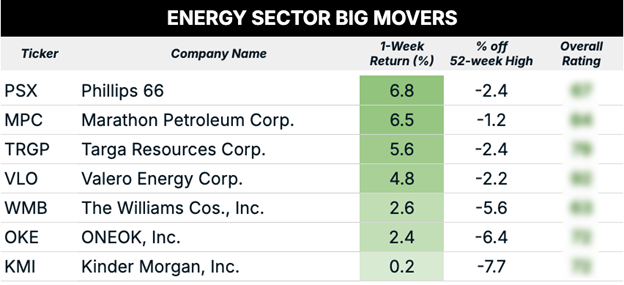
As I do every week, I ran my customary screen of the biggest movers in the sector that were still within 10% of their 52-week highs last week. The idea is to look for solid, market-leading stocks that are getting stronger.
Here’s what I came up with:
Notice something?
Every stock on this list rates as “Bullish” on my Green Zone Power Ratings system.
But that’s not the only common tie here…
All of these companies are refiners or American pipeline and infrastructure plays. Conspicuously absent are the multinational supermajors with global exposure.
The U.S. is in a unique position as a net energy exporter. Yes, the American economy is sensitive to rising energy prices. Every extra dollar spent at the pump is a dollar not available to be spent elsewhere in the economy.
But unlike some of our trading partners in Europe and Asia, there is little chance of American pumps literally running dry.
So, the longer the crisis in Iran drags out, the better for American energy companies. They can enjoy higher sales and profits without the risk of plunging the U.S. into a nasty recession.
What’s the Story With Materials?
We should never read too deeply into a single week’s performance. Materials have had a fantastic year, spending most of 2026 among the best-performing sectors.
Some of this is due to sticky inflation, as commodities tend to do well when the dollar is losing value.
But the bigger story is the AI infrastructure boom.
The sheer size of investments in data centers and other brick-and-mortar manifestations of the AI arms race has created a windfall for many materials stocks.
So, was last week’s dip just regular, healthy profit-taking? Or was it a legitimate warning shot?
Let’s see what my system says.
I ran my customary screen of the sector’s biggest losers for the week that are still trading within 10% of their 52-week lows. The idea is to find beaten-down gems that look poised to recover.
After the massive rally this year, finding enough materials stocks within 10% of their 52-week low to fill out a list was impossible, so I loosened that criteria. Here’s what I came up with:
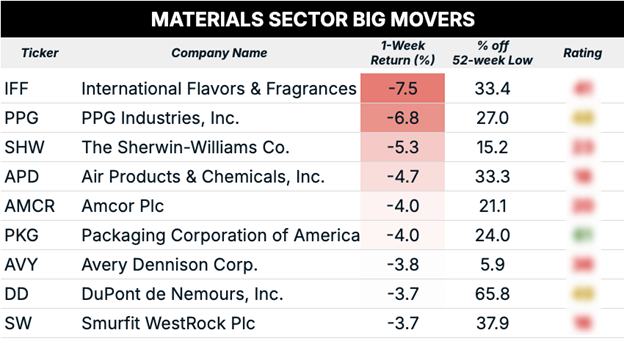
One thing immediately jumps off the page. The materials stocks that fell the hardest last week weren’t the ones I’d associate with the AI infrastructure boom.
For example, International Flavors & Fragrances (IFF) develops flavorings and seasonings for processed foods and scents for perfumes and personal care products. Unless OpenAI is planning to train the next generation of ChatGPT on how to taste or smell, the stock is irrelevant to the AI megatrend.
Sherwin-Williams (SHW) and PPG Industries (PPG) have indirect exposure. The AI-related construction boom does create demand for paints and specialized coatings. But I would hardly call either an “AI play.”
As for the broader question of whether there are any good buying opportunities after the sell-off, my system is clear. Only one stock on the list – Packaging Corporation of America (PKG) – rates as “Bullish” on its Green Zone Power Rating.
Most of the rest rate as “Bearish.” So, we should tread carefully when buying the dip in materials. My system suggests that most of the stocks here are dipping for legitimate reasons.
Tomorrow, I’ll do a deeper dive into the materials sector to uncover “Bullish” opportunities in the companies helping to build out our critical AI infrastructure.
To good profits,

Adam O’Dell
Editor, What My System Says Today