


If there’s one word that’s been beaten to death this election cycle, it would be “affordability.”
Public frustration with rising prices was the single biggest factor that sent President Donald Trump to the White House for a second term.
And the stickiness of those rising prices is why most polls show the Republicans taking a drubbing in next month’s election.
A lot can happen in a month.
We’ll see how the election shakes out.
But it doesn’t look like inflation is going away any time soon.
At a time when budgets are tight, companies that keep the costs of basic necessities in check are a lifesaver.
Today, we’ll do a sector X-ray of the consumer staples sector with a focus on budget retailers selling the basics.
We have good material to work with.
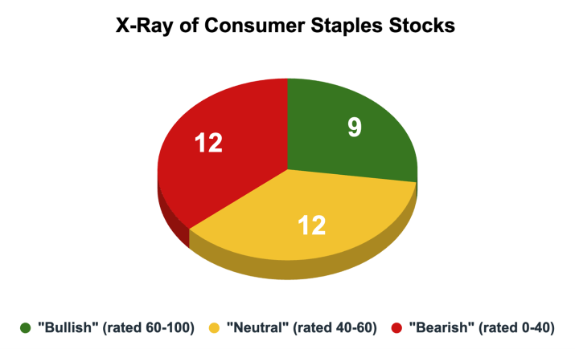
Nine consumer staples stocks rate as “Bullish,” meaning a score of 60 or higher out of 100. (For those new to my system, “Bullish” rated stocks outperform the S&P 500 Index by double on average over the following year.)
The “Bullish” consumer staples are concentrated in the discount retailers that are beating inflation.
We’ll get to that shortly.
Another 12 stocks are rated as “Neutral,” meaning my system would expect them to perform more or less in line with the broader market.
And 12 rate as “Bearish,” meaning my system would expect them to significantly underperform the market.
Where Do Consumer Staples Pick Up Points?
The Green Zone Power Rating system is a composite score based on six primary factors: momentum, size, volatility, value, quality and growth, each of which comprises several sub-factors. (As we are looking at large-cap constituents of the S&P 500, I don’t consider size when doing the sector X-ray.)
So, where do consumer staples stocks pick up the most points?
Keep in mind, consumer staples are known as a defensive sector. Demand for their products tends to be stable and not all that sensitive to the health of the economy.
So, it makes sense that the sector tends to rate well on volatility.
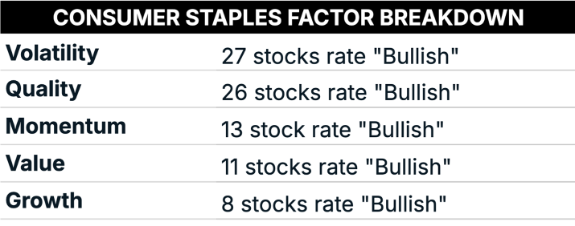
Fully 27 out of the 33 stocks in the sector rate as “Bullish” on their volatility factor. Stocks highly rated on volatility tend to move less than the broader market.
The sector also rates strongly on quality, with 26 stocks rated as “Bullish” on that factor.
That’s good. It means they are conservatively managed, tend to carry a modest amount of debt and have maintained their profit margins during a difficult time of relentless cost pressures.
The “Bullish” factor ratings really drop off after that.
Only 13 rate as “Bullish” on momentum. That tracks, as investors have been flocking to technology and energy stocks all year.
Consumer staples just haven’t been on their radar.
And only 11 rate as “Bullish” on value… and an even more paltry eight on growth.
This isn’t unusual.
Consumer staples aren’t generally hyper-fast growers. The same characteristics that make them low-volatility defensive stocks by definition mean relatively modest growth.
And because these stocks tend to be high-quality, they also rarely go on sale. Broadly speaking, I don’t expect to see stocks that rate well on quality to also rate well on value.
Bullish Consumer Staples
Enough teasing. I promised you we’d cover the retailers helping Americans beat inflation. So, let’s get to it.
I broke down the nine “Bullish” stocks in the consumer staples sector and ranked them by their Green Zone Power Ratings.
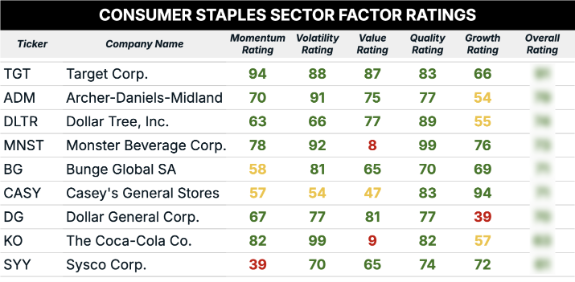
Only one stock rates as “Bullish” on all five of the factors: big-box retailer Target Corp (TGT).
It was a long road to get here.
Target performed exceptionally well during the pandemic years but really struggled to pivot once life returned to normal. The company spent years rightsizing its inventory to focus on the post-pandemic preference for experiences over “stuff.”
The stock had lost close to two-thirds of its value before finally bottoming out late last year.
But since then, Target has been on fire and now rates a “Strong Bullish” 94 on momentum.
The company is a discount retailer, of course. But when the shekels really get tight, consumers trade down to dollar stores.
And sure enough, two deep-discount dollar stores made the list this week, Dollar Tree (DLTR) and Dollar General Corp (DG). Both rate as “Bullish” on every factor but growth, and rate particularly well on quality and value.
One final discount retailer to cover is Casey’s General Stores (CASY), a chain with nearly 3,000 locations across the South and Midwest.
Casey’s is a fixture along America’s highways, blending a reliable fuel stop with a neighborhood kitchen and convenience store. It also happens to be America’s fifth-largest pizza chain.
More than two-thirds of its stores are located in small towns with populations under 20,000, often serving as the primary community hub and fuel station.
It isn’t exactly an original idea… and it certainly isn’t new. But Casey’s is clearly doing something right because it rates a “Strong Bullish” 94 on its growth factor.
The chain fills a needed niche along rural America’s highways.
To good profits,

Adam O’Dell
Editor, What My System Says Today