

Momentum is the only force in investing that can lie to you for a full year and never get caught.
It does it quietly.
A stock goes up, making it look strong. Looking strong pulls in more buyers. And for as long as that loop keeps spinning, nobody checks what the company is actually worth.
Then the loop stops. And everything the price was covering up reappears on the screen at once.
That is what just happened to the most popular uranium stock in the market.
Cameco (CCJ) has been the easy answer for two years running.
You want to own the nuclear buildout. You want a piece of the power demand coming from AI data centers.
You do not want to gamble on some junior miner in Saskatchewan with a drill and a dream. So you buy the big one.
Forty-two billion dollars in market value. The name every headline uses.
And here is the uncomfortable part.
The story is good. I am not going to stand here and tell you nuclear power is a fad.
Reactors are being restarted. Data centers do need enormous amounts of steady power. The demand case is real.
That is exactly what makes it dangerous.
A true story does not make a stock cheap. Those are two separate questions, and the market keeps forgetting it.
The good news is that Adam O’Dell’s rating system does not forget it. He built it to ask both questions at once and score them separately.
This month, the two answers finally split apart.
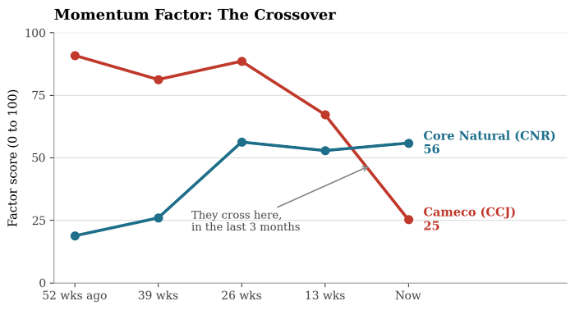
A year ago, Cameco scored near the top of the entire market with a 91 out of 100 on Adam’s Momentum factor. The stock was working, and the system confirmed as much.
Six months ago, it was still sitting at 88. Then it slid to 67. Today, it reads 25.
Look at the other line on that chart. Core Natural Resources (CNR) is a coal company. Twelve months ago, it scored 19 on Momentum, near the bottom of the market. It now reads 56. The two lines crossed inside the last three months.
And that tells us something important.
This isn’t simply a story about uranium versus coal.
It’s a story about what happens when the momentum shifts beneath a popular investment thesis.
So, let me back up and explain how these two ended up on the same chart…
How I Found These Two
Adam’s system scores every stock on six separate factors. Momentum, Size, Volatility, Value, Quality and Growth.
Each one gets measured on its own, from 0 to 100, against every other stock in the market.
A score of 90 means the company sits in the top tenth. A score of 10 means the bottom tenth.
Think of it as an X-ray.
The overall rating tells you how the stock looks from the outside. The six factors tell you what is actually happening underneath.
I started with one question. Which two stocks did Adam’s system rate about the same a year ago, but rate completely differently today?
It’s a narrow screen, and it does not return many matches. Just 207 names.
Then I threw out every pair that was not in the same business. Comparing a software company with a shipping company might tell you something about the market, but it doesn’t tell you much about what is happening within a particular industry.
What is left is a short list of genuine rivals that went in opposite directions.
Cameco and Core Natural emerged from that screen.
Same corner of the energy market. Same rough starting point 12 months ago. Almost nothing alike today.
Then I did the part that matters.
I pulled each of the six factors separately, quarter by quarter, going back a full year for both names.
Not the summary score. The pieces underneath it.
That’s where the story was hiding.
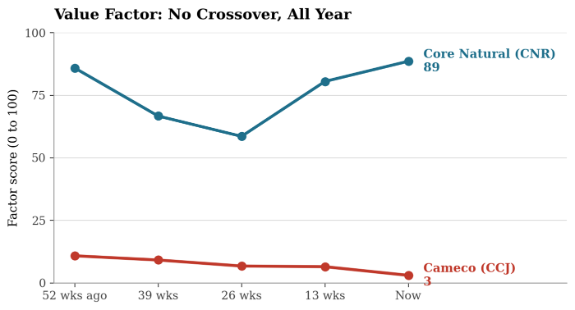
These are the same two companies on the Value factor. And this chart has no crossover in it at all.
Cameco has not scored above 11 on Value at any point in the past year. Not once. It sits at 3 today. Core Natural has not dropped below 58 at any point, and it currently reads 89.
Read that again.
The gap was never close. It was roughly 75 points wide 12 months ago and 85 points wide today. Nothing about Cameco’s price ever made it cheap. The rally did not create the gap. It only hid it.
And the numbers behind the score aren’t complicated.
Cameco trades at 164 times trailing earnings and 89 times what Wall Street expects this year. Sales shrank 1.8% over the past 12 months.
Earnings fell 33%.
Core Natural trades at 19 times forward earnings. Sales grew 30%.
So Momentum flipped.
Value never budged. What about the rest of the X-ray?
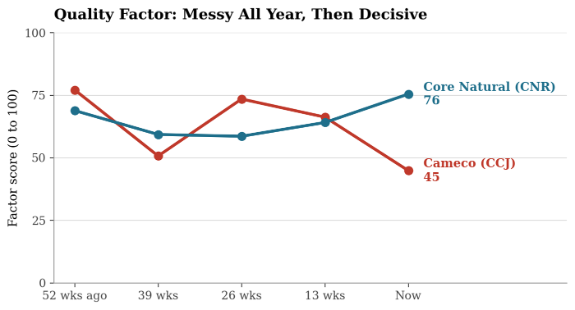
Quality is messier, and I want you to see the disarray. The two lines weave back and forth for most of the year. Neither company holds an edge for long.
Then the last three months arrive, and it breaks the same way Momentum did.
Cameco started the year at 77. It finished at 45, the lowest reading it has posted in 12 months. Core Natural went the other way, from 69 to 76, its highest of the year.
Two factors breaking in the same quarter is not a coincidence. It is the same event showing up twice.
Now let me tell you about the one that did not cooperate.
The Growth factor was useless here. Cameco’s Growth score went from 99 to 46 to 96 to 90 to 64. That is not a business changing direction four times in a year.
That is a quarterly earnings comparison whipsawing on lumpy numbers. Both companies finished in the same range, so there was no contrast to draw anyway.
I am telling you that because three factors agreeing is a real finding, and four factors agreeing would have been me picking the ones that fit. You should always know which evidence did not show up.
I am also not going to pretend the coal name is flawless.
Core Natural’s earnings are down 9.6% over the past year, and its Growth reading slipped last quarter. Coal is not a business anyone is calling the future. But I would rather own a cheap company with a soft quarter than an expensive one with a broken chart.
Here is what I want you to take from this.
Cameco’s overall rating was strong a year ago. But when you pulled it apart, almost all of that strength came from one factor.
Momentum was carrying the whole thing. Value was screaming the opposite, and Quality was drifting the wrong way.
That is not a strong rating. That is a countdown.
A rating built on a single factor is only as durable as that factor. And momentum is the least durable of them all.
It can hold a stock up for a year. But it cannot hold it up forever, and it gives you no warning on the day it quits.
The reverse is also true, and it is the part most people miss.
Core Natural spent most of last year looking like nothing. Bottom of the market on Momentum. No story. No headlines. But Value and Quality were solid throughout, which meant the only missing ingredient was attention.
Attention is the one thing that can arrive overnight.
So, here is your homework for this week… It will take you about 10 minutes.
Pull up the three largest positions you own.
Not the overall rating. Pull up the factor breakdown underneath it.
Ask two questions about each one.
First, is any single factor doing all the work? Second, if that factor is Momentum, what do the other five say?
If Momentum is high and Value is in the single digits, you do not own a good company. You own a price trend.
That can still work for a long while. But you should be aware of that before the market explains it to you.
And if you find a stock scoring well on Value and Quality with nothing happening in the price – like Core Natural 12 months ago – put it on a list. I will be watching Cameco’s Momentum score from here. If it stabilizes in the 20s while Value stays at 3, this story is not over.
Until next time…
Safe trading,

Matt Clark, CMSA®
Chief Research Analyst, What My System Says Today
P.S. At first glance, it looks like just another obscure company on the Nasdaq. But dig a little deeper, and you find a proposed defense deal, a rapidly growing drone industry and a ticker trading for less than $5. Moneyball Economist Editor Andrew Zatlin believes there’s much more to this story.
On Monday, he’s hosting a presentation to reveal the company he’s been eyeing, walk through its backdoor IPO structure and explain why September 30 is such an important date. If everything plays out as expected, investors who understand what’s happening beforehand could position themselves for massive gains.