
Nike (NKE) was the brand of my childhood and teenage years.
Michael Jordan wore Nike shoes… and I had a pair of Air Jordans I guarded with my life.
Every American kid my age wanted to be like Mike, no matter how unimpressive our vertical jumps might have been.
Growing up, I’d visit my aunt in Chicago every summer, and she’d take me to “Niketown,” a massive, multi-level flagship store downtown.
It was a 10-year-old boy’s dream come true!
Nike was an absolute powerhouse of a consumer brand, and it maintained that dominance for decades.
So when I saw the news that the iconic sportswear company was set to be booted from the S&P 500 Index later this month, it made me a little nostalgic.
After years of losing ground to upstarts, Nike no longer makes the cut as one of America’s 500 largest and most influential companies.
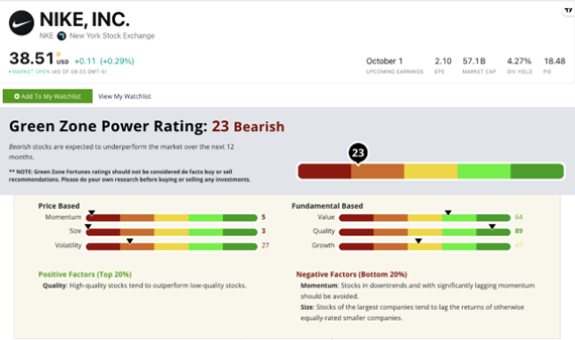
But while I was a little sad, I can’t say I was surprised. Nike rates as “Bearish” on my Green Zone Power Ratings, and hasn’t rated well for quite some time.
It’s still a profitable company, as you can see from its high quality factor rating. But its growth stalled long ago, and the shares have struggled to find direction.
So, what happened to Nike?
How did the company that invented “athleisure” as a fashion trend end up as an also-ran?
You can point to a few specific mistakes.
In 2017, Nike attempted to cut out the middleman and sell directly to consumers.
That strategy completely backfired, and the shelf space vacated by Nike was filled by new rivals like Hoka, On and New Balance.
Nike also leaned too heavily on its legacy brands like Air Jordan – eventually mass marketing them to the point that they lost their cachet.
But the biggest problem is that Nike got caught in the middle.
As I’ve written all year, we have two consumer economies today.
At the high end, wealthy consumers have benefited enormously from the AI-driven economy and continue to spend.
Then there’s everyone else.
Years of high inflation and stalling wage growth have left millions of Americans struggling to pay their bills and with less money to spend on discretionary purchases.
This has created opportunities for companies helping Americans save money.
For example, off-price retailer Ross Stores (ROST) has enjoyed a fantastic run. And it should come as no surprise that Ross is the highest-rated of all consumer discretionary stocks on my Green Zone Power Ratings.
With all of this in mind, let’s do a sector X-ray of the consumer discretionary sector to see what insights we can glean.
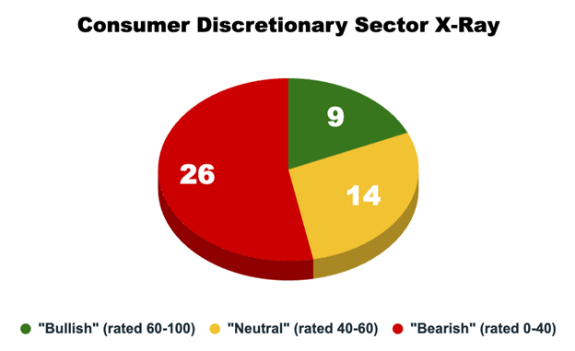
There’s no need to sugarcoat it. Consumer discretionaries look terrible from the top down.
Of the 49 consumer discretionary stocks, only nine rate as “Bullish,” meaning a score of 60 or higher out of 100. (For those new to my system, “Bullish” rated stocks outperform the S&P 500 by double on average over the following year.)
Another 14 rate as “Neutral,” meaning my system would expect them to perform more or less in line with the broader market. And 26 consumer discretionary stocks – a solid majority – rate as “Bearish,” meaning my system would expect them to significantly underperform the market.
Let’s keep digging.
Where Do Discretionary Stocks Pick Up Points?
The Green Zone Power Rating system is a composite score based on six primary factors: momentum, size, volatility, value, quality and growth, each of which comprises several sub-factors. (As we are looking at large-cap constituents of the S&P 500, I don’t consider size when doing the sector X-ray.)
So, where do consumer discretionary stocks pick up the most points?
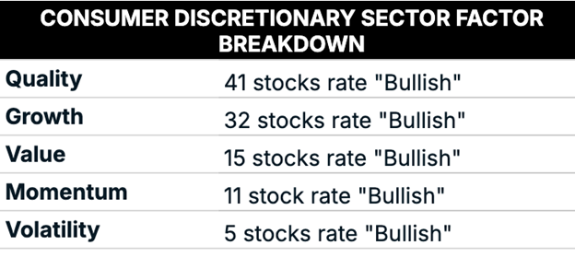
Given the overall weakness in the consumer economy, I’ll admit I was a little surprised to see this sector rated as well as it is on its quality and growth factors. Overall, 41 rate as “Bullish” on quality and another 32 rate as “Bullish” on growth.
This is a testament both to the pricing power a good brand provides and to the ability of American retailers to adapt to the times.
Perhaps reflecting the uncertainty ahead, the sector rates poorly on volatility. Only five rate their volatility factor as “Bullish”.
In my Green Zone system, a low volatility rating means the stock is volatile. It tends to “bounce around” relative to other stocks.
So, what are we to make of this?
It seems that Wall Street is having a hard time pricing the sector. Given the moving parts today – inflation, job risks due to AI adoption, etc. – the masters of the universe lack conviction in the sector.
But what does my system say?
Let’s find out.
Bullish-Rated Discretionaries
I ranked the stocks in the sector by the Green Zone Power Rating and limited the list to only those rated as “Bullish.” Here’s what I got:
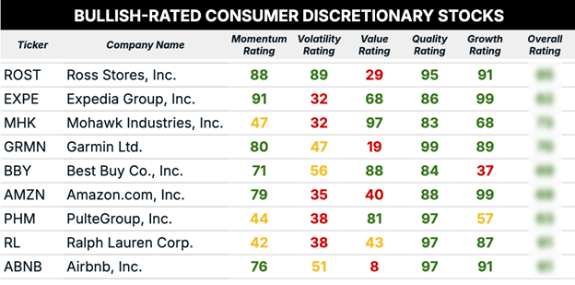
As I mentioned a moment ago, Ross Stores has the highest rating. And apart from an iffy value rating, it rates as “Strong Bullish” on all other factors.
This is a company almost perfectly designed for the retail environment we’re in. Americans still want the brands they know and love.
They just can’t afford to pay full price for them right now. So, they’re looking for them at off-price retailers like Ross or T.J. Maxx.
Expedia (EXPE) and Airbnb (ABNB) also made the cut. And the tie that binds them is obvious. Americans still love traveling, but they’re looking to do so on the cheap. Expedia and Airbnb allow them to shave a few dollars off their travel bills.
And naturally, there’s Amazon.com (AMZN). Wall Street considers Amazon more of an “AI stock” than a retailer these days, and that’s fair. Through its AWS cloud services business, Amazon remains one of the major hyperscalers fueling the AI infrastructure boom.
But Amazon also remains America’s premier online retailer and is unrivaled in its convenience and ease of use. Plus, the company is also quietly building out a logistical empire to directly compete with United Parcel Service (UPS) and FedEx (FDX).
It’s no coincidence that Amazon rates a 99 out of 100 on its growth factor.
To good profits,

Adam O’Dell
Editor, What My System Says Today