
Yelp Inc. (YELP) earned 57 cents a share last quarter.
Wall Street expected 32 cents.
That is a 78% beat.
Not a rounding error. Not a penny of window dressing.
Yelp came in more than half again as far ahead as what the smartest people covering the stock had written down.
Then those same analysts cut their numbers.
Over the past four weeks, analysts lowering their Yelp estimates outnumbered those raising them by 12. The stock fell more than 15% during that stretch.
Read that again.
The company beat earnings estimates by 78%. The forecasts went down.
Something is broken there.
And it’s not the company…
The Disconnect Our System Hunts For
This week, I pointed Adam’s Green Zone Power Ratings system at one gap in particular: companies where analysts keep cutting their forecasts, yet the company keeps beating them anyway.
That combination should be rare.
Analysts cut when they see trouble coming. Companies beat when the trouble never shows up.
When both happen at once, one side has it wrong.
My money is on the side with the receipts.
Here is how I found them…
First, our system has to like the stock. Every name below sits in the top band of Adam’s ratings. I am not fishing in the junk pile for a bounce.
Second, analysts have to be cutting. I count every estimate change over the past four weeks, raises minus cuts. The number has to be negative. Every stock on today’s list has more analysts walking their numbers down than up.
Third, the company has to have beaten big. Not “beat by three cents” big. I measure the surprise against how tightly clustered the analysts were.
Think of it this way. If every analyst covering a company agrees within a penny, and the company comes in a nickel ahead, that is a shock.
If the analysts are scattered all over the map and the company comes in a nickel ahead, nobody should be surprised. Same nickel. Very different meaning.
The screen I created scores the beat against the surrounding disagreement. The score has to clear one to make the list.
Fourth, it cannot be a one-off. I average that surprise score across the last three quarters and require it to stay positive. One lucky quarter is noise. I want a habit.
Fifth, the sales have to beat, too. This one matters more than most investors realize. A company can beat on earnings by cutting staff, delaying projects, or buying back stock. It cannot manufacture customers. When the sales line beats alongside earnings, real money walks in the door.
Sixth, the business has to be sound. My quality score runs 0 to 100. It looks at returns on capital, cash flow, margins, debt and the efficiency with which the company manages its assets. A stock has to clear 65.
Then two housekeeping rules. The stock has to trade at least $5 million a day and sell for more than $5 a share. A great screen result you cannot actually buy is worth nothing.
Ten stocks made it through.
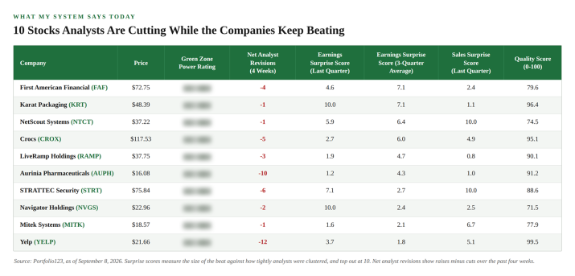
Two notes on that table.
The surprise scores top out at 10. A 10 means the beat was as extreme as Adam’s system measures.
Two names on this list deserve a closer look.
Crocs Raised Guidance and Fell 12.7%
Crocs Inc. (CROX) sold $1.18 billion worth of shoes last quarter. Analysts expected $1.15 billion. Adjusted earnings landed at $4.55 a share against a $4.35 estimate.
Management then raised full-year guidance to $13.85 a share at the midpoint.
The stock dropped 12.7% that day.
That drop-off was a result of the forecast for the coming quarter coming in light. Wall Street looked past a beat, past a raise and priced the one soft line in the release.
The analysts followed the stock down. Five more of them have cut their Crocs numbers than raised them over the past four weeks. Shares are off about 14% in that time.
Meanwhile, the beats keep landing. Crocs has topped estimates in each of the last three quarters. Its quality score sits at 95 out of 100. Very few companies in this market run that clean.
Yelp Scores Strong On Quality… Analysts Still Cut
That 99.5 is the highest quality score on this list, and close to the highest Adam’s system hands out.
Look under the hood, and you can see what makes analysts nervous. Advertising revenue, still 91% of the business, fell 3% last quarter to $342.5 million. That is the old Yelp, and it is shrinking.
Now look at the other line. Everything that is not advertising — data licensing, food ordering and its Hatch home services product — grew 98% to a record $33 million.
One-half of Yelp is fading. The other half is doubling. Analysts are pricing the first and ignoring the second.
Total revenue still beat, at $375.5 million against a $366 million estimate. Management then narrowed full-year revenue guidance to $1.460 billion to $1.470 billion. Narrower, not lower. The midpoint did not move an inch.
Wall Street cut anyway.
Why This Matters More Than It Looks
Here is the part worth holding onto.
Analyst estimates are not predictions. They are a bar.
When analysts lower the bar on a company that keeps clearing it, they are not warning you about the business. They are making the next quarter easier to beat.
Academics have a name for what tends to happen next. They call it post-earnings-announcement drift.
Stocks that deliver big positive surprises tend to keep outperforming for weeks and months after the report, as the market takes time to absorb the good news. Researchers first documented it decades ago.
It still shows up in the data today.
The estimate cuts hand you the other half of the trade.
They push the price down while the business holds up.
Six of these 10 stocks fell over the past four weeks.
Yelp lost 15%. Crocs lost 14%. The market is handing you the same beats at a lower price.
This list also spans eight corners of the market: insurance, packaging, software, online media, footwear, biotech, auto parts and shipping.
That tells me this is not one sector’s problem. It is a habit that runs through the whole analyst community.
So do this today.
Pull up every stock you own and check two things. What did the company report last quarter? And where have estimates gone since?
If the company beats and the estimates fall, do not sell into that. You are looking at a lowered bar in front of a company that has a habit of clearing it.
If the company missed and the estimates fell, that is a different story. That is the market telling you the truth.
The 10 names above are where those two signals disagree. Keep the list in front of you.
I’ll be back on Friday to seek out bullish and bearish earnings for next week.
Until then…
Safe trading,

Matt Clark, CMSA®
Chief Research Analyst, What My System Says Today