
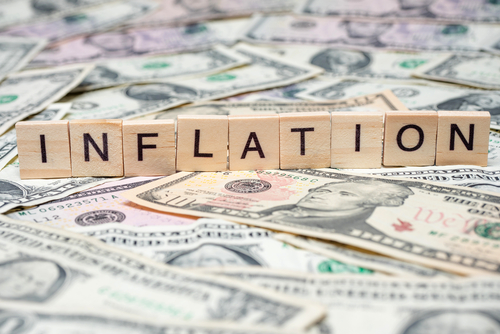
Ground beef costs $6.89 a pound in July. That’s the highest price ever recorded, up 12.5% in a year.
August set another record.
Now, guess how many S&P 500 Index companies mentioned inflation on their latest earnings calls.
The number is falling.
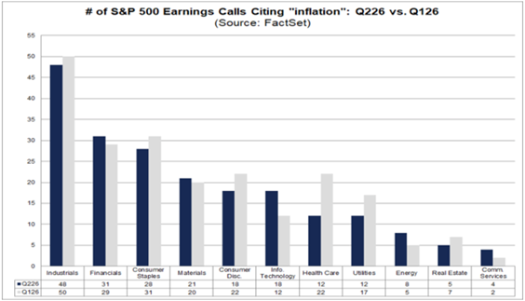
Just 205 companies mentioned inflation on calls held between June 15 and September 10 – down 6% from the 217 that mentioned it last quarter. And that figure sits well under the five-year average of 276.
Look at where it came from and where it went.
Health care dropped the most, down 10 companies. Utilities fell by five. Tech went the other way, up six.
Materials and consumer staples had the highest shares of any sector, with 84% and 80% of their companies raising the subject, respectively.
That’s not a market with one problem. That’s 11 sectors, each with a different problem.
Zooming out to the 10-year view tells you why this matters…
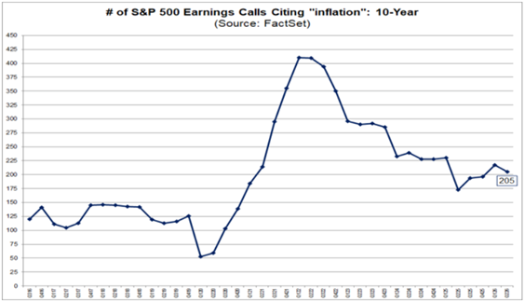
Look at that mountain in the middle. In second-quarter 2022, 410 companies talked about inflation.
Every CEO on every call. It was the only story in the market.
But look at where the line sits now.
At 205, we’re back near the 10-year average of 199.
Here’s the part most investors get wrong.
This regression back to a “normal” figure doesn’t mean inflation went away. It means inflation stopped being everybody’s problem at once.
It’s now a company-by-company problem.
One retailer passes the cost along without mentioning it. One restaurant chain swallows it and watches its margin shrink.
Same economy. Opposite outcomes.
And next Thursday, September 24, you get to watch both happen in one day.
“Bullish” Earnings to Watch
These stocks are expected to beat their earnings per share (EPS) from the previous quarter. And if those expectations are met or exceeded, they could potentially trade higher.
For this screen, stocks must meet four criteria:
- 10 or more analysts cover the stock.
- The average analyst recommendation is a “Buy.”
- It BEAT analysts’ EPS estimates for the previous quarter.
- The average analyst estimate for the current quarter’s EPS is greater than the previous one.
Here are two companies that made this week’s list:

Cintas Corp. (CTAS) reports on Wednesday, September 23, with a $1.35 estimate, up from $1.26 last quarter.
But Costco Wholesale Corp. (COST) is the one to watch.
Costco reports Thursday after the close. The estimate is $6.55 a share, up from $4.93 last quarter.
Don’t let that jump fool you.
Costco’s fourth quarter runs 16 weeks. The quarter before it runs 12. Those four extra weeks of selling explains most of the gap.
Here’s the better reason to like this setup.
Costco reports its sales every month, so we already know how the quarter went.
Fourth-quarter net sales came in at $93.9 billion, up 11.3%. Same-store sales rose 9.4%.
For the full fiscal year, Costco rang up $297.3 billion in sales, up 10.2%. E-commerce grew 20.9%.
The top line is banked.
All that’s left to learn on Thursday is what fell to the bottom.
Now look at how inflation shows up in those numbers.
In August, the average Costco transaction rose 5.7%. Strip out gas and currency, and it rose 2.8%. Gas prices alone added about 2.9 percentage points to reported comparable sales.
So yes, inflation is padding the register. But here’s the number that matters more: foot traffic rose 2.5% worldwide.
When prices squeeze a shopper, traffic is the first thing to go. People make fewer trips. Costco’s trips went up. And 92.2% of its U.S. and Canadian members renewed.
That’s a company that collects inflation rather than pays it.
Costco lands in Bearish territory on our Green Zone Power Ratings. That’s the price tag talking, not the business.
A great company at a rich valuation is still a rich valuation. This is a setup to hold through, not a reason to back up the truck.
“Bearish” Earnings to Watch
For our “bearish” earnings screen, we’re only looking for two things:
- 10 or more analysts must cover the stock.
- The average analyst estimate for the current quarter’s EPS is less than the previous quarter’s.
We want companies that are covered by a sufficiently large group of Wall Street analysts who collectively expect the company to report a quarter-over-quarter (QOQ) decline in earnings.
Here is one company that passed this screen:

Darden Restaurants (DRI) reports that same Thursday morning, before the bell. The estimate: $2.05 a share, down from $3.51 last quarter.
Ignore most of that drop. Darden’s fourth quarter is its biggest, and its first quarter is its smallest. That’s seasonal, not a warning.
The warning is in the beef case.
LongHorn Steakhouse carried Darden last quarter, with same-restaurant sales up 9.5%. Olive Garden managed 2.4% and missed analyst expectations.
So, the brand doing the heavy lifting right now is the brand that sells steak, in the year beef hit an all-time high.
Darden built its 2027 plan on total inflation of about 3%. Beef is running at four times that.
The company can raise menu prices, trade guests into cheaper cuts, or accept a thinner margin. Usually, it’s some of all three, and all three show up in this print.
Then there’s the bar itself.
A year ago, Darden earned an adjusted $1.97 in this same quarter. The estimate calls for $2.05. That’s 4% growth from a company that just reported 22.8% growth in adjusted earnings last quarter.
Slow growth against a high-cost quarter is how a good company misses.
And Darden certainly fits the bill.
It rates Bullish, the strongest rating of the three names here. That’s the whole point.
A strong business can still walk into a bad quarter, and this one reports before the market opens, which means you can’t react while it happens.
What To Do Before Thursday
Two companies. One day. Two sides of the same inflation.
If you own Costco, this is a hold-through-earnings setup.
The sales are already reported, so watch two lines in the release: gross margin and membership fee income. Those decide the number. Don’t add to the position at this rating.
If you own Darden, act before Thursday morning, not after.
Set your stop now.
Then read the release for one line: food and beverage costs as a share of sales. If Darden still says 3% inflation for the year with beef where it is, that’s a promise it has to keep for nine more months.
And carry this into every report you read this season. The question stopped being, “Is inflation high?” That one is settled, and the earnings calls have moved on.
The question now is simpler and far more useful.
Who pays for it?
Somebody at every company you own is answering that question right now. Next week, two of them will answer out loud.
That’s what the system says today.
I hope you all have a great weekend. Until next time…
Safe trading,

Matt Clark, CMSA®
Chief Research Analyst, What My System Says Today
P.S. A ticker change. A golf-course company. A proposed defense merger. A Trump family connection. Each clue by itself might not mean much, but Moneyball Economist Editor Andrew Zatlin believes the breadcrumbs tell a much bigger story.
On Tuesday, he’ll go on camera to put the pieces together and reveal the little-known ticker at the center of the proposed transaction. He’ll also explain why September 30 matters and where he believes the opportunity could be for investors watching this story early.