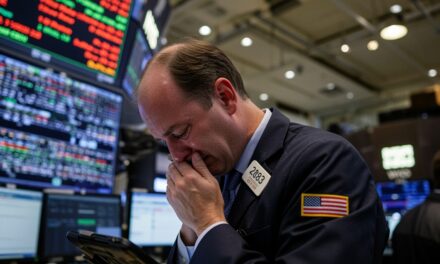


2025 was a rollercoaster for investors all over the market.
Everything from cutting-edge big tech to precious metals saw massive moves during the first year of Trump’s second presidential administration.
And we saw tremendous volatility as the market struggled to adjust to Trump’s new reality. From the “Liberation Day” tariff selloff to the subsequent surge in data storage stocks, all roads led to Trump’s transformative policies and agenda.
But now we have a whole new year. And with it, new trends that are starting to crop up in our data.
Today, we’re diving into the “Mystery Market” to discover where your portfolio is really headed through the rest of this year.
Click below to watch the video:
Video transcript:
Welcome to Moneyball Economics. I’m Andrew Zatlin.
And if you thought last week was choppy, this week could be another week of choppiness because again, we’ve got all this economic data coming out concentrated in a week.
And quite frankly, the markets are nervous.
So they’re likely to overreact up or down depending on the day and depending on the economic data points coming down the pipeline. To give you some context, okay, we are now in 2026, the second month. 2026, well, the market’s looking for direction. What is it going to look like?
Using that Groundhog Day metaphor [from last week’s Moneyball Economics], are the markets going to emerge from hibernation, look around and see sunny days ahead? Or are they going to be doom and gloom and cloudy up ahead?
We don’t know yet and the markets don’t know either. They’ve made some assumptions and this economic data will give them some insight.
2026, we’re a little bit further away from 2025. So 2026 can stand on its own two legs.
We’re not seeing as much of 2025’s tornado — Trump, the tariffs, the government shutdown.
And so we’re not getting these external shocks to the economy and now we want to see what happens next. Having said that, the bulk of the data points coming out this week are still, they’re still kind of laggy. They’re still talking about what was happening in December, but that’s okay. It’s what we got.
So let’s talk about what we can expect to see this week…
We’ve got retail data coming out, our consumer spending. Do we have an economy that’s growing? We’ve got inflation, CPI. Our consumer’s seeing inflation. If you’ve got more inflation, there’s less room in the pocketbook to spend on other things. Also, it tells us what the Fed may or may not do. More inflation, Fed unlikely to cut rates.
And then we’ve got the labor market in the form of payrolls on Wednesday and jobless claims on Thursday. Let’s talk about what the markets are expecting and where there could be divergences because quite frankly, the market responds to the divergences more than what they’re expecting.
Let’s start with retail.
We are a consumer economy. What happens with retail is an insight into whether or not the Fed’s going to cut rates, but it also is insight into 2026. If consumers continue to spend at the rate of their wages growing, say around 4% or so, that’s a good sign. If they’re spending less, well, that’s a sign that they might be more worried, a pullback.
Right now, the latest snapshot will be retail data, which looks at December. So again, it’s a little bit outdated. It also doesn’t include things like the interest rate cut that came. So that data is not necessarily “past is prologue,” but it’s the best we have right now.
The markets are expecting as steady as you go, 0.4%. I’m going to tad below that just because I think we’ve got some issues with the gas prices coming down, which is a good thing because that lowers inflation.
But in terms of the retail number, if prices are lower, well, that just means people are spending less on gas.
In any event, if retail comes in below 0.4%, well, does that mean the Fed’s more likely to cut rates or should we be more concerned about, “Hey, the economy’s going to slow down.” I think it’s a rate cutting decision if it’s below. If it’s higher, well, there’s strength in the market. We have a firming up of the market, but not too crazy.
So again, question is, will economic strength make the markets concerned about interest rate cuts going forward?
That’s where they get a little bit weird…
If it’s 0.4% plus minus a little bit, markets aren’t concerned. Inflation, that’s a big one because again, inflation and jobs are the two major levers that drive whether or not the Fed’s going to cut rates.
Also, inflation, well, it’s taking money out of the pocketbook of consumers. They can’t spend it on other things. The beauty of inflation for the past year has been bringing down gas prices. That has been in and of itself a major deflationary impact.
But to be honest, it’s kind of run its limit.
And so inflation isn’t necessarily going to come down that much. And so right now, the markets are expecting for inflation as steady as you go number. Again, no surprises. The beauty of CPI, which is coming out is it’s a January snapshot. So if retail was looking at, yeah, that happened but almost two months ago, this CPI is looking at more recent views.
And again, as long as inflation doesn’t perk up, and in fact, if it comes down, we’ve got room for rate cuts, markets will be happy. So that’s bullish.
Now let’s talk payrolls. Look, payrolls this month are going to be crazy. And they’re going to be crazy because we’ve got a major revision in the works. So they’re doing some backwards looking and they’re going to reduce the amount of payrolls that are out there in the past.
But for January, they’re also rolling out a major new model and they’re making changes to the model which are also bearish, pulling down payrolls. The problem is right now, introducing this model, we don’t know what they’re really going to do in the land of government statistics, the Bureau of Labor Services.
So we don’t know what’s really going to happen. And so right now we’ve got forecasts going from zero to a hundred.
Nobody really knows, but let’s put a stake in the ground. The run rate for a couple months has been somewhere around 50,000 payrolls added, weak. Not recessionary weak, but weak. Anything above that, hints at gathering strength, a firming up. The closer you get to 100,000, more firming up. Again, the markets don’t like that because there will come a point where the Fed says, “Hey, markets are firm enough. We don’t need to cut rates right now.”
However, this model, it’s a major headwind. I believe that under normal conditions, we would see a 100,000 payroll number. And I’ve been saying that for two months now. However, I’ve backed down. I’m closer to 70,000 because quite frankly, this model is a headwind and I think it’s going to push payrolls down a tad. I’m actually really close to consensus on this view.
But again, right now, there are people out there who think it’s going to be seriously low.
I don’t think so, but the markets are responding to anything and everything with nervousness. With that in mind, your view for 2026 should be bullish. You should be buying the dips. That’s what I have been saying because we have a strong economy. That strong economy is going to pull along a strong stock market. It’s just what happens.
So when there are major selloffs, you should be thinking about jumping in. And if we have the economy that I expect we’re going to have, it’s going to be very industrial oriented. And so things like materials and industrials are likely to benefit the most.
Also, if indeed payrolls do go up, you might want to look at companies that are in the labor market like a Workday, Robert Half, companies that tend to benefit as more and more workers come back and as employers seek to sort of gather more payrolls and staffing.
In any event, choppiness this week likely up and down, but we’re in it to win it.
Zatlin out.

Andrew Zatlin
Editor, Moneyball Economics