
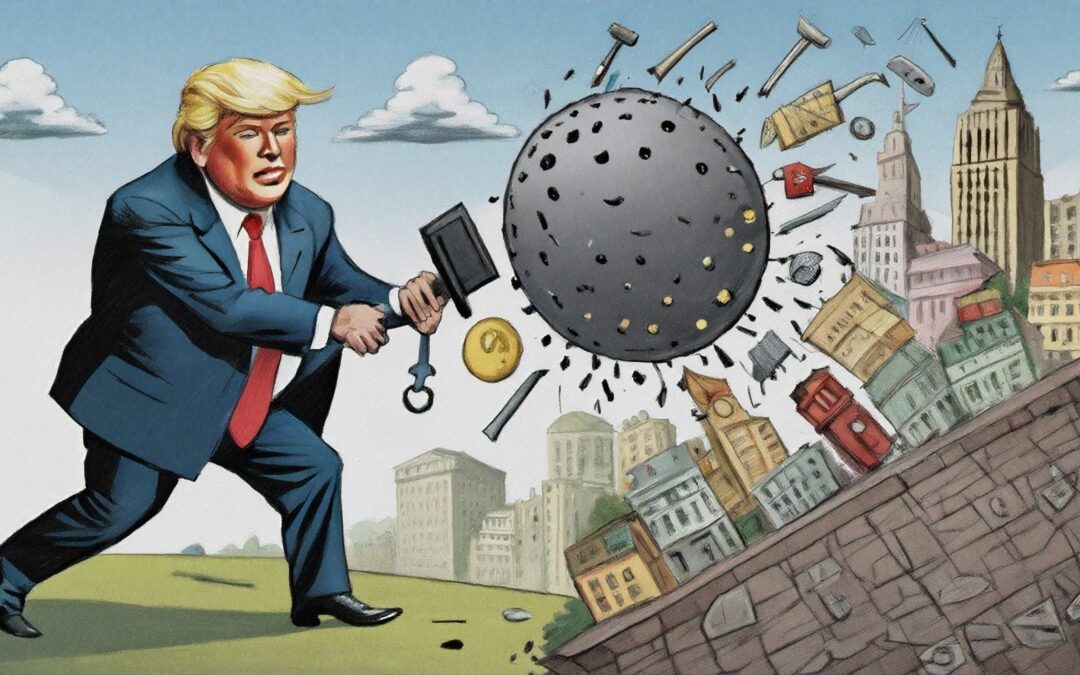
Over the first year-and-a-half of Donald Trump’s second term as President, we’ve seen him enact some bold new changes to the way our government works…
He’s tinkering with everything from tariffs to prescription drug prices — following through on the mandate that helped put him back in office after the 2024 election.
Despite the constant barrage of headline news, media spin and outspoken criticism, we’re not hearing much about the actual results of these policies.
There’s no shortage of talking heads out there ready to argue about ethics or established law. But when it comes to the real-world economic data showing how things are panning out, no one’s speaking up.
Until today.
Click below for the full story:
Video transcript:
I’m Andrew Zatlin.
Welcome to Moneyball Economics.
Welcome back from your three-day Memorial Day weekend!
As I was sharing on my sister channel, Superforecast Trader, this year’s Memorial Day is especially, especially meaningful to me.
You see, every year we spend Memorial Day thinking about the sacrifices that our armed forces have made for us for making the United States of America particularly safe for recognizing what they do for us. And this year I had the chance to do that at a personal level because my son, Cadet Ari Zatlin, just finished his first year at West Point and he came home for Memorial Day weekend.
So we got to celebrate Memorial Day together, got to tell him how proud I am of him. We even hit the gym together and my God, the guy’s an animal now. Barely one year in the army, he’s already packed on about 10 pounds of muscle!
He was running for 45 minutes, which obviously meant he had a big appetite for the grilling that I did later on, hamburgers and hotdogs. Yeah, I am a true blue American.
In addition to taking time to reflect on my son, I had the chance over this weekend to reflect on where we are in the broader economy as we start our sixth month of 2026. I sat back and I said, I was saying towards the end of last year, at the end of 2025, how big 2026 is going to be as bullish an economy can be, and especially in the second half.
And so far I have been proven pretty much right.
I said, “look, man, you got to dive into the stock market in 2026. It’s going to be on a bull tear.” When it dipped, I said, “buy the dip.” Hopefully you are along for the ride with me and you are enjoying the results because the market’s way up and the economy’s way up as well.
And that’s something that doesn’t get talked about enough.
So today I just want to check in and share with you what is going on and why it has such strong legs, not just for a few months, not just for the rest of the year, but for a few years.
You see, Donald Trump has created an American manufacturing renaissance and an economic renaissance. And it’s worth taking a minute and checking in on why I say that.
Let’s start with the biggest, biggest, biggest metric of all. GDP, gross domestic product, how much we do basically if the US was a company. Historically, we have a run rate of GDP about 3.1% year over year. So we grow about 3.1%. In the last Biden year, we were close, 2.8%.
Last year was not a good year. No bueno. It was 2.1%. Still growing, still expanding, but kind of lethargic.
Well, this year we have kicked off with a bag.
The first quarter was growth of 2.7% year over year. Now, let’s put this in perspective. We know why 2025 went down. The body economy was hit over and over throughout the year by a series of shocks. It started off second quarter with the tariffs.
That’s right. Remember those? We had nothing but tariffs coming in, major disruption to the supply chain, major pullback in spending in the manufacturing sector, just chaos all over. Nobody knew what to do. Then we get further and further, we have the DOGE initiative.
And DOGE, not only do we fire 300,000 government workers, and remember they’re consumers. 300,000 people out of work, maybe they’ve got jobs, maybe they don’t, but clearly not working and throwing money into the economy as much from the federal government didn’t just stop with cutting payrolls.
A lot of spending in the private sector was also cut back by the federal government.
You’re talking tens of billions of dollars of non-spending in the private sector. The tariffs, government spending pullbacks, and then we’ve got added to that the government shut down October, November. Every few months, a hit to the body politic and the body economic.
And yet last year we still managed to pull out 2.1% of growth. That’s how resilient the US economy is. And now fast forward, it’s one year since. We have had a chance for the supply chain to adjust to all these spending shocks. And guess what? They have adjusted and more than that…
Let’s start off with a couple of data points. Let’s look, for example, start with where the supply chain is, because again, tariffs and dog and government shutdown, those are all spending impacting. And so the supply chain’s going to respond to it. And how did it respond to it? Well, it went down.
If you look at basically my favorite metric, which is capacity utilization. So this is looking at, think of it as a hotel. A hotel has a fixed number of rooms and some of them are vacant. Some of them aren’t vacant. The level of vacancy implies a level of demand. So if the supply is fixed, like a hotel has a limited set of rooms, but their vacancy rate’s going down, it’s because demand is going up.
Well, that’s what we talk about when we talk about, for example, factory capacity utilization.
A factory can make so many widgets. There’s a peak amount of widgets they can make, and then there’s the run rate. But generally speaking, they’re going to have some buffer. Just like a hotel’s vacancy rate, that buffer is going to expand or contract based on demand.
Because in the short term, you don’t just throw another factory out there. So you have sort of a fixed amount of capacity.
Well, guess what? This is where it gets amazing. Every year since 2022, every year since we came off of COVID, factory utilization has been contracting every year. October ‘22, that’s about three and a half years ago. Well, starting about six to eight months ago, it started to expand, or I should say contract less until basically starting in January.
It actually started to expand year over year. Factories started to have their capacity used more and more. And that has been continuing even with what’s going on in Iran. Factories are finding more demand for their products. Now, why is that? Well, let’s shift gears. Let’s talk imports and exports. The tariff resulted in making imports less profitable, more costly, and that shifted domestic producers to look for sources domestically.
That’s why factory capacity is now being used more and more.
And you can see that in the import data and in the export data.
What you’ll see in the import data is when you strip out this unusual AI spending on computers, imports are down almost 6% year over year. That’s huge. We have reduced our spending on goods coming into the US by 6%.
And how do we do that? By shifting it to domestic production.
That’s key.
So now we’ve got all these jobs floating out there that are in the goods and services production sphere. And as that continues to grow, you’re going to see more jobs, you’re going to see lower jobless claims. And let’s talk about those data points. Look at jobless claims. They’re at about 210,000 plus minus. And as I’ve been saying, they’re going to continue to slide and go down. Why is that?
Well, partly because the supply has shrunk. The supp has shrunk for two reasons. Like I said, supply has shrunk because we’re expanding our manufacturing base and so they’re soaking up more workers. But it’s also down because we did get rid of two to three million workers under Trump. We’ve deported them or they’ve self-deported. As a result, demand rising, supply falling, companies don’t want to let go of their workers.
So they’re holding on. That’s why jobs claims are going down. Payrolls are going up because it’s reflecting the fact that demand continues to rise, supply continues to fall and manufacturing blue collar jobs, they’re just growing. So as a result, you look at 2024 and 2025, payroll growth very weak last year, zero basically.
This year already, four months into the year, 320 something thousand jobs have been created. That’s huge. And it looks like we’re going to continue that path.
So we’ve got an economy that’s growing. It’s expanding 2.7%. It will probably expand a litle bit more in the second half. The second quarter’s going to be a little bit limping through some of this Iran oil shock stuff. But generally speaking, you can expect expansion, expansion, expansion, more jobs, more jobs, more jobs.
And jobs are great. Job growth is great because as people come into the job market, they spend money, they create more demand for workers. They then come into the economy and so on and so forth. So it’s got this fantastic feedback loop.
I believe that as the year progresses, we’re going to continue to see an acceleration in GDP and as a result, we’re going to see an acceleration in stock market growth. Bond market, not so much because unfortunately with all this growth, with this capacity utilization starting to firm up, these are more inflationary water.
So we’re more inclined to see interest rates kind of sort of move up. Not strong, not huge, but more on that upward tilt.
This isn’t going to crush the stock market. It will absorb it because we’re also going to see at the same time margin expansion and explosive profit expansion. We are entering our six month.
Everything looks great for the macroeconomy. Little bit of oil shock issues to deal with, but they’re going away. It’s transitory. Longer term, Trump has turned to ship in a direction that if it is maintained, could last five to 10 years.
So it’ll be very interesting to see how big of a cycle this will be. Stay in the stock market. It’s what I’ve been telling you when we had that pullback, I said, buy the dip. This economy underneath everything is growing and it will push the stock market up.
We’re in it to win it, folks.
Zatlin out.
Andrew Zatlin
Editor, Moneyball Economics