
Energy continues to absolutely crush every other sector of the stock market.
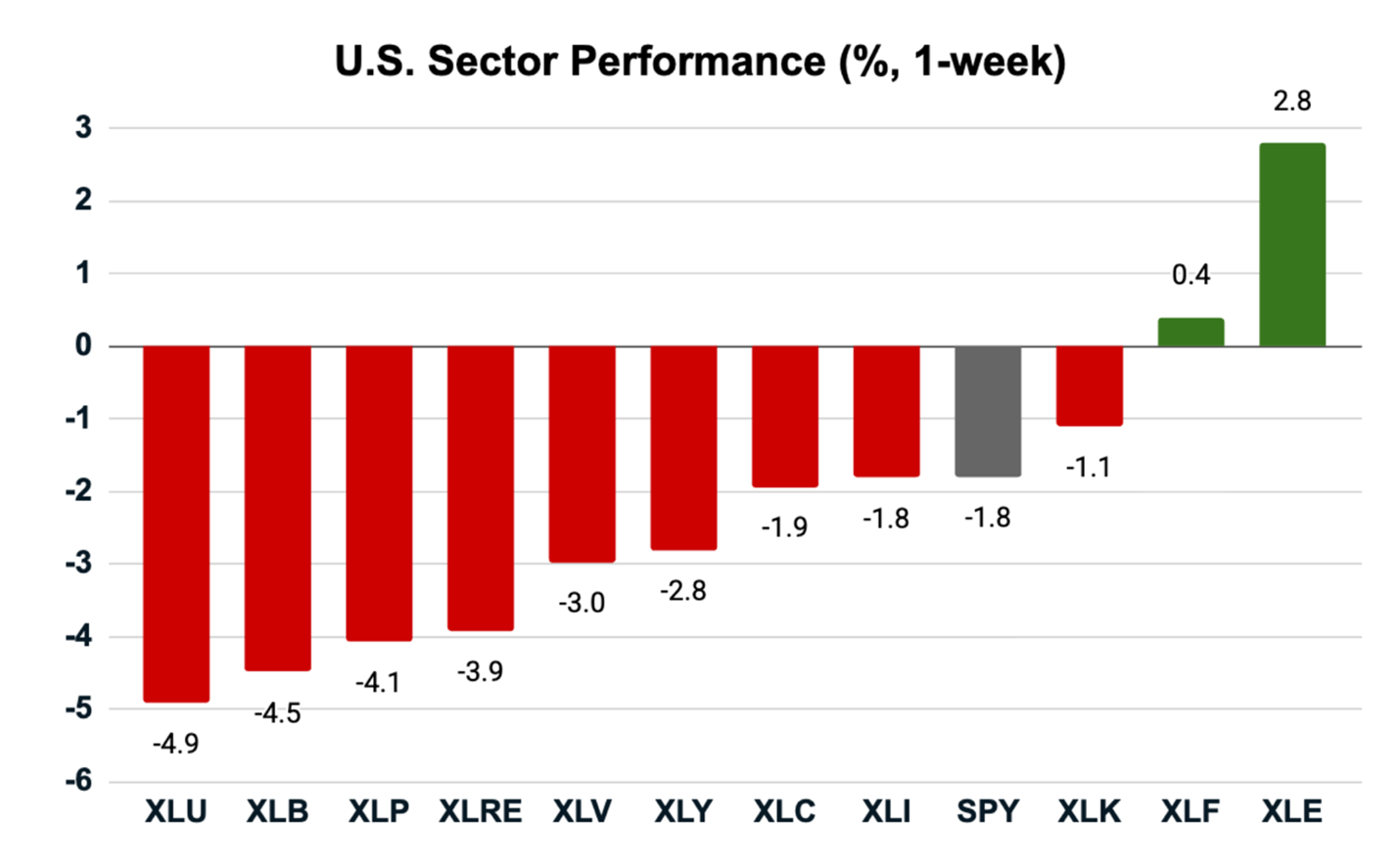
The State Street Energy Select Sector SPDR ETF (XLE), which includes all of the energy stocks in the S&P 500 Index, was up almost 3% last week – making it the top-performing sector yet again.
That brings its year-to-date growth to over 32%.
Meanwhile, financials managed a small gain last week, with the State Street Financials Select Sector SPDR ETF (XLF) up 0.4%.
Every other sector finished the week in the red, with the State Street Utilities Select Sector SPDR ETF (XLU) finishing at the bottom of the pile, down almost 5%.
The massive outperformance in energy needs no explanation.
We’re entering the fourth week of a brutal war in Iran that has shut down the Strait of Hormuz – the world’s most important energy corridor. So, it only makes sense that energy investors would be licking their lips right now.
But what about utilities? Why would utilities – normally considered the safest and most defensive sector – be dropping so hard?
It comes down to the Federal Reserve.
As I wrote last week, the Fed has absolutely no idea what to do right now.
The longer Hormuz stays closed, the worse the energy and food crisis is going to get. (Remember, Hormuz is a major chokepoint for fertilizer as well as oil and gas. It’s why my Green Zone Fortunes readers are already up 25% in less than a month in a leading fertilizer company.)
The spike in energy and food prices threatens to reignite the inflation that the Fed has spent the past four years trying (and mostly failing) to bring down.
The Fed will not cut rates in an environment like this. As I write this, the futures markets are pricing in a no better than 12% chance that rates are even a quarter point lower by the December Fed meeting… and a 30%-plus chance that rates will be higher.
And this is where things get sticky for utilities.
Utilities have traditionally been thought of as “income stocks,” and their high dividend yields make them direct competitors with bonds.
Well, bond yields have been rising due to fears of inflation and of a more hawkish Fed. Rising bond yields mean falling bond prices… and falling prices for bond substitutes like utilities.
That’s why utilities got absolutely pounded last week.
So, could the carnage in the sector have created some buying opportunities?
Perhaps.
But first, let’s examine the big picture.
As I wrote last Monday, “if you’re attempting to trade the headlines, you’re very likely to get whipsawed. Unless you happen to run a ring of spies with better intel than the CIA, you and I don’t have an information advantage here. Trading war headlines is a game we can’t win.”
I’d say the same for trading Fed headlines. You don’t have an edge there, and neither do I. We don’t have any special insight into Jerome Powell’s psyche.
Our edge is in our ability to tune out these headlines and use my Green Zone Power Ratings system to focus on the real long-term drivers of stock returns.
I want to emphasize again that energy stocks were rising long before the Iran war started. And they have consistently rated well on my system for months. A high rating does not guarantee a profitable trade, of course.
But decades of research show that it stacks the odds in our favor.
So, my advice to you is to simply keep calm and follow the system.
Key Insights:
- Energy is leading the pack yet again.
- The Fed may be raising rates rather than cutting… and investors are repricing everything.
- Now, more than ever, a system is the key to maintaining your sanity.
Energy Absolutely Dominating
For the third week in a row, energy remains the only major sector making money.
I ran my customary screen of the biggest movers in the energy sector that were also still within 10% of their 52-week highs last week. The idea is to look for solid, market-leading stocks that are getting stronger.
Here’s what I came up with:
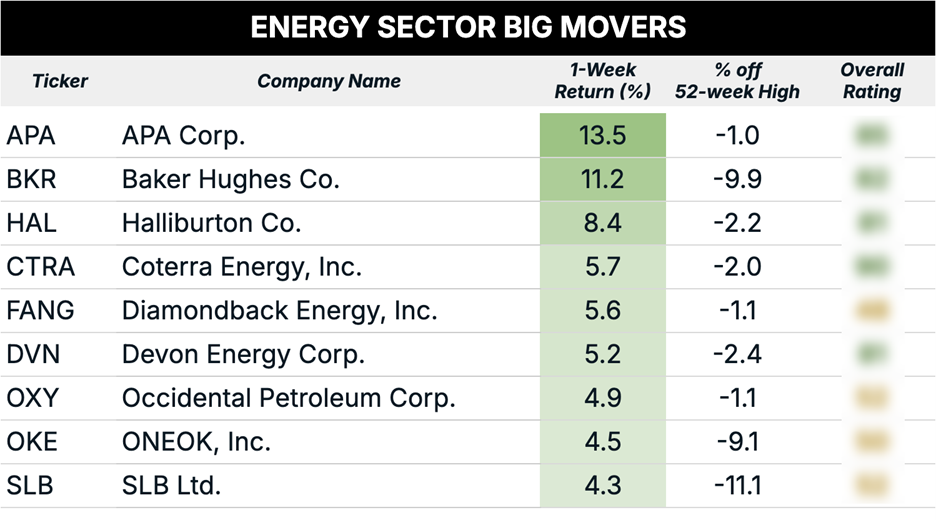
Some of the strongest performers last week were holdovers from the previous week. APA Corp (APA), Devon Energy (DVN) and Occidental Petroleum (OXY) all continued to blast higher. Plus, all three rate as “Strong Bullish” on my Green Zone Power Ratings system.
I want to clarify yet again that energy stocks were trending “Bullish” before the bombs started falling on Iran. And given the damage to Middle Eastern oil and gas infrastructure, American energy companies very likely have a multiyear runway ahead of them.
There will be volatility, of course. A ceasefire could trigger some short-term profit-taking, or a recession could sap some demand for crude oil. But until my system suggests otherwise, it makes sense to stay “long and strong” in energy.
Utilities Are a No-Man’s Land
It’s a strange market when the most conservative sector is the one getting beaten up the most in a market decline. But that’s where we are today in utilities, and my Green Zone Power Ratings System is signaling caution.
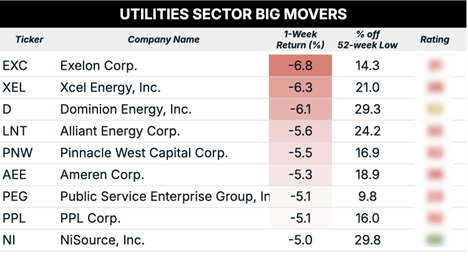
I ran my customary screen of the sector’s biggest losers for the week that are still trading within 10% of their 52-week lows. The idea is to find beaten-down gems that look poised to recover.
Well, the pickings were slim. Despite the drop in prices, all but one were still well above their 52-week lows, so I had to relax the criteria.
So, what exactly does that tell us?
Utilities are in an ugly no-man’s land.
Investors piled into the sector last year as a “picks and shovels” play on the AI boom, believing that the surge in power needs would be a major boon to utilities.
That trade has since faded, as data center operators are increasingly looking to generate their own power rather than tapping into the public grid and dealing with the political blowback from higher utility prices.
Meanwhile, the prospect of higher interest rates is weighing on the sector as well. Utilities have fallen out of favor with growth investors… yet remain too expensive for value investors.
You can see this reflected in the Green Zone Power Ratings system. Seven of the nine stocks are rated as “Bearish,” one is “Neutral” and only one – NiSource (NI) – is rated as “Bullish.”
My system shows that the utilities sector is mostly uninvestable right now.
Those conditions won’t last forever, of course. And it’s possible that all of this bearishness could be setting us up for a nice buying opportunity later in the year.
But for now, you’re better off avoiding the sector.
To good profits,

Adam O’Dell
Editor, What My System Says Today