
Well, I’ve got some good news and some bad news for you today…
First — the “bad” news. The economy’s running hot, with Personal Consumption Expenditure (PCE) topping 3.3% just as I predicted on Tuesday. That means inflation is slightly higher than where the Fed would like to see it, so we could see a rate hike or two starting in the final months of this year.
The good news? The economy’s running hot!
Corporate profits are climbing, and stocks look strong as ever heading into the final months of 2026.
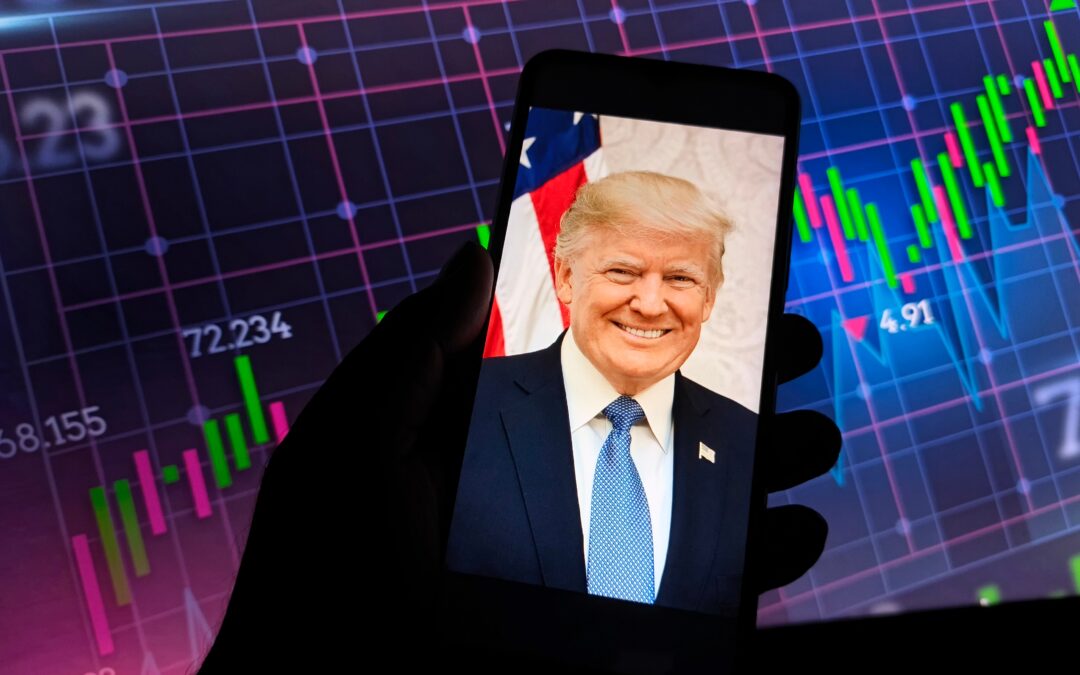
And this is all part of larger long-term economic cycle I’ve dubbed the “Trump Cycle,” which is set to carry stocks even higher in the coming years.
Click today’s video below for the full story:
Video Transcript:
I’m Andrew Zatlin, welcome to Moneyball Economics.
Today, I have some good news to share with you.
This week, some macroeconomic data came out and it confirms my prediction that we have finally reached an inflection point, that inflection point where the US economy is growing at an accelerating rate.
That’s wonderful news.
Now, on the one hand, it does mean interest rates are going to be going up, but on the other hand, with the economy raging, you can expect the stock market to continue to grow at double digit rates.
I want to share with you the data that came out, but to really appreciate it, let me give you some background…
We got to go back six years to the start of COVID. That was kind of an economic reset. Interest rates were brought down to 0%. We threw $20 trillion at the economy. In essence, we rebooted an entire economy overnight.
Sales went through the roof. People refinanced homes. More money was injected into the economy. Everything took off. But after a while, the subsidies slowed down and so did this activity. So by 2022, after about two years of this love, well, sales inevitably started to slow down.
The problem though was that companies, businesses didn’t see that sales were slowing down. They continued to ramp up hiring. They continued to ramp up inventories as if past was going to be future. In fact, there was a one-year lag between the peak of business sales and the peak of business inventories.
So by 2023, companies had built up staffing and inventories too high and that the sales level wasn’t supporting it. So there was a crisis that suddenly kicked in in late 2023.
That’s when companies looked out on the horizon. They suddenly discovered that sales were slowing down a lot faster than they expected and that they had to make a move in order to maintain their profitability.
See, CEOs are paid based on year-over-year profit growth, and the CEOs weren’t going to be paid very much in 2024 because they saw what was coming down the pipeline. At the end of 2023, sales had basically crashed.
In the fourth quarter, 2023, corporate profits had peaked at about 14%, but they didn’t slow down. No, they were crashing. First quarter 2024, instead of yielding 14% or so corporate profit growth, it collapsed to 4%.
Suddenly, companies were barely beating the rate of inflation with their growth. They couldn’t increase their top line because as I said, sales were coming down. So the only choice they had was to shrink their bottom line. That meant massive layoffs and a freeze on inventory buildup. So 2024 and even 2025, you’ll see that payrolls went nowhere. Companies stopped hiring. Inventories basically didn’t grow. This was a healing process and it was inevitable.
Regardless of who was going to come in last year’s president, it was inevitable that the economy was going to go through a period of healing. It was going to bottom and then start to move up. What wasn’t inevitable was when the economy was going to move up and at what pace.
Now introduce a Donald Trump into the equation.
On the one hand, he hits the economy hard every few months. We’ve got the tariffs, we’ve got Doge cutting spending, we’ve got government shutdown, we’ve got an oil shock. Every three months there’s some kind of big hit to the economy, but he’s also bringing in some major structural changes that boost the economy.
For example, the tariffs have been successful at moving manufacturing on shore. When you’re manufacturing more here, that’s great for economic growth, but it also reduces imports and expands exports. So fast-forward to GDP.
GDP growth looks kind of soft right now, but let’s face it, it’s only soft because of federal government spending. At federal government level, remember we fired 400,000 workers and reduced spending because of DOGE by tens of billions of dollars. If you look at the private sector, oh, growth is looking really, really strong. And that’s what this week’s data came out and showed. It showed us what’s going on with the consumer and it showed us what’s going on with corporate profitability.
Those two are connected because consumers are also employees. So if companies are doing well, the employees are doing well, money is going into their pockets, and as consumers, they’re going to start spending more. And again, corporate profits also drive more hiring. Companies, if they’re seeing a lot more business activity, are going to need to support that with more hiring. And if their profits are up, they can afford to hire more.
Well, again, let’s go back to the COVID cycle.
The COVID cycle ended last year and we kicked off a new Trump economic cycle, but it’s been shaky again because we’ve taken some body hits, but also companies wanted to get firmly into a place where profit growth was moving forward. 2024, 2025 profit growth was in the low single digits.
But by last year, companies started to recognize that things were healing, they were on the right trajectory. So we start off this year. In fact, corporate profits this year and the first quarter, high single digits. They’re moving up.
But in this quarter, as we just found out this week from the data, they’re at 25% year-over-year growth, and that’s not because of some base effect like last year was especially weak. What’s happened is we have an economy that bottomed. It has grown a trillion dollars year over year while the cost of supporting that economy have basically been contained.
Massive profits are on the table, 25%. We haven’t seen levels like this unless we are immediately coming out of a major recession or like in the 2000s, we’re just seeing major growth. And guess what folks? That’s what we’re seeing.
We are kicking off finally a major economic up cycle. So what can you expect? Go back to companies making 25% profit and likely to continue that for the rest of this year. Employees see this, they know this, and now they’re getting a little bit. I don’t want to put this positive.
Let’s say hopeful that companies are going to share the boom. In other words, most employees are now sitting here saying, “I should be getting a great bonus this year at the end of the year, and I should be getting a pretty good raise next year.” And companies are having to toe that line. Employees are going to get a lot more money in their pockets and employees are consumers.
So you can expect the economy to continue to move forward and not just existing employees, trillion dollars of growth and you’re growing even more, you’ve got to start hiring. So we’re going to start seeing a hiring wave as well.
And again, more consumers. In essence, the US economy is now in a positive feedback loop of growth on growth on growth, and we’re seeing some movements where we’re trying to export more to other countries. So far so good. Let’s talk to consumer. The second data point that came out looked at how consumers have been dealing with the economy changing over the last six months.
Remember, we got an oil shock in the early part of this year. That led consumers to shift how they’re spending, to try and stretch their dollars instead of steak buy chicken, that kind of a thing. But it also meant that while consumers will spend all the dollars that are coming at them, they got to stretch a little bit.
So credit card spending’s gone up and at the same time, savings rates went down. Well, in the latest data, which looks at July, we’re inflecting up again. Suddenly the savings rate is going up and that’s a good thing. That means consumers no longer are having to close their wallet just to survive, that now they can put some money aside.
That’s a sign that consumer spending is about to come in even faster. Key point, as we get further and further into this year, the economy’s going to get stronger and stronger. All these data signals are going to start getting uniform, pointing to a strong economy.
The only thing on the table right now is when does the Fed start raising rates? Personally, I don’t think they do it until probably November, likely December. That’s what I think. If you look out on the market, the market doesn’t know what to think.
My clients don’t know what to think, and that’s the biggest bet right now. In essence, the Fed doesn’t raise rates in September, October, stock market will propel forward further. Then when they raise rates, you’ll see a pullback.
Conversely, you see a rate hike sooner, markets will stumble a little bit, and then at the end of the year it’ll take off. Don’t think about the next couple of months each month, look at January. Stock market’s going to be raging as we get into January, and I hope that you are taking long bullish positions.
We are in it to win it, folks.
Zatlin out.
Andrew Zatlin
Editor, Moneyball Economics