


Manufacturing accounts for only about 10% of U.S. GDP today.
But that 10% gives me something the rest of the economy often can’t: forward visibility.
Factories have to respond to demand months before the final sale ever happens. That means when sales start outrunning inventory, manufacturers feel the pressure first.
And that’s exactly what I’m seeing now.
In today’s video, I’ll show you why this “small” corner of the economy may be giving us one of the biggest signals for what comes next.
Click the link below to start:
Video Transcript:
Welcome to Moneyball Economics. I’m Andrew Zatlin.
A reader recently wrote to me asking point-blank, “Zatlin, why do you waste time looking at the manufacturing sector? The US economy is a service economy. It’s a digital economy.”
Well, my friend, you are absolutely 100% correct.
Manufacturing drives barely 10% of the US GDP, and that’s down a lot from the 1950s when it was 20 to 25% of US GDP. But before you rush to dismiss manufacturing, that 10% is still pretty huge, and that’s two and a half to $3 trillion of manufactured goods being sold every year.
That means the US is the second largest manufacturing power on the face of the planet, second only to China.
But the other reason we want to focus so much on manufacturing activity is because it gives us an edge in the stock market. One of the number one ways to boost your stock market returns is timing, knowing when to get in, knowing when to get out, entry and exit.
I can’t tell you how many times, and maybe you’re like me, I’ve left money on the table because I didn’t get out of the stock fast enough or I didn’t get out of the market fast enough.
Now, another thing we have to agree to is that when the economy is growing, the stock market’s growing. When the economy is slowing, the stock market is slowing. So that’s your entry and exit big picture. And would you believe me that even at 10% of the US economy, manufacturing is probably one of the number one leading indicators for where the economy’s going.
If I want an edge in the stock market, I want something that’s going to give me forward visibility to where things are going, and that is manufacturing. Now, why is 10% the most powerful 10% for getting prediction capability?
Let me explain…
Here’s a chart of the US GDP over time:
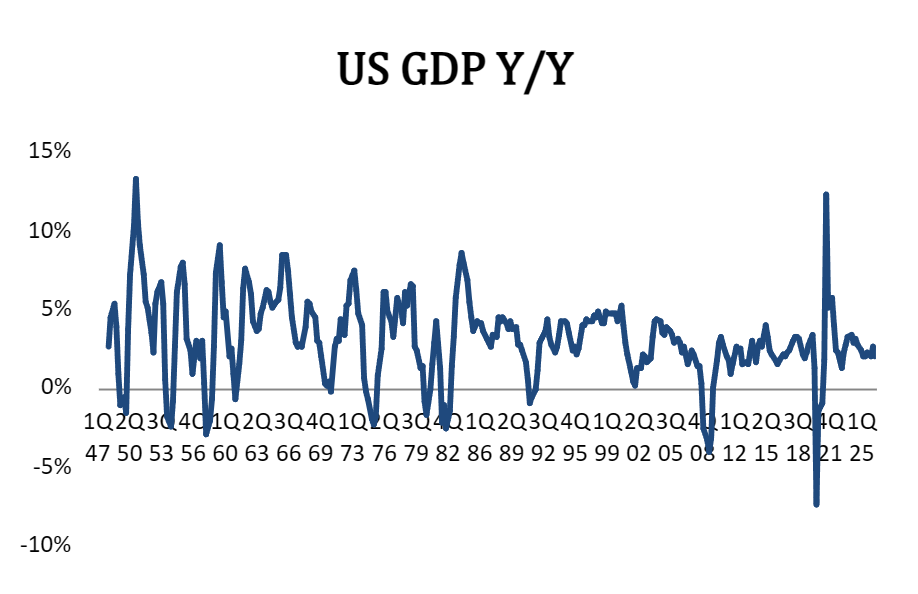
Now, what I want you to notice is the volatility here.
Until the internet came around, you had wild swings up and down in the US GDP.
Then the internet comes in and do you notice how much smoother the GDP is getting? It’s no longer soaring, but it’s also no longer collapsing. And the reason is because inventory management smoothed out.
See, prior to the internet, factories had to guess how much demand was going to be. There were multiple steps between the factory and say the vendor, and even the vendor didn’t know what the end user needed.
And so you had multiple places, multiple bottlenecks where bad information was flowing up and down. And to compensate for this situation, factories, warehouses, vendors, everybody stockpiled a lot of inventory. Just in case someone came in the door and needed to buy it, you had to have it sitting available on the shelves.
So inventory swings, maybe you had too much inventory, in which case demand finally reaches the factory and they realize they’ve overproduced. Uh-oh. Now they hit the brakes, they pull back on inventory and you’ve got the GDP suddenly crashing. The way the internet smoothed things out in the GDP is by looking at supply management, by looking at how inventory was being managed.
For starters, the internet enabled all these different players in the supply chain to more closely communicate. Factories could bypass everyone in the middle and talk directly to retailers. Same thing, retailers could talk directly to factories. What that meant was factories no longer had to bulk up on inventory that they might have to dump.
At the same time, retailers got more confident that by being able to go to the factory directly, they could get what they needed when they needed. So you had a much tighter business to business communication capability.
To understand the effect this had on inventory, take a look at this chart which compares the amount of inventory to sales. So what this means is every dollar someone is selling, they have to have some stock on the shelves. Well, before the internet, companies basically kept about a buck 50 worth of stock for every dollar that they were selling. They tied up a lot of their capital in inventory.
That’s why these swings were so painful.
If things collapsed, they had a lot of their money tied up in inventory that was now worth a lot less.
The internet comes in, enhances this communication, and instead of having a $1.50 worth of stock on hand for every dollar in sale, you go down to a buck 20. All of a sudden in the ’90s and 2000s, all this capital is freed up. That’s a lot of why the stock market surged and why the economy surged.
There was a lot more efficiency gain because of the communication and reduced inventory, but it also meant there was a lot more profit being made. And fast forward, you had companies like Amazon that took it to the next level, namely instead of it being a business to business type of engagement, now you could have business factory direct to the user and you could bypass the vendors.
In essence, the internet removed a lot of the bad communication, tightened up the flow of everything, reduced stockpiles. This was a huge change for the US economy and the manufacturing space. And here is how manufacturing came to play a big role in sending out a signal as a leading indicator. First of all, understand factory production happens well before a sale is made to a consumer. We are a consumer economy. And so if a consumer is set to buy, the factory has to have the stuff on the shelves.
Walmart, for example, in January is already making its orders for the holiday season sales nine months away. They have strong line of sight to what the end users are expecting and they go ahead and start making it.
So if I can dip my ladle into the supply chain early enough in the spring, for example, I know exactly what manufacturers and vendors are expecting for the economy going forward. That’s massive forward visibility. That’s an edge.
Because of this tightness in the supply chain, that means manufacturing has more than ever a huge reflection of what’s going on in the economy because they’re so tightly connected to the end user. Any kind of demand change up or down is rapidly passed to the factories in a leading way.
Before people start to hear about how much Costco is selling, the factories knew months before. So again, manufacturing is much more sensitive than ever because of the streamlined economy that we have.
There’s another reason why manufacturing activity gives us an edge, and that has to do with manufacturing is much more than 10% of the economy. That’s like saying, I went out for steak dinner and all I cared about was the steak.
We’re not factoring in the transportation, the valet parking, the bottle of wine, the cream spinach, the dessert, the bread, everything that goes along with the steak dinner. So when you’re talking about manufacturing, there’s also transportation.
There’s also getting it on the shelves at the retailer. So now we got to include retail all up and down, whether it’s in the private sector with business sales or to the consumer. It’s more than just what’s made. It’s getting it on the shelves and making the sale. It’s the software that goes into tracking the inventory, into managing the point of sale money transaction and so on and so on.
In effect, manufacturing is the heart of about 50% of the US economy. It is huge. And so we want to focus on manufacturing for the timing, for the entry and exit. It gives us a couple of months edge. And right now, manufacturing is set to boom. Take a look at this chart:
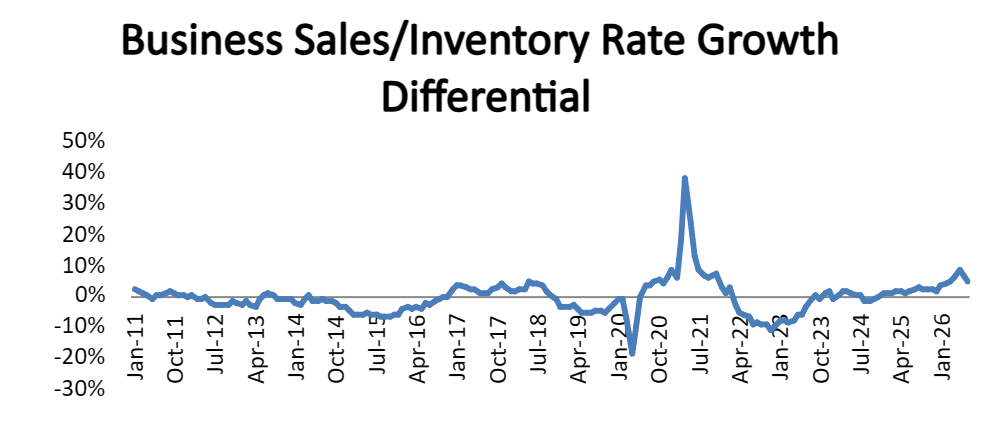
Companies have sales and then they have to have inventory to meet those sales. Well, there’s a certain amount of sales growth. So you want to move along from the inventory perspective and grow your inventory comparatively at the same rate. Well, guess what? That’s not what’s been happening. Sales growth has been taking off month after month after month, but inventory growth is lagging and lagging a lot. What does that mean? The US economy’s growing. That means sales are going to grow even more over the next few months. Stores are going to run out of goods.
And so as a result, you’re going to see a rush to replenish and stockpile all of this inventory. You are going to see, based on what’s going on in the manufacturing space, a surge in the US economy. There’s a lot of different things that spill out from that, but the big picture, should we be in the stock market? Is the stock market set to grow?
Well, the economy is set to grow.
That’s why you want to be bullish. I keep telling you be bullish. When the market was collapsing a couple of weeks ago, I said, “Be bullish. Still got time to jump in there because the economy is growing and sure enough, the stock market’s back.” You have many, many buy opportunities between now and March. There will be times where the threat of a rate hike might shake things out. That’s a buy opportunity.
Big picture, this economy is set to surge because that’s what the manufacturing sector is telling us. We’re in it to win it, folks.
Zatlin out.