
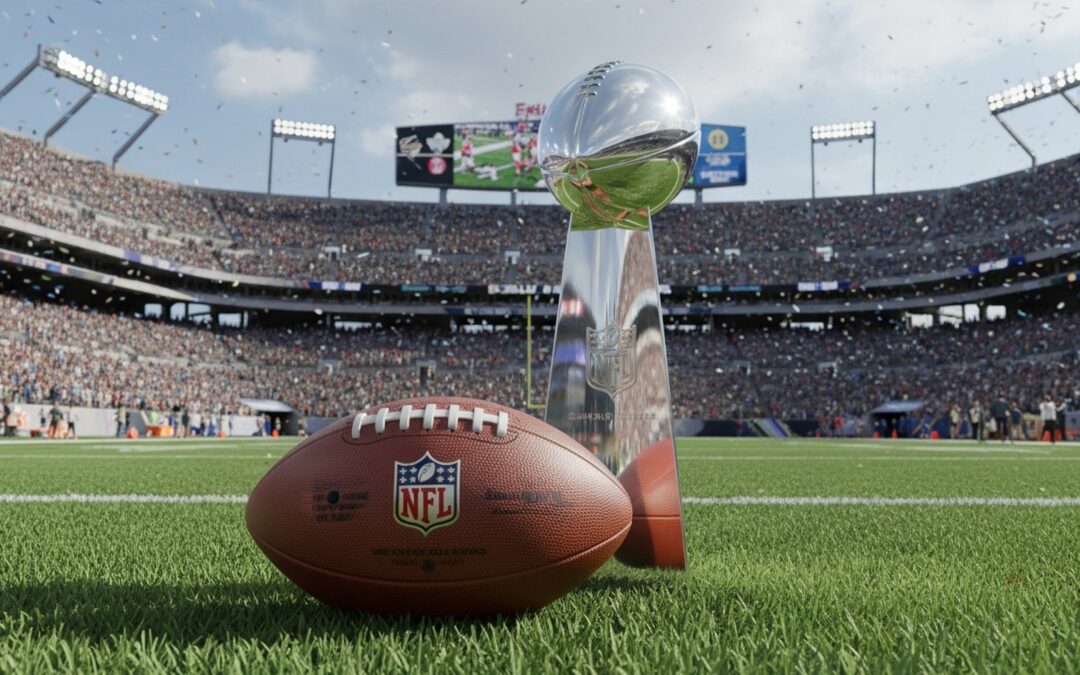
It’s t-minus three weeks to Super Bowl Sunday, with the Seattle Seahawks and Los Angeles Rams looking like strong contenders to make the game.
Of course, it doesn’t matter who makes the game this year. An estimated 127 million Americans is set to tune in anyway … many of whom will only be in it for the blockbuster commercials that debut between the action.
It’s always fun to see which top Hollywood star makes the cut for the year’s zany ads featuring Bud Light or Doritos. Personally, I’m always fascinated by the sheer cost of these ads, and how they end up working as a kind of “Phantom Tax” on the product’s consumers (most of whom don’t even realize they’re paying a premium to watch Bradd Pitt toast with Amstel Light).
And there’s another, much larger Phantom Tax that’s set to affect every American in 2026. That’s what we’ll be talking about in today’s episode of Moneyball Economics.
Hit the video below to get started:
Video transcript:
I’m Andrew Zatlin. Welcome to Moneyball Economics.
The Super Bowl. Super Bowl’s coming up. I’m pretty excited. I host a Super Bowl game and it’s interesting because one of my guests, she couldn’t give a rat’s ass about the game. That’s right. She doesn’t follow football, doesn’t know who’s in the playoffs, doesn’t care. But you know what she does care about? The awesome commercials.
And I love those commercials too. I mean, if you ask me who played in 2000 in the Super Bowl, I can’t remember. But I do remember the Budweiser commercials. I remember the, what’s up. Those commercials are awesome. And when you think about it, a lot of money is spent on those commercials.
So for example, this year alone, you’re going to see a 30 second commercial cost, $8 million for airtime. Now you throw in whatever celebrity you’ve got in there and the production time.
This is a big ticket event and get a big ticket event.
And guess what? Who pays for that? You do. I do. We pay for it in a form of price inflation.
So let’s say you’re Pepsi and you’re spending X dollars on advertising. You do the Super Bowl commercial. It’s fantastic. But that’s just an ordinary cost of doing business. And so if those costs go up like they are with the Super Bowl, well, I got to pass that along to my consumers in the form of higher prices.
So when you see inflation in one point in advertising world, understand that you’re paying for it and I’m paying for it. And that’s not the only form of tax, an advertising tax that you and I are paying for that we really don’t have a say in. There’s also a celebrity tax. Whenever you see a brand endorsement, for example, well, guess what?
You’re paying for that. Nike, Nike spends about one and a quarter billion dollars a year on endorsements. Basically Michael Jordan and Tiger Woods and others. One and a half billion dollars almost. That’s equal to 4% of their total annual costs. Well, guess what? You got to pay for it. You may not buy Jordan’s shoes. Doesn’t matter. Nike’s taking that and peanut butter spreading it across all of their footwear and products. You’re paying for it in the form of higher prices on the shoes. Now it’s not huge, but it’s a little bit.
And it’s the same thing as with Pepsi. It’s not huge. Another dime, another nickel on a bag of chips. But we’re seeing this everywhere as consumers. Companies, well, they just pass along the costs. Same thing. When you look at sports, there’s a sports tax on you and me.
Let’s use Shohei Ohtani as an example. He’s got a guaranteed $700 million contract. That’s spread out over time, but in any given year, I think he’s expected to make $40 million base salary plus kickers. And who pays for that? Well, the team pays for that ostensibly. In reality, that cost has just passed along in the form of, well, the team eventually raises prices on their tickets or their swag, food in the stadiums.
And you say, “That’s cool. Doesn’t affect me because I don’t go to those games. I’m not a baseball fan. I’m a football fan.” No, that’s not how it works. Because now they also have to raise the cost to broadcasters. They’re out there scrounging for ways to pay for Ohtani. Well, now the broadcasters have to say, “Well, I’ve got to raise my rates as well. ESPN, wherever you go. I’m seeing nothing but a celebrity, a sports athlete, an advertising tax.” And it adds up.
Netflix needs to raise their prices because Leonardo DiCaprio has a movie coming out. They want to make it available, streaming. But Leonard DeCaprio have got a $50 million paycheck for this movie.
Guess what? Studios have to raise the price that they negotiate with Netflix. So we’re kind of like frogs in the pan that’s being turned on hot. It’s just been gradually growing and growing. I don’t know the actual statistics here of how much you and I are paying for these various forms of advertising tax, celebrity tax, sports tax. But whether or not you indulge in those, whether or not you consume Pepsi, whether or not you go to a baseball game, you’re paying for it.
Let’s talk about another form of mandated tax that affects you and me, whether or not we participate, and that’s minimum wage. In a pure marketplace economy, supply meets demand and wages and salaries are dictated by supply and demand.
However, we have something called minimum wage. Now, minimum wage is a mandated cost of doing business. And it’s not huge, but let’s just talk about what’s happening this year because guess what? There’s going to be more wage pressure, more wage inflation here. And this is a concern for a lot of my hedge fund clients because wage inflation works against interest rate cuts. And guess what? They want more interest rate cuts.
Let’s talk about minimum wages. I’m going to read some details to you here. So 44 states have announced what they’re doing in 2026 when it comes to their minimum wages. 20 of them are changing their minimum wages. Okay? Let’s talk about those 20 states. Let’s talk about not are they raising or are they dropping, but the rate of growth, because that’s what inflation is.
It’s not just how much I’m spending today versus yesterday. It’s the pace at which I’m spending. So to just walk through this, if we look at last year, 2025, six states raised their minimum wages at a faster pace and 14 raised their rates at a slower pace. So 20 states, six raised it, they basically accelerated. 14 decelerated. We’ll come to this year. Eight states accelerated. So it’s eight versus six. So more states have accelerated, 11 states slowed. So you’ve got more states stepping on the gas, raising wages faster, and you’ve got fewer states slowing it down.
That is the definition of more inflation. And this is happening as of January 1st. So this is already trickling through the economy. So another thing to think about though is, as I said, 44 states have announced what they’re doing with minimum wages, but only 20 are making changes. And that’s important because last year, 10% of the population were affected by the faster wage growth, 37% affected by the slower.
So even though they raised rates at a certain level, they lowered rates at a certain level. It affected the population differently. Well, this year it’s the exact opposite. This year, last year, 10% of the population enjoyed a faster wage growth. This year it’s 18%.
So to net this out, what I’m saying is we experience various forms of forced taxation to keep the economy going along. Minimum wages have kicked in this year and they are accelerating. More of the population is going to get even higher minimum wage increases.
And as a result, it’s going to get passed along to you and me. Starbucks is going to have to raise their prices, for example. Be aware that this year is moderately inflationary. And for the stock market, when you start to see inflation, it can work in two ways. One, it can boost asset values, or two, it reduces profit margins.
If you have holdings in companies that rely on minimum wage workers, be aware that their profit margins are being nibbled at on the margins, so to speak, but it’s happening, lower profits potentially at the McDonald’s and Starbucks of the world. We’re in it to win it, folks, Zatlin out.

Andrew Zatlin
Editor, Moneyball Economics