
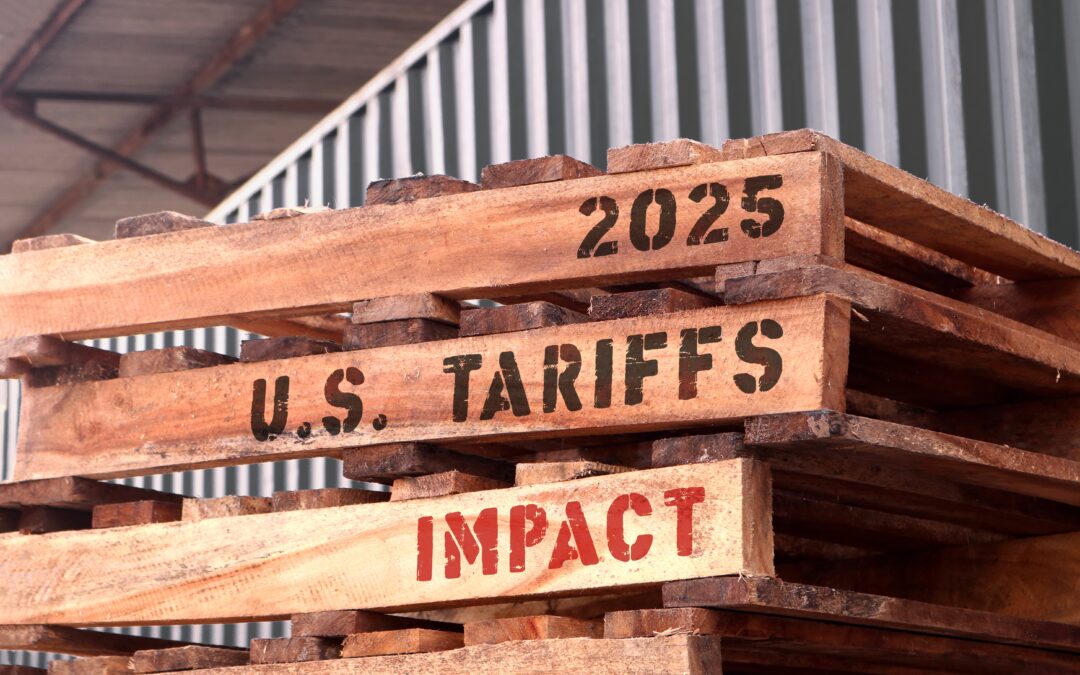
It’s now been just over a year since Trump’s “Liberation Day” tariff announcement shocked the world … and the consensus is still divided…
Stocks are up nearly 30% over the last year, but Americans are still worried about their financial future. Well today, I’ve got good news. And we’re going to dive into that in just a minute.
But first, I want to tell you a little about our very first “Moneyball Happy Hour,” coming up on May 14 at 3PM EST. This is going to be an informal LIVE webinar get-together for you and a few hundred of your closest Moneyball friends.
I’m scheduling this event to run a full hour, so I can share some of my deeper macroeconomic insights — the kind of stuff that just doesn’t fit into one of our nine-minute weekly videos. I’m also going to be hosting this event via Zoom to ensure it’s accessible to absolutely everyone out there (if you haven’t installed Zoom yet, just click here to download).
Our Moneyball Happy Hour is completely free of charge and all of our readers are welcome. No sales pressure, just a live and open forum where you can share your thoughts and questions on what’s going on in the economy today. Should be a great time. May 14 at 3PM. Save the date!
Now let’s get into today’s video:
Video transcript:
I’m Andrew Zatlin. Welcome to Moneyball Economics. Thanks for joining me today.
Oh, and speaking of joining me, I want to invite you to a virtual happy hour on Thursday the 14th in the afternoon. Come on down free of charge. Let your hair down. We’re going to have kind of a first time out. We’re going to do a virtual kind of fireside chat format. Talk about economics, where we are, where things are going.
Bring your questions, whatever’s top of mind. Let’s take the time out to hang out and have an informal chit chat. And speaking about where things are and where they’re going, I would like to take this opportunity one year in to talk about what is going on with US manufacturing…
As you recall, it was a year ago when Donald Trump announced his tariffs as part of his industrial policy. He wants more manufacturing happening in the US. He wants onshoring. Okay.
So a year later, how are things playing out?
Because this time last year, you may recall, all the experts out there were just doom and gloom. You raise tariffs, you raise the cost of importing all the stuff that we import into the United States. Well, those costs are going to get passed along to consumers and producers alike. That means massive inflation, you’ve destroyed the entire economy.
Well, turns out those experts were completely wrong.
And it turns out that Trump has dramatically changed the US manufacturing space.
We are talking about a major, not minor, but major change in US manufacturing underway. It’s not being discussed. But today, I’d like to at least check in on what’s going on and where the success has been. Right off the bat, you may recall, these tariffs were out there. We’re talking not 5%, 10%, but 50%, 100%.
Very eye catching. And the goal is pretty straightforward. To get onshoring into the United States, you’ve got to make it cost competitive.
And that’s kind of a problem, right? When you’re importing from China, it’s cheaper to buy a T-shirt from China than here. Well, the easiest path forward is to raise the cost of imports. The US brings in about $4.3 trillion a year of goods and services. $4.3 trillion.
Well, one way to lower that is just basically make it too expensive, make that Chinese T-shirt twice the price.
And hey, guess what? An American vendor’s probably going to be a better supplier. Trump went out there and he used these tariffs to extract concessions from other countries.
He went initially country to country. And it worked because they had tariffs on US goods. And this was a great way, a crowbar to get them to lower their tariffs. And we in turn would lower our tariffs.
He didn’t just start and stop with tariffs that stick. He also went directly to major players. He went to companies like Eli Lilly and Pfizer, and he cut deals. Why would he go to Eli Lilly and Pfizer? Well, the answer is, if you’re looking at that 4.3 trillion of imports, almost a trillion dollars comes from two sectors, autos and pharmaceuticals.
You want to reduce imports? Go talk to the players there because there aren’t a lot of auto players to talk to, right? There’s four, there’s GM, there’s Toyota. And when it comes to pharmaceuticals, there’s Lilly, there’s Pfizer.
So this is a much more focused laser-like conversation, and it seemed to work.
If you recall, Trump emerged quite quickly with a most favored nation pricing deal. He said, “We’re spending the most on medications. I don’t want to hear that France pays less per unit of aspirin than I do. We should pay the least. But Pfizer, Lilly, the US used to be a pharmaceutical manufacturing powerhouse. Stop making that stuff in India. Start making it over here.”
And they committed billions of dollars. They said, “Sure, we’ll expand factories in the US. We’ll put billions of dollars in play.”
Well, that’s great. That’s talk. That was the summertime. That got them off their back. Did they follow through? Well, if you look at the numbers, they did…
Let’s talk about imports.
We now have January, February, and March import data from the Census Bureau. So three months. What’s happened? Well, right off the bat, it’s amazing what has happened.
If we strip out imports of AI goods like computers, we got to do that because that’s a phenomenon in and of itself. If we take that out and we look at everything else, US imports are dropping at the rate of 50 to $60 billion a month.
We are on track to cutting almost a trillion dollars of that $4.3 trillion import number.
20% drop in imports.
This is unheard of.
A trillion dollars is suddenly flipping from being an import to being domestically manufactured. So that’s a trillion dollars of potentially additional economic growth. And what’s going on is you’ve got two main sectors to talk to, autos and pharmaceuticals, because they make up that trillion dollars.
Autos is a little tricky. It’s a little convoluted. Sometimes it’s a direct import to made in China or Japan. It goes through Mexico and into the United States supply chain. Other times, Ford and GM are making stuff here, and then they move it out across the border to Canada and Mexico to do some other stuff. Then they bring it in.
And so what Trump is trying to do is say, quit playing this shell game. He went to the NAFTA agreements, revisited them so that whatever the labor wage advantages Mexico had or Canada had were eliminated, trying to get to some kind of level playing field of whatever kind.
But bottom line, make the incentive to make in the United States and stay in the United States for autos. Same thing with steel, and then with pharmaceuticals. Pharmaceutical imports, the first three months of the year are down $70 billion, seven, zero in three months.
Now, how is this possible? Well, it’s possible because the drugs are being made here. It’s not that Americans are suddenly healthier and they don’t buy stuff. It’s being made here.
I mean, this is unheard of. This is a massive shift in the US economy. If this continues, if this $170 billion shift in imports is taken out for the rest of the year, that’s huge from a balance and trade standpoint. But if it is correspondingly equal to an exact number of domestic made product, wow, we’re talking about three quarters of a trillion dollars to a trillion dollars of goods being made in the US and being shipped.
The hiring that goes along with it, this is huge as a permanent shift in the American economic landscape. This is a major win and let’s see if it continues and carries forward. It is now six months until the election.
If this kind of economic data starts to emerge, this could be a game changer for the elections, but even if it doesn’t emerge and isn’t part of the political landscape, over the course of the next couple of years, you are looking at a massive manufacturing renaissance in the United States.
It’s something breathtaking and worth taking a step back and acknowledging this is a huge win.
We’re in it to win it.
Zatlin Out.
Andrew Zatlin
Editor, Moneyball Economics