
Tariffs.
If the media is to be believed, tariffs are something like a political boogeyman … an archaic and outdated policy that has no place in today’s proudly globalized society…
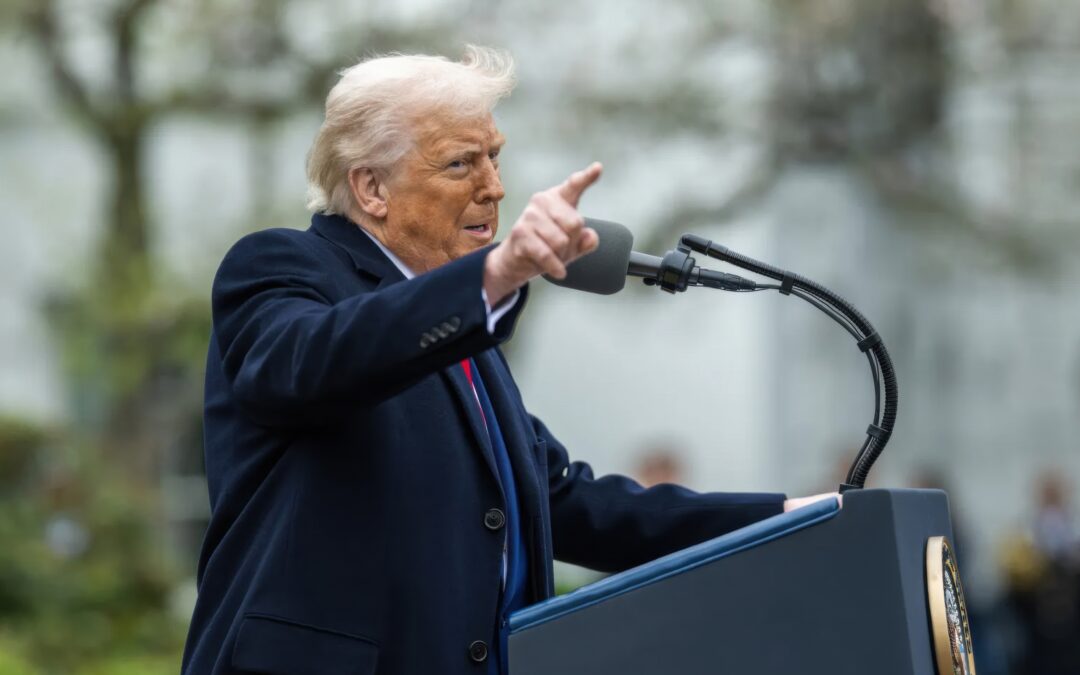
That’s why last April’s “Liberation Day” tariff announcement was such a sea change event.
Because President Trump wasn’t just bringing back old trade restrictions. He was going full throttle with blanket tariffs — forcing nearly every single one of America’s trading partners to come back to the table and renegotiate its standing.
This is a policy that’s central to the President’s administration. It’s one he clearly cares very deeply about. And at the same time, it’s also nothing short of a total transformation for the way America does business.
So now that we’re over a year past America’s Liberation Day, it’s fair to ask the question … is it working?
Is Trump’s aggressive new trade policy really helping America’s economy?
The answer (in true Trump fashion) is one that truly begs belief:
Video transcript:
Welcome to Moneyball Economics. I’m your host, Andrew Zatlin.
I’m doing some traveling today. I am on my way to West Point where I will be watching my son rappel out of a helicopter. He’s going to be graduating the Air Assault School. He’s doing it on his first pass, which is a pretty big deal. He’s one of maybe 10% of his class to do so.
It’s also a pretty big deal to me as his father…
He has always had a strong fear of heights.
I mean, to the point where he wouldn’t even go up a ladder, zip lining definitely off the table. And yet after one year at West Point, the guy is repelling out of a helicopter. He has come a long way in a short amount of time.
And speaking of coming a long way in a short amount of time, let’s talk the improvement in the US economy. Hope you like that segue, by the way.
There are a lot of different ways to measure economic growth and strength.
One of the preferred ways is to measure what’s called the balance of trade, how much we’re selling as a country exporting versus how much we’re buying importing. Traditionally, economies are stronger when they are selling more than they are buying because they’re accumulating wealth.
Put differently, we’ve never seen an economy — we’ve never seen a country survive for long when they are only importing and they’re not exporting. Your currency dissolves and goes away. One of the ways that we have been able to sustain this level of import over export is through debt. That’s created a series of problems. Number one, we issue debt, it weakens our currency, but it also gives the debt buyers a certain amount of leverage.
If you are a major buyer of US debt, well, then it can be weaponized.
You’ve got leverage over us and that’s exactly where China has gone.
So Donald Trump came to town at a time when it’s been decades where our balance of trade has been weak. And in general, the predecessors to Trump assumed that we were an empire in decline and their job, Biden’s job, Obama’s job was to manage that decline. Trump and his administration is trying to reverse that decline. And that’s why, for example, he implemented tariffs.
The tariffs are intended to raise the cost of imports to the point where factories and producers in the United States look for local production solutions. So more onshoring of manufacturing, that should then drive jobs and so forth. And it should reduce the imports and maybe even raise the exports. That’s the general plan.
So one year later, what is going on with that plan? Let’s take a look. First of all, right off the bat, we’ve got the import export.
We’ve got our trade data from January to May, so five months out of the year. We’re going to look at those five months and you’re going to hopefully walk away going, “Why isn’t this being talked about? This is huge.”
So right off the bat, the first five months, the total level of imports is down 4%. Pretty impressive. One year we have bought 4% less and we’ve exported more. But the devil’s in the details. See, during that period of time, AI has taken off.
And so we have purchased computers and telecom equipment and semiconductors and the prices of semiconductors have gone up, so everything’s gone up, blah, blah, blah. Our purchase of this equipment is up $150 billion. If we take that out, if we strip out that 150 some odd billion dollars, our imports have collapsed, ready? 24% this year versus same period last year.
24%. It’s unheard of. It’s unheard of.
And one of the major drivers of this is pharmaceuticals. Donald Trump initiated tariffs. That was one thing. But that wasn’t the only way that he has driven a lot more onshore manufacturing and lower imports. Cajoling, arm twisting, call it what you will. He went to the pharmaceutical companies like Eli Lilly and he said, “We really want you to do the right thing here.”
One of the things he accomplished was something I’d call the most favored nation, pricing. He stipulated that the United States in purchasing medications and pharmaceuticals would pay the lowest per unit price compared to every other country on the face of the planet.
We could do that because we have leverage because we spend the most when it comes to pharmaceuticals. He followed that up though with the arm twisting, with the cajoling, saying, “Why don’t you manufacture here?” And guess what?
That is exactly what’s going on.
We have seen, get ready for this. We have seen a 55% drop in imports of pharmaceuticals, 80-something billion dollars less spent buying from places like Ireland, by Switzerland and so forth and sourcing it in the United States. That’s a big swing. 24% drop in imports after we exclude AI. And that includes things like oil imports and oil has gone up, right?
So what is going on with pharma?
Well, another way to look at it is if you’re manufacturing more in the United States, then that is going to create more economic activity. And it’s a boon, not just in the sense of we’re importing less and our balance of trade is more favorable. It’s creating economic activity domestically. And one way to take a look at that would be jobs. So we just got jobs and it’s interesting when you look at the data.
Let’s take a look at it together.
Let’s go back a couple of years. Pharmaceuticals were in kind of a free fall when it came to jobs. However, in 2023, for example, no payroll jobs were added in the pharmaceutical industry. You get to 2024 over the course of the entire year, a whopping 3,000 people were added to the payrolls for pharmaceutical companies.
Now, last year before Trump came to town, an additional 2,000 people were added. Let’s take a look at the Trump administration impact. Since Trump has come to town in basically 15 months, 6,000 pharmaceutical payrolls have been added. So again, nothing in 23, about three in 24, a couple before Trump came to town last year, and then six. He has in one year created more payrolls for the pharmaceutical industry than the years prior to him.
We are seeing tariffs and cajoling and arm twisting pay off in the form of a stronger US economy in just one year.
It boggles the mind what could possibly be accomplished over the next couple of years if this economic industrial policy continues.
I’m going to continue to check in on this. I’m flabbergasted. As an economist, we’ve never seen this, quite frankly. And I’m surprised it’s not being discussed more in the mainstream media. Well, actually I’m not that surprised. It’s a positive.
And in today’s world, we don’t like positives, but this is a fundamental sea change of enormous power.
And if it continues, US economic strength and financial leverage and the soft power that we have will only grow.
We’re in it to win it, folks.
Zatlin out.

Andrew Zatlin
Editor, Moneyball Economics