

Is energy’s run over?
That was the question I asked this time last week.
Now, we have our answer.
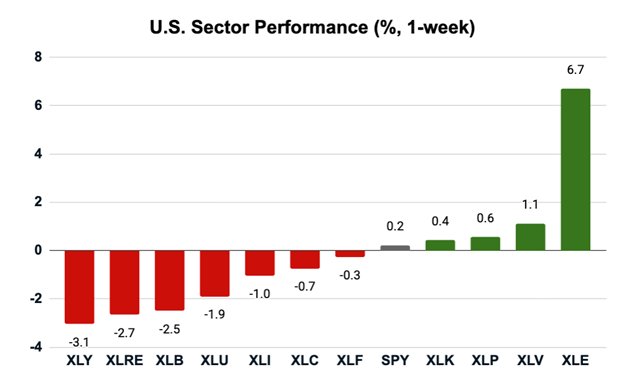
The State Street Energy Select Sector ETF (XLE) didn’t just lead the market last week – it steamrolled it, surging 6.7% and leaving every other S&P 500 Index sector ETF in the dust. The next-best performer gained just 1.1%.
So, what lit the fuse under energy stocks yet again?
Another market acronym with a Mexican food twist, of course!
Last year, traders embraced “TACO” — short for “Trump Always Chickens Out” — as a tongue-in-cheek buy-the-dip strategy whenever tough trade rhetoric rattled markets.
Today, we have a more somber yet equally tasty “NACHO,” for “not a chance Hormuz opens.”
Who knew that trading wisdom would go so well with a margarita or an ice-cold Corona!
I don’t trade based on Wall Street acronyms, no matter how witty they are (or how hungry they make me!).
And I certainly know better than to read too deeply into a single week’s performance.
I’m going to repeat, word for word, what I wrote last Monday: “It’s probably a mistake to read too much into the recent performance of the energy sector, since so much of it has been driven by headlines about the Iran war.”
That was true then, and it’s equally true today. The Iran war has turned this sector into a ping pong ball. But if you’re trying to trade based on war headlines, you are virtually guaranteed to see disappointing returns.
The best way to navigate this ongoing chaos is to ignore the headlines and follow a system.
Meanwhile, it’s worth noting that the S&P 500 was up a modest 0.2% despite most sectors finishing the week negative. To explain this, look no further than the 0.4% return eked out by the State Street Technology Select Sector ETF (XLK).
I’ve been writing all year that as goes tech, so goes the stock market. Tech and tech-adjacent sectors like communications make up a majority of the S&P 500’s market cap today. So, for the bull market to be sustainable, we need to see tech continue to move higher.
Finally, it’s telling that the worst-performing sector ETF was the State Street Consumer Discretionary Select Sector ETF (XLY), which was down 3.1%. Does Wall Street believe that the American consumer is finally buckling under higher fuel costs and nagging inflation?
We’ll get into that shortly.
Key Insights:
- Energy has retaken the crown for best-performing sector.
- The market remains highly dependent on the tech sector.
- Sagging consumer discretionary stocks suggest consumers are hurting.
Energy Back on Top
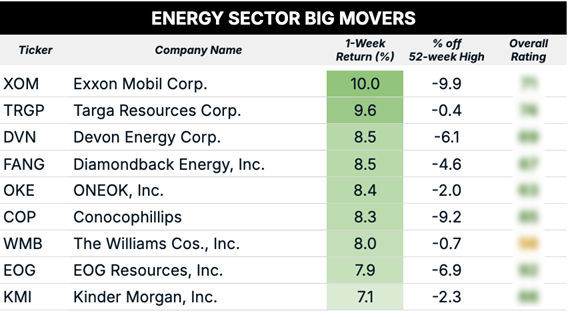
I ran my customary screen of the biggest movers in the sector that were also still within 10% of their 52-week highs last week. The idea is to look for solid, market-leading stocks that are getting stronger.
Here’s what I came up with:
A few observations here…
The past month has been exceptionally volatile for energy stocks. We’ve seen some breakneck moves higher… and lower… depending on Wall Street’s mood that week regarding the Iran war.
Yet despite all the zigzagging, we still have a lot of energy leaders close to their 52-week highs.
And of the nine best-performing energy stocks last week, eight rate as “Bullish” or “Strong Bullish” on my Green Zone Power Ratings system.
My research has proven that “Bullish” rated stocks outperform the market by double on average over the following year, and “Strong Bullish” rated stocks by triple.
Those returns aren’t guaranteed, of course. Nothing is guaranteed in this game. But decades of market research suggest that the bull market in energy stocks still has a long way to run.
However the Iran war ends (or doesn’t end!), my system is telling us to stay long and strong energy.
Is the Consumer Done?
Mark Twain is credited with saying, “The rumors of my death have been greatly exaggerated.”
That’s been the general case with the American consumer for the past several years. When the pandemic stimulus checks ran out and inflation continued to bite, Wall Street started fretting that the end was nigh.
The thing is, they weren’t wrong.
As I’ve written for the past year, we have a K-shaped economy in which a relatively small number of wealthier consumers are doing phenomenally well, fueled in part by rising stock and home prices. But middle- and working-class consumers have really struggled.
But are upper-middle-class consumers finally starting to feel the pinch too?
Based on the recent performance of consumer discretionary stocks, it seems Wall Street thinks so.
But what does my system say?
Let’s find out.
I ran my customary screen of the sector’s biggest losers for the week that are still trading within 10% of their 52-week lows. The idea is to find beaten-down gems that look poised to recover.
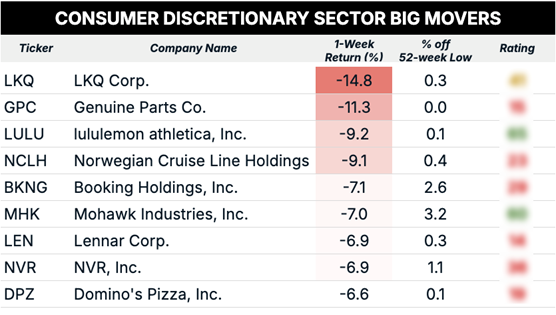
It’s hard to draw conclusions from a lousy week in a fashion stock like Lululemon Athletica (LULU), as tastes can be fickle. But the weakness in homebuilders and travel stocks suggests that caution might be warranted.
And it’s worth noting that only two of the stocks currently rate as “Bullish.”
We’ll see how the consumer holds up this summer. But my system is definitely sending warning signs.
To good profits,

Adam O’Dell
Editor, What My System Says Today
P.S. Most people approach the market hoping their investments will eventually grow. But in today’s environment, more investors are asking a different question: “How can my portfolio start producing income now?”
That’s the shift that has shaped the evolution of my Max Profit Alert service over the past year — moving toward a more active, cash-flow-focused approach built around repeatable “deals” designed to potentially generate income on a more consistent basis.
Tomorrow, I’ll be hosting a LIVE presentation where I’ll walk through exactly how this process works in real time, showing how these deals are identified and executed step by step.