

From a distance, the story of today’s market looks simple enough…
The S&P 500 Index just keeps climbing, stocks are up, investors are happy and anyone who panic-sold in late March is regretting it.
But look a bit closer, and a more complicated picture emerges. This rally isn’t so much a broad-market resurgence as a star turn by an extremely small cast.
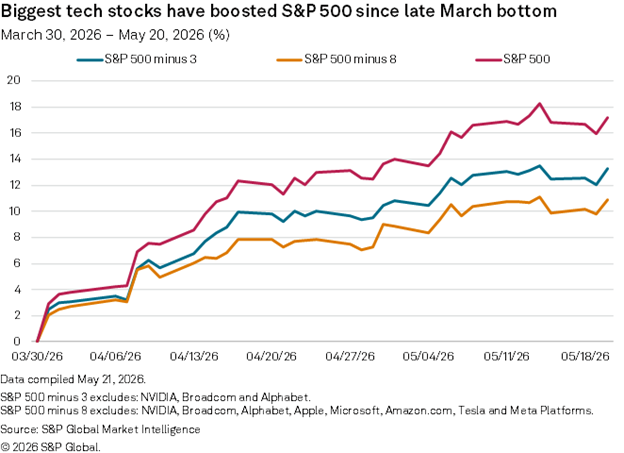
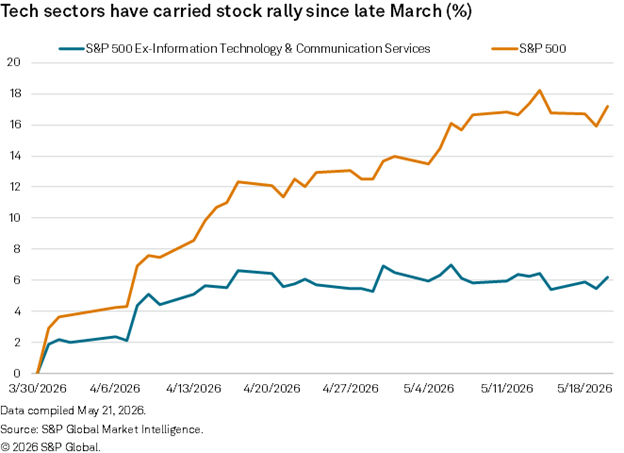
Since the March 30 low, the broad market has gained roughly 17%.
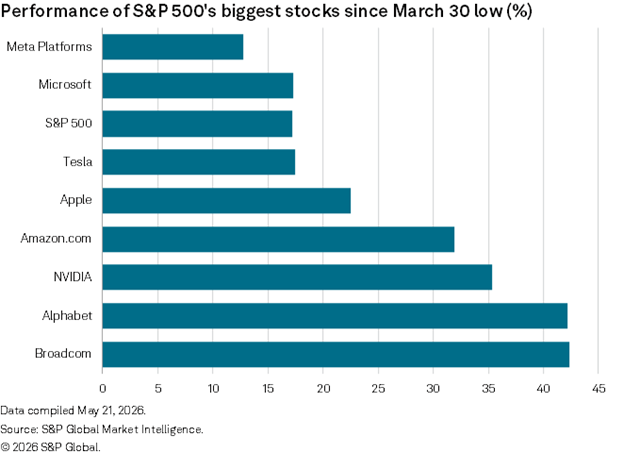
Pull out the eight largest tech stocks — NVIDIA Corp. (NVDA), Apple Inc. (AAPL), Microsoft Corp. (MSFT), Amazon.com Inc. (AMZN), Alphabet Inc. (GOOGL), Broadcom Inc. (AVGO), Meta Platforms Inc. (META) and Tesla Inc. (TSLA) — and that gain shrinks to under 11%.
Remove just three of them — NVIDIA, Broadcom and Alphabet — and you’re still only at around 13%. The point is, a handful of trillion-dollar companies are doing the bulk of the heavy lifting.
The gap is even starker when you compare the S&P 500 with a version of itself that strips out information technology and communication services.
The S&P 500 is up roughly 17% from the March low. The ex-tech version? About 6%. That’s not a rally with broad participation. That’s a rocket ship with eight passengers.
Zoom out to the year-to-date picture, and mega-cap tech’s fingerprints are everywhere.
The S&P 500 is up about 8% since January 1.
Subtract NVIDIA, Broadcom and Alphabet, and you’re at around 6%.
Subtract all eight mega-caps, and you land in roughly the same place, which tells you the contributions are concentrated at the very top of the market-cap ladder, and thinner below it.
The driver behind all of this is, in a word, AI.
Investors continue to funnel money into companies they believe are best positioned to capitalize on the AI boom — the data centers, the semiconductors, the platforms.
NVIDIA alone accounts for more than 8.5% of the entire S&P 500’s weight. Information technology and communication services together make up around half the index.
When those sectors run, the index runs with them, and the earnings power justifies much of the enthusiasm — mega-cap tech is generating outsized profits while the rest of the market muddles along with single-digit growth.
Still, even within the elite eight, the picture is far from uniform.
Breaking Down the Eight
I ran each of the eight stocks through a screener to examine period returns and ratings history on Adam’s Green Zone Power Ratings system…
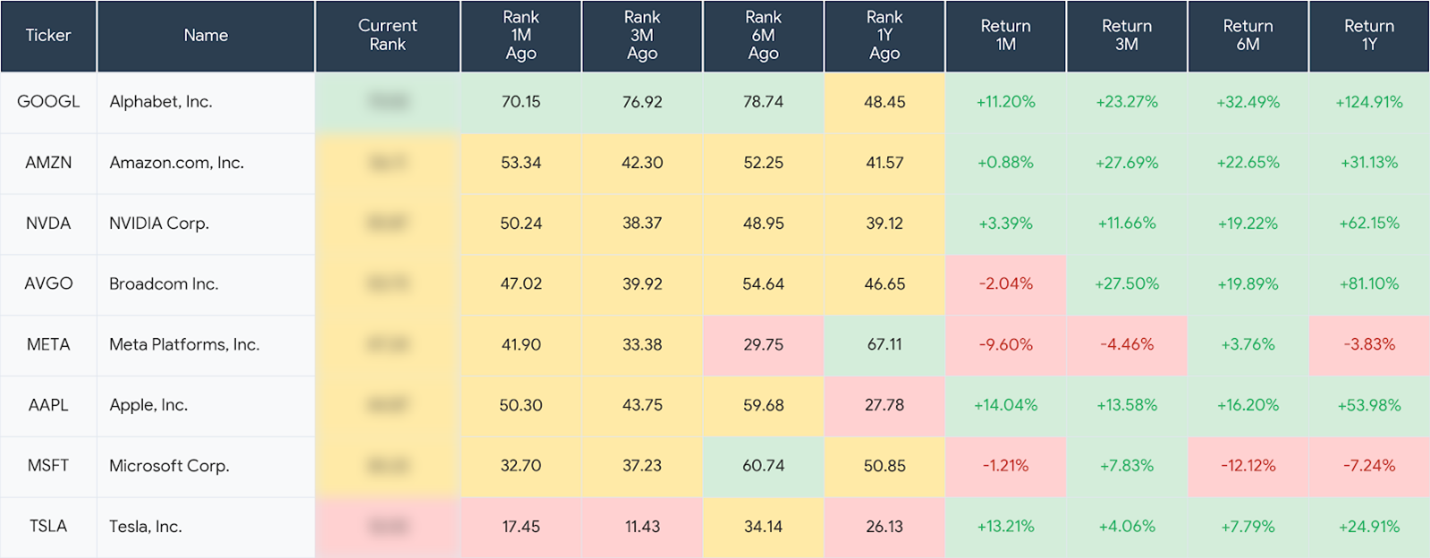
Alphabet is in a class of its own. It’s up 124.91% over the past year, with consistently high overall rankings across every lookback period.
Apple has quietly emerged as a near-term standout, up over 14% in the last month alone. Amazon’s three-month return of 27.69% is also hard to argue with.
But the two biggest winners from the post-March rally — Broadcom and Alphabet, each up roughly 42% since the bottom — are starting to diverge.
Alphabet’s overall rankings confirm the strength is durable.
Broadcom is a different story: its one-year return of 81.10% is impressive, but it slipped into negative territory last month, down 2.04%, with ranking scores that have been quietly drifting lower for months.
NVIDIA looks similar — just 3.39% in the past month despite a commanding 62.15% one-year gain. The AI tailwind appears intact, but the easy money from the post-March bounce may already be accounted for.
Then there’s the group’s dead weight.
Meta is negative over one month (-9.60%), three months (-4.46%) and the full year (-3.83%), with rankings that have been sliding for six months.
Microsoft isn’t much better: down over the past month, off 12.12% over six months, and still negative on a one-year basis at -7.24%.
Both names remain well below their all-time highs. They carry trillion-dollar market caps, but right now they’re passengers, not pilots.
Tesla, for its part, posts the lowest-ranking scores of the group by a wide margin — its recent gains looking more like a bounce than a trend.
The concern with all of this isn’t that the rally will necessarily stop — it’s that only about half the stocks on the New York exchange are trending upward, and the index’s headline number depends heavily on a small number of names continuing to hold their ground.
If Broadcom and NVIDIA’s near-term fatigue spreads, and Meta and Microsoft can’t find a floor, there isn’t much depth beneath them to cushion a stumble.
The scoreboard still looks good. But a rally built on eight stocks — with two of its biggest stars already showing cracks — isn’t quite the same thing as a healthy market.
Until next time…
Safe trading,

Matt Clark, CMSA®
Chief Research Analyst, Money & Markets